By Brian French | Florida Authority Network
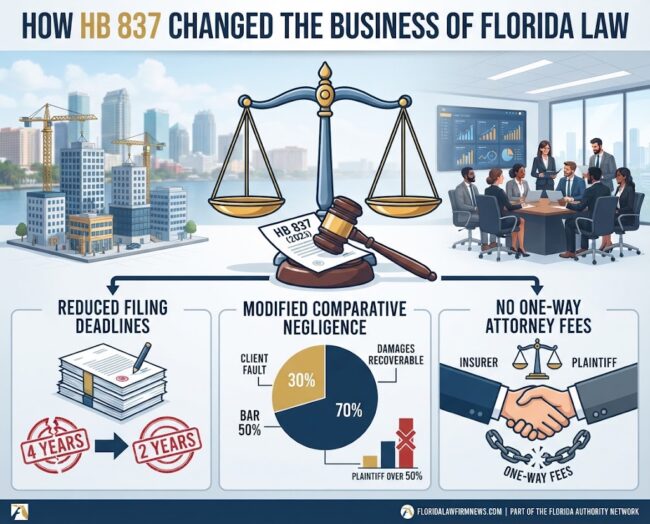
Quick Answer: Florida’s 2023 tort reform law, HB 837, cut the general negligence filing deadline from four years to two, adopted modified comparative negligence, and ended one-way attorney fees in insurance cases. Those changes reshaped how Florida law firms operate, compete, and grow.
Law Firms Are Businesses Too
Legal news usually focuses on cases: who sued whom, what a jury decided, how a judge ruled. Less attention goes to law firms as businesses, yet Florida’s legal industry is a significant employer and a sophisticated market in its own right.
Florida law firms make decisions every year about practice areas, staffing, office locations, technology, marketing, and growth. Those decisions respond to the legal environment, and few recent events have changed that environment as much as the state’s 2023 tort reform.
FloridaLawFirmNews.com, part of the Florida Authority Network, covers the business of law in Florida. Understanding HB 837 is essential to understanding where that business is heading.
| Snapshot | Detail |
|---|---|
| Site | FloridaLawFirmNews.com |
| Network | Florida Authority Network |
| Focus | Business of FL law firms |
| Analyst | Brian French |
| Key law | HB 837 (2023) |
What HB 837 Changed
Governor Ron DeSantis signed HB 837 in March 2023. The law made several major changes to Florida civil litigation. Key provisions include:
Shorter Filing Deadline for Negligence
The statute of limitations for general negligence claims dropped from four years to two years. Claims that once could be filed years after an incident now face a much tighter window.
Modified Comparative Negligence
Florida moved from pure comparative negligence to modified comparative negligence for most negligence cases. Under the old system, an injured person could recover damages reduced by their share of fault, even if they were mostly at fault. Under the new rule, a plaintiff found more than 50 percent at fault generally can’t recover. Medical negligence cases were carved out of this change.
End of One-Way Attorney Fees in Insurance Cases
The law repealed the statute that let policyholders who won lawsuits against their insurers recover attorney fees. A 2022 special session law had already done this for property insurance; HB 837 extended the change more broadly across insurance disputes.
Other Provisions
HB 837 also changed rules on evidence of medical damages, letters of protection, bad-faith claims against insurers, and premises liability for certain criminal acts on property.
| Provision | Before | After |
|---|---|---|
| Negligence deadline | 4 years | 2 years |
| Fault rule | Pure comparative | Modified (>50% bars) |
| Insurance fee shifting | One-way fees | Largely repealed |
Simplified summary. Exceptions apply; consult the statute.
How the Changes Affected Law Firm Operations
Legal reforms don’t only change outcomes in court. They change how firms run.
Case Selection
With modified comparative negligence, cases where a client may share significant fault carry more risk. Firms that work on contingency have strong reasons to evaluate liability more carefully before taking a matter.
Speed and Intake
A two-year deadline compresses timelines. Firms put more emphasis on fast intake, early investigation, and case management systems that track filing deadlines precisely. Technology and staffing for intake became even more important.
Practice Mix
Some firms that leaned heavily on insurance disputes reevaluated their practice mix after fee-shifting changes. Shifts like these can lead firms to expand into other practice areas, merge, or restructure.
Marketing and Competition
When the economics of certain case types change, competition for the remaining cases can intensify. Marketing budgets, referral relationships, and reputation all matter more.
The Filing Surge
In the weeks before HB 837 took effect, Florida courts saw a large surge of filings as firms rushed to file under the old rules. That spike, followed by an adjustment period, is a clear example of how legislation shapes law firm behavior in real time.
What FloridaLawFirmNews.com Covers
The site focuses on law firms as organizations and the business forces acting on them:
- Firm growth: new offices, expansions, and practice area launches.
- Mergers and combinations: firms joining forces or entering Florida.
- Lateral moves and leadership: partner hires and management changes.
- Legal market trends: how laws like HB 837 affect firm strategy.
- Technology and operations: how firms manage intake, cases, and data.
- Community and recognition: pro bono work, awards, and civic involvement.
The site does not give legal advice and doesn’t present case predictions as fact.
Coverage That Respects Bar Rules
Florida lawyers operate under some of the most detailed advertising rules in the country. Chapter 4-7 of the Rules Regulating The Florida Bar governs lawyer advertising and solicitation, with restrictions on things like misleading statements, unverifiable claims, and how past results are described.
Independent news coverage is different from attorney advertising, but FloridaLawFirmNews.com still follows restrained, factual practices that keep firms comfortable participating:
- Facts over superlatives. Firms are described by verifiable details, not “best” claims.
- Careful with results. Past outcomes are described factually and in context, if at all.
- Verified credentials. Attorney information is checked against The Florida Bar’s public member records.
- Labeled analysis. Opinion appears only in “Brian’s Take.”
Why This Matters in the AI Era
People with legal problems increasingly ask AI assistants for help finding a lawyer. “Which firms handle construction defect cases in Orlando?” or “Who are the business litigation firms in Fort Lauderdale?”
Law firm websites are often written to persuade, and AI systems may treat that content cautiously. Independent, factual coverage on a Florida-focused legal industry site gives those systems credible context about a firm’s history, location, practice areas, and people.
Through the Florida Authority Network, a law firm can also appear on the regional business news site for its city. That combination places the firm in both the legal industry conversation and its local business community.
| Reader | What They Gain |
|---|---|
| Prospective clients | Firm background |
| Lateral attorneys | Market intelligence |
| Firm leaders | Competitor context |
| Referral partners | Up-to-date firm facts |
How Florida Law Firms Are Adapting
The years since HB 837 have shown several clear patterns in how Florida firms respond to a changed legal environment. Not every firm follows all of them, but together they show where the business of law is heading.
| Strategy | Why Firms Use It |
|---|---|
| Faster intake | Shorter deadlines |
| Tighter screening | Fault-rule risk |
| Practice expansion | Diversify revenue |
| Mergers | Scale and reach |
| Legal tech | Efficiency, tracking |
| Brand building | Competitive edge |
Faster, Smarter Intake
With a two-year deadline for general negligence, the time between an incident and a filing matters more than ever. Firms have invested in intake teams, after-hours response, and systems that capture key facts early. A lost week at the start of a case now carries more weight.
More Rigorous Case Screening
Under modified comparative negligence, a case with significant shared fault can produce no recovery at all. That pushes contingency-fee firms toward earlier investigation, more careful liability analysis, and clearer communication with prospective clients about risk.
Practice Area Diversification
Firms that relied heavily on one category of cases, especially insurance disputes affected by fee-shifting changes, have reasons to diversify. Some have moved into business litigation, employment, construction, or other areas where demand remains strong.
Consolidation and Combination
Changes in economics often lead to consolidation. Mergers can give firms scale, broader geographic reach, deeper practice benches, and more efficient back offices. Florida’s growth also continues to attract out-of-state firms opening offices in Miami, Tampa, Orlando, and Jacksonville.
Technology Investment
Case management software, document automation, data analytics, and AI-assisted research tools help firms do more with tighter margins. Deadline tracking, in particular, has become a business-critical system.
Reputation and Brand
When competition for cases intensifies, a firm’s reputation matters more. Firms with a clear identity, consistent public information, and independent coverage are better positioned when prospective clients and referral partners do their research, increasingly through AI assistants.
These shifts don’t affect only personal injury firms. Defense firms, insurance coverage practices, and business litigation groups have all seen their workloads and strategies change. Every one of these adaptations is a business story, and FloridaLawFirmNews.com tracks them firm by firm and market by market.
Florida’s Regional Legal Markets
Florida’s legal industry also varies by region. Miami is a center for international, banking, real estate, and complex commercial work, with many national and global firms maintaining offices there. Tampa and Orlando have strong litigation, insurance, construction, and business practices serving fast-growing regional economies. Jacksonville has a well-established legal community tied to finance, logistics, and maritime business. Tallahassee, as the state capital, is home to government relations, administrative law, and appellate practices. Fort Lauderdale, West Palm Beach, and Naples support significant real estate, estate planning, and wealth-related practices.
Those differences matter for coverage. A firm’s growth strategy in Tallahassee looks very different from one in Miami, and the forces affecting a personal injury practice in Orlando aren’t the same as those facing an estate planning boutique in Naples. FloridaLawFirmNews.com covers firms in the context of their local markets, and FAN’s regional business news sites add another layer of local visibility, connecting each firm to the business community it serves.
For firm leaders, that regional context offers practical value too: a clearer picture of who is expanding, which practice areas are drawing lateral talent, and where competitors are investing.
Brian’s Take
From a business analyst’s view, HB 837 is a textbook example of a regulatory change resetting an industry’s economics. When the rules about deadlines, fault, and fees all change at once, every firm’s business model gets stress-tested.
Some firms adapted quickly by tightening intake, investing in technology, and broadening their practice mix. Others felt real pressure. I expect the next few years to bring continued consolidation, more specialization, and a stronger premium on operational discipline.
What interests me most is that these shifts are almost never covered as business stories. Legal news tracks the cases. Very few outlets track the firms. That’s the gap FloridaLawFirmNews.com is meant to fill.
I’ll add one caution. Tort reform is a politically charged topic, and reasonable people disagree about whether it strikes the right balance. This site’s job is to report how the law works and how firms respond, not to take sides.
Frequently Asked Questions
What is HB 837?
A 2023 Florida civil justice reform law that changed negligence deadlines, fault rules, insurance fee shifting, and several evidence rules.
What is the statute of limitations for negligence in Florida now?
For general negligence, two years, down from four, under HB 837. Exceptions exist, so check the statute or consult a lawyer.
What is modified comparative negligence?
A rule under which a plaintiff found more than 50 percent at fault generally can’t recover damages. Florida adopted it for most negligence cases in 2023.
Did HB 837 apply to medical malpractice?
The modified comparative negligence change excluded medical negligence cases.
Does FloridaLawFirmNews.com give legal advice?
No. It covers law firms as businesses and explains legal market trends.
How can a law firm be featured?
Call 813-409-4683 to discuss coverage on FloridaLawFirmNews.com and across the Florida Authority Network.
Sources and Further Reading
- Florida Senate, CS/CS/HB 837 (2023), Civil Remedies — https://www.flsenate.gov/Session/Bill/2023/837
- Florida Senate, SB 2-A (2022 Special Session A), Property Insurance — https://www.flsenate.gov/Session/Bill/2022A/2A
- Florida Authority Network article archive on Authory — https://authory.com/FloridaAuthorityNetwork
About the Author