By Brian French | October 4, 2026
Quick Answer
AI agents could help Florida law firms verify every citation before filing, audit opponents’ briefs, guard statute-of-limitations deadlines changed by 2023 tort reform, triage post-hurricane client surges, monitor condo association compliance, assemble domicile evidence for snowbird clients, and police their own billing for ethics compliance. The firms that benefit most will pair agents with strict human review, because Florida now holds every filer personally responsible for the accuracy of cited authority.
Why Florida Is the Most Interesting AI Law Market in the Country
Florida has quietly become a laboratory for AI in legal practice. In January 2024, The Florida Bar approved what it described as the nation’s first comprehensive guidelines for the ethical use of artificial intelligence in law practice. Then the courts moved.
On May 28, 2026, the Florida Supreme Court amended Rule 2.515(d)(2) to require the signer of any document filed in any Florida court to represent that “the legal authorities identified exist and are accurately cited.” As of June 15, 2026, the statewide rule replaced the patchwork of local AI-disclosure orders, focusing on the accuracy of citations rather than disclosure of the tool. Individual courts may not impose their own AI disclosure requirements.
The stakes are real. In August 2026, Florida’s Second District Court of Appeal found 46 hallucinated authorities in two briefs filed by a lawyer with four decades of experience, imposed a $1,500 fine, ordered him to personally pay the opposing party’s fees for responding, and referred him to The Florida Bar. One tracker counts 54 cases in Florida courts where judges have called out AI hallucinations.
Florida’s rule set therefore rewards a specific kind of AI adoption: aggressive use paired with rigorous verification. That is exactly what well-designed agents can provide.
The Adoption Paradox
| Indicator | Finding |
|---|---|
| Solo practitioners using AI | 71% |
| Small firms using AI | 75% |
| Mid-sized firms using AI | 86% |
| Solo and small firms reporting AI revenue gains | Fewer than 33% |
| Enterprise firms reporting AI revenue gains | Nearly 60% |
| Mid-sized firms saying AI lets them handle more work | 65% |
Source: Clio 2026 Legal Trends reports.
Clio’s 2026 research identifies an efficiency paradox: firms are working faster with AI but many are not earning more, and firms still billing by the hour may see AI shrink revenue. Most solo and small firms also rely on general-purpose consumer tools rather than AI built for legal work.
The lesson for Florida firms: the value of agents is not speed alone. It comes from new capabilities, lower risk, and pricing models that capture the efficiency.
A Framework: The Florida Agent Readiness Matrix
FAN evaluated potential agent use cases on three dimensions: value to the firm, risk if the agent errs, and how specifically the use case addresses Florida law or conditions.
| Agent Use Case | Value | Error Risk | Florida-Specific |
|---|---|---|---|
| Citation Verification Sentinel | High | Low (it reduces risk) | High |
| Opposing Brief Auditor | High | Low | High |
| HB 837 Deadline Guardian | High | Medium | High |
| Confidentiality Gatekeeper | High | Low | High |
| Billing Integrity Auditor | Medium | Low | High |
| Hurricane Surge Intake Triage | High | Medium | High |
| Legislative Impact Mapper | Medium | Low | High |
| Condo and HOA Compliance Monitor | Medium | Medium | High |
| Snowbird Domicile Evidence Agent | Medium | Medium | High |
| Evidence Authenticity Screener | Medium | Medium | Medium |
| Closing Wire-Fraud Guardian | High | Low | Medium |
| AI Search Visibility Agent | Medium | Low | Medium |
FAN analytical framework. Ratings are judgments, not survey data.
The pattern is notable: the highest-value, lowest-risk agents are not the ones that write briefs. They are the ones that check work, protect data, and guard deadlines.
Deep Dive: 12 Agent Use Cases for Florida Firms
1. The Citation Verification Sentinel
The problem: Rule 2.515(d)(2) makes the signer personally certify that every authority exists and is accurately cited.
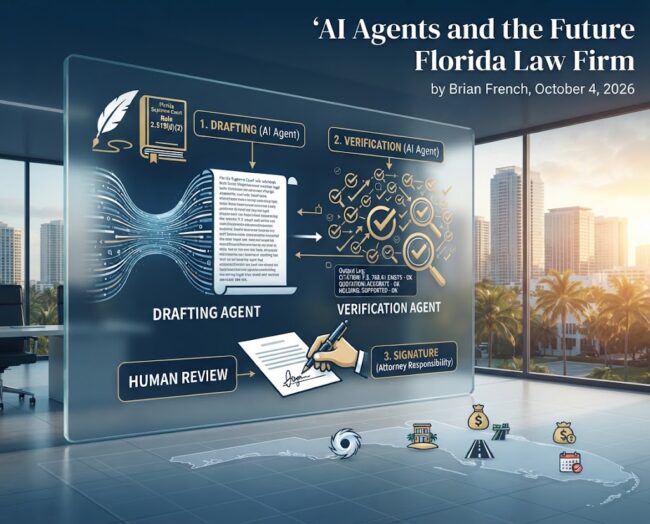
The agent: A separate verification agent, independent from any drafting tool, pulls every citation from a draft, confirms each case exists in an authoritative database, checks that quoted language appears in the source, tests whether the holding supports the proposition, and produces a verification log for the signing attorney.
Why it is novel: Most firms think of AI as the drafter. The more valuable design separates duties: one agent drafts, a second agent audits, and a human signs. It mirrors how good firms already use associates and partners.
Human role: The attorney reviews flagged items and signs. The agent never certifies.
2. The Opposing Brief Auditor
The problem: Hallucinations are now common enough that opposing counsel’s filings may contain them.
The agent: Runs the same verification on every brief the firm receives and flags nonexistent or mischaracterized authority.
Why it matters: In the Second District case, the court ordered the offending lawyer to pay the opposing party’s fees for responding. Catching an opponent’s fabricated authority early can strengthen a response and support a fee request.
3. The HB 837 Deadline Guardian
The problem: Florida’s 2023 tort reform cut the statute of limitations for general negligence from four years to two and moved Florida to modified comparative negligence, under which a plaintiff more than 50% at fault recovers nothing, except in medical negligence cases. The two-year deadline applies to injuries on or after March 24, 2023, while earlier injuries remain under the old four-year rule.
The agent: Reads intake records and medical files, identifies the accrual date, applies the correct limitations period, calendars the deadline with redundant alerts, and flags matters approaching the cutoff. For plaintiff and defense firms alike, it can also build a fault-evidence checklist (police reports, witness statements, video sources) early, when evidence is freshest.
Guardrail: Limitations analysis involves legal judgment on accrual, tolling, and exceptions. The agent flags; the lawyer decides.
4. The Confidentiality Gatekeeper
The problem: Opinion 24-1 tells lawyers to research an AI tool’s data retention, sharing, and self-learning policies and to obtain informed client consent before putting confidential information into a third-party tool. Florida’s evidentiary privilege is narrower than the ethics rule, so a disclosure can survive a privilege challenge and still be an ethics violation.
The agent: Sits between lawyers and every outside AI service. It classifies content before it leaves the firm, checks whether the matter has client consent on file, blocks or redacts confidential information when consent is missing, and logs every transfer.
Why it is novel: It turns ethics guidance into an enforced technical control rather than a policy memo.
5. The Billing Integrity Auditor
The problem: Opinion 24-1 requires reasonable fees. Commentators summarize it as prohibiting billing for hours AI saved, double-billing, or passing AI subscription costs to clients without disclosure. The opinion says lawyers should inform clients, preferably in writing, before charging the actual cost of generative AI.
The agent: Compares time entries with system activity, flags entries where billed time appears inconsistent with AI-assisted work, checks that AI costs are disclosed in engagement letters, and recommends matters suited to flat or value-based fees.
The business angle: This is the bridge out of Clio’s efficiency paradox. An agent that identifies which work has become faster can help firms convert those tasks to flat fees that capture the value rather than giving it away.
6. Hurricane Surge Intake Triage
The problem: After major storms, Florida firms handling property, insurance, contractor, and landlord-tenant matters can see sudden spikes in inquiries.
The agent: Handles multilingual first contact, collects facts and documents, runs preliminary conflict checks, and routes matters to the right practice group. Florida’s large Spanish- and Haitian Creole-speaking populations make multilingual capability especially valuable.
Guardrails: Opinion 24-1 specifically notes that lawyers may not delegate acts constituting the practice of law to AI and flags this concern for firms using website chatbots for client intake. The agent must identify itself as AI, avoid legal advice, and hand off to a lawyer for any judgment.
7. The Legislative Impact Mapper
The problem: Florida’s Legislature changes the rules frequently. In 2026 alone, firms tracked Live Local Act amendments, a statewide property tax amendment headed to voters, and new court rules on AI.
The agent: Monitors enacted laws and court rule changes, matches them to active client matters by issue, and drafts client alerts for attorney review. A land-use group could instantly see every client parcel affected by a Live Local change; an estate group could see which clients might be affected by a property tax amendment.
8. The Condo and HOA Compliance Monitor
The problem: Since the Surfside collapse, Florida condominium associations face inspection, reserve, and reporting obligations that have been amended repeatedly.
The agent: Tracks each association client’s buildings, inspection status, reserve requirements, and key deadlines, and alerts the firm and board when action is needed. It turns reactive legal work into a proactive compliance service.
Guardrail: Because these rules have changed several times, the agent’s rule base must be maintained by a lawyer and checked against current statutes.
9. The Snowbird Domicile Evidence Agent
The problem: Many affluent clients move to Florida for its lack of a state income tax, but their former states may challenge whether they truly changed domicile.
The agent: With client authorization, compiles a running evidence file: declaration of domicile, homestead filing, voter registration, driver’s license, vehicle registration, and day-count records from calendars or travel data. It flags gaps before an audit, not after.
Why it is novel: It converts a one-time estate planning task into an ongoing, defensible record that could be offered as a recurring service.
10. The Evidence Authenticity Screener
The problem: Deepfakes are entering courtrooms, and a suspected deepfake has already surfaced during a Miami-Dade virtual hearing.
The agent: Screens audio, video, and images received in discovery for signs of manipulation, checks metadata consistency, and flags items needing forensic expert review.
Guardrail: Detection tools are imperfect. The agent’s output is a reason to investigate, not proof.
11. The Closing Wire-Fraud Guardian
The problem: Real estate closings are a favorite target for wire fraud, and Florida’s high transaction volume makes firms that handle closings attractive targets.
The agent: Monitors closing communications for changed wire instructions, spoofed domains, and unusual timing, and requires verified callback confirmation before funds move.
12. The AI Search Visibility Agent
The problem: Prospective clients increasingly ask AI assistants which lawyer to hire. What those systems say about a firm depends on the public information available.
The agent: Monitors how answer engines describe the firm, flags inaccurate practice areas, outdated addresses, or missing attorneys, and drafts corrections and content for lawyer review. Opinion 24-1 allows lawyers to advertise their use of AI, but advertising must still comply with Bar rules and avoid misleading claims.
The Architecture: Separation of Duties
The safest way to deploy agents in a Florida firm borrows from internal controls in finance:
| Role | Who Performs It |
|---|---|
| Draft | AI drafting agent or associate |
| Verify | Independent verification agent |
| Protect | Confidentiality gatekeeper |
| Decide and sign | Licensed attorney |
| Audit | Billing integrity agent and firm management |
No single agent should both create and approve work. Opinion 24-1 already treats generative AI much like a nonlawyer assistant under Rule 4-5.3, so the lawyer remains responsible for the result. A separation-of-duties design makes that supervision practical.
The Risks No Agent Removes
- Professional responsibility: The attorney who signs is responsible for every citation, fact, and argument.
- Unauthorized practice: Agents cannot negotiate claims or exercise legal judgment for clients.
- Confidentiality: Every third-party tool is a potential disclosure.
- Changing rules: Florida’s AI rules changed significantly in 2026 alone; agents need maintained rule bases.
- Overconfidence: The 2DCA lawyer treated AI as his primary research tool. Agents should make lawyers more careful, not less.
A Roadmap for Florida Firms
Now Through Mid-2027
- Adopt a written AI policy aligned with Opinion 24-1.
- Deploy citation verification on every filing.
- Install a confidentiality gatekeeper before expanding AI use.
- Update engagement letters to address AI use and costs.
2027 to 2028
- Add deadline guardians in high-risk practice areas such as personal injury.
- Build practice-specific agents such as condo compliance and domicile tracking.
- Pilot flat fees for work AI has made faster.
2028 and Beyond
- Connect agents across matters for firm-wide risk monitoring.
- Offer proactive monitoring services as a new revenue line.
Brian’s Take
Florida has set the clearest rules in the country for AI in legal practice, and the message is simple: use the tools, but own the output. That framework favors firms that invest in verification and supervision over firms that chase speed. The most valuable agents for the next few years are not the flashy brief-writers; they are the quiet checkers that make sure nothing false reaches a judge, no deadline is missed, and no client secret leaks.
From an investment standpoint, the bigger opportunity is new services, not just cheaper old ones. Ongoing condo compliance monitoring, domicile evidence files for relocated clients, and legislative impact alerts can become recurring revenue that did not exist before. Clio’s data shows most small firms have not turned AI efficiency into revenue. The firms that redesign their offerings, and their pricing, around what agents make possible will be the ones that capture the gains.
There is also a competitive shift underway in how clients find lawyers. As more people ask AI assistants for recommendations, a firm’s accurate, consistent presence across trusted sources will matter as much as its billboard. In Florida’s crowded legal market, that may be one of the most overlooked uses of AI of all.
Frequently Asked Questions
How could AI agents help a Florida law firm?
Agents could verify citations before filing, audit opposing briefs, track statute-of-limitations deadlines, protect client confidentiality, audit billing, triage post-storm intake, map new laws to client matters, monitor condo compliance, assemble domicile evidence, screen evidence for deepfakes, and guard against closing wire fraud.
Can Florida lawyers use AI?
Yes. Florida Bar Ethics Opinion 24-1 allows generative AI use if lawyers protect confidentiality, supervise outputs, charge reasonable fees, and follow advertising rules.
Do Florida courts require AI disclosure in filings?
Not as of June 15, 2026. A statewide amendment to Rule 2.515(d)(2) replaced local disclosure orders and instead requires signers to represent that cited authorities exist and are accurately cited. Local courts may not impose separate AI disclosure requirements.
What happens if a Florida lawyer files AI-hallucinated citations?
Courts can impose sanctions including fines, fee awards, striking filings, and Bar referrals. In August 2026, the Second District Court of Appeal fined a lawyer, ordered him to pay opposing fees, and referred him to The Florida Bar after finding 46 hallucinated authorities.
Can AI handle client intake for a Florida law firm?
AI can collect information and route inquiries, but Opinion 24-1 says lawyers cannot delegate acts constituting the practice of law to AI, and intake chatbots should be designed so they do not give legal advice.
Are law firms making more money from AI?
Not consistently. Clio’s 2026 research found fewer than a third of solo and small firms reporting AI-driven revenue gains, compared with nearly 60% of enterprise firms.
Sources and Further Reading
- Florida Bar Ethics Opinion 24-1 and Technology Packet — The Florida Bar: https://www-media.floridabar.org/uploads/2025/11/Technology-Packet-updated-11-14-25.pdf
- Florida Bar Explores AI Guardrails — The Florida Bar News: https://www.floridabar.org/the-florida-bar-news/florida-bar-explores-ai-guardrails/
- Before You Prompt: AI, Privilege, and Confidentiality for Florida Lawyers — Business Law Section of The Florida Bar: https://flabizlaw.org/member-articles/before-you-prompt-ai-privilege-and-confidentiality-for-florida-lawyers/
- The Florida Bar Provides Guidance on Lawyers’ Use of AI — Rumberger Kirk: https://www.rumberger.com/insights/the-florida-bar-provides-guidance-on-lawyers-use-of-artificial-intelligence/
- AI Legal Ethics in 2026 — GC AI: https://gc.ai/blog/ai-legal-ethics
- Florida Supreme Court Tackles AI Hallucinations With New Rule — XIRA: https://xira.com/p/2026/05/28/florida-supreme-court-tackles-ai-hallucinations-with-new-rule-applicable-to-all-state-courts/
- Florida’s New Statewide AI Rule: What Changed — Black Law: https://www.blacklawpa.com/insights/florida-statewide-ai-rule-2026
- Florida Supreme Court Posts New Rule on AI Hallucinations — Insurance Journal: https://www.insurancejournal.com/news/southeast/2026/06/02/872039.htm
- Four Decades a Lawyer and Forty-Six AI Hallucinations — Property Insurance Coverage Law Blog: https://www.propertyinsurancecoveragelaw.com/blog/ai-hallucinations-legal-briefs-florida-lawyer-sanctions/
- Administrative Order 26-04 — Eleventh Judicial Circuit of Florida: https://www.jud11.flcourts.org/docs/ao-html/1b10ef43-b414-40e5-88d7-401f46d0a081.html
- AI in the Courtroom: Deepfakes and Florida Rules — Almazan Law: https://www.almazanlaw.com/blog/2026/february/ai-in-the-courtroom-what-a-suspected-deepfake-me/
- CS/CS/HB 837 Civil Remedies Final Bill Analysis — Florida Senate: https://www.flsenate.gov/Session/Bill/2023/837/Analyses/h0837z.CJS.PDF
- Tort Reform Overhauls Florida’s Litigation Landscape — Greenberg Traurig: https://www.gtlaw.com/en/insights/2023/4/tort-reform-overhauls-floridas-litigation-landscape
- Report: Small Law Firms Lag Larger Peers on Using AI to Grow Revenue — Clio: https://www.clio.com/about/press/2026-solo-small-firm-report/
- AI Is Reshaping How Mid-Sized Law Firms Scale — Clio: https://www.clio.com/about/press/ai-is-reshaping-how-mid-sized-law-firms-scale-clio-reports/
- By the Numbers: Law Firm AI Adoption — North Carolina Bar Association: https://www.ncbar.org/nc-lawyer/2026-05/by-the-numbers-what-surveys-show-about-law-firm-ai-adoption/
About the Author