By Brian French | FloridaLawFirmNews.com
Quick Answer
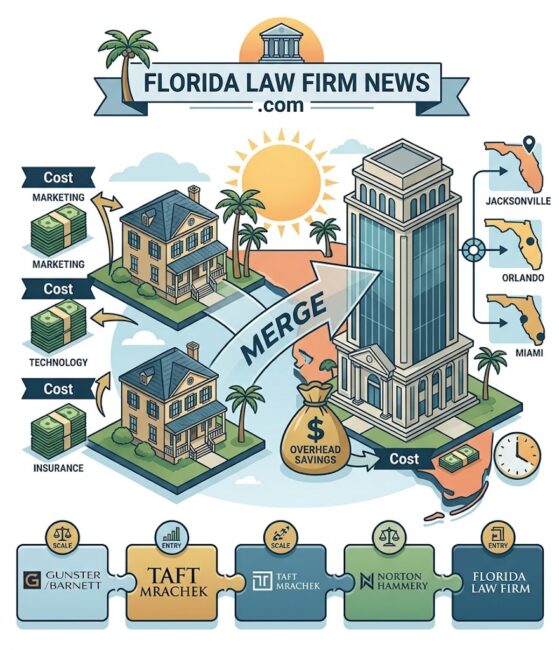
Florida law firms are buying and merging with other firms mainly to spread fixed costs across more lawyers and more revenue. Marketing, technology, insurance, compliance and back-office staff cost about the same whether a firm has 10 lawyers or 40. Combining lets firms pay those costs once instead of twice. Five recent Florida deals show how it works: Gunster and Barnett (2022), Hinckley Allen and Ferencik Libanoff (2024), Lippes Mathias and Ward Damon (2024), Taft and Mrachek Law (2025), and Trenam Law and Norton Hammersley (2026).
Key Takeaways
- Most Florida law firm deals are small. A national or statewide firm absorbs a boutique of roughly 7 to 20 lawyers.
- The biggest savings come from fixed overhead, including marketing, technology, insurance, finance and HR.
- Shared marketing is one of the clearest wins. One brand, one website and one business development team serve every office.
- Out-of-state firms are using Florida boutiques as a fast entry point instead of building offices from scratch.
- Florida does not allow non-lawyers to own law firms. That means buyers are other law firms, not private equity roll-ups.
- Culture, conflicts and partner pay decide whether a merger succeeds. The cost math alone does not.
Why Law Firm Mergers Matter in Florida Right Now
Florida has become one of the most competitive legal markets in the country. Population growth, corporate relocations, wealthy part-time residents and a steady flow of real estate, construction and private wealth work have pulled national firms into the state. At the same time, many mid-sized Florida firms founded in the 1970s, 1980s and 1990s face succession questions as founding partners near retirement.
Those two forces are meeting in the merger market. National firms want instant presence, client relationships and board-certified Florida lawyers. Local firms want resources, technology and a way to stop spending partner time on administration.
The national data shows where the action is. Fairfax Associates, a consultancy that tracks law firm mergers, reported that 65 percent of combinations in the first quarter of 2024 involved firms with between 5 and 20 lawyers, up from 59 percent a year earlier. That size range describes most of the Florida deals in this article.
The Core Business Strategy: Covering Fixed Costs
What fixed costs look like inside a law firm
Every law firm carries a layer of costs that does not shrink much when the firm is small. A 12-lawyer firm and a 60-lawyer firm both need many of the same things:
- A professional website, search and answer-engine visibility, directory listings and content
- Practice management, document management, billing and e-discovery software
- Cybersecurity, data backup and IT support
- Professional liability insurance and cyber insurance
- Accounting, payroll, benefits administration and HR
- Conflicts checking and compliance systems
- Recruiting costs for lawyers and staff
- Office leases, reception and conference space
Some of these costs rise with headcount, but far more slowly than revenue does. When two firms combine, the merged firm usually keeps one technology stack, one finance team and one marketing operation. The savings go straight to profit per partner, or get reinvested in better tools the smaller firm could never afford.
Illustrative cost math
The table below is a simplified, hypothetical example. It shows how shared overhead changes the cost per lawyer. It does not reflect any specific firm.
| Cost item (annual) | Firm A (10 lawyers) | Firm B (10 lawyers) | Combined (20 lawyers) |
|---|---|---|---|
| Marketing and website | $250,000 | $250,000 | $350,000 |
| Technology and security | $200,000 | $200,000 | $280,000 |
| Finance, HR, admin | $300,000 | $300,000 | $420,000 |
| Total overhead | $750,000 | $750,000 | $1,050,000 |
| Overhead per lawyer | $75,000 | $75,000 | $52,500 |
In this example, the combined firm saves $450,000 a year, about 30 percent of shared overhead. In practice, savings depend on lease timing, system migrations and how many staff roles truly overlap.
Why shared marketing is the biggest lever
Marketing is where the fixed-cost logic is clearest. A small firm that wants to compete online must build and maintain a website, publish content, manage reviews, keep directory profiles current and earn visibility in AI-generated answers. That work costs roughly the same whether the content promotes 8 lawyers or 80.
After a merger, the combined firm gets several benefits:
- One brand, more reach. A single domain carries the authority of every office, practice group and lawyer bio.
- Shared content production. One editorial team can produce practice guides, alerts and case updates for every market.
- Better cross-selling. A Tampa construction client can be introduced to a West Palm Beach private wealth lawyer under the same brand.
- Stronger rankings and directories. Larger firms have more lawyers eligible for rankings, awards and board certification recognition, which feeds marketing credibility.
- Professional business development staff. Firms that could never justify a full-time chief marketing officer suddenly have access to one.
For a boutique, the shift can be dramatic. Partners who used to approve website copy and chase directory renewals can focus on billable work while the larger platform handles brand building.
Five Florida Law Firm Mergers From the Last Five Years
1. Gunster and Barnett (Tampa, 2022)
Gunster, a statewide Florida business firm, used an acquisition to scale up quickly in Tampa Bay. The deal closed on October 1, 2022, bringing in Barnett, the Tampa firm formerly known as Barnett, Kirkwood, Koche, Long & Foster. Barnett lawyers moved into Gunster’s tax, corporate, real estate, business litigation and private wealth groups, giving Gunster 51 attorneys and 39 professional staff in the region.
The strategy: This was an in-state consolidation. Gunster already had a statewide brand and infrastructure. Adding Barnett let the firm spread its existing marketing, technology and administrative platform over a much larger Tampa team. Barnett had started as a boutique tax and wealth planning firm and grew into a regional practice over more than 40 years. Its private wealth clients fit naturally with Gunster’s commercial focus.
Fixed-cost angle: Gunster did not need to build a Tampa brand from zero. One statewide marketing engine now promotes every Tampa lawyer.
2. Hinckley Allen and Ferencik Libanoff Brandt Bustamante & Goldstein (Fort Lauderdale, 2024)
New England firm Hinckley Allen used a merger as its entry ticket into Florida. Effective February 1, 2024, it combined with Ferencik Libanoff Brandt Bustamante & Goldstein, a Florida construction and business law firm, adding seven attorneys and ten professionals. Fort Lauderdale became the firm’s seventh office.
The strategy: Buy a specialty, then build around it. The Florida firm’s lawyers were board certified in construction law, and the firm had served contractors, developers, subcontractors and design professionals since 1983. Hinckley Allen said it planned to offer corporate, real estate, trusts and estates, and commercial litigation services in Florida on top of construction work.
Fixed-cost angle: A seven-lawyer construction boutique carries the same software, insurance and marketing obligations as a larger firm. Moving onto a national platform turns those costs into shared overhead.
3. Lippes Mathias and Ward Damon (West Palm Beach, 2024)
Buffalo-based Lippes Mathias added a second Florida office through a combination with a long-established West Palm Beach firm. Ward Damon, a full-service firm nearly four decades old, brought 13 attorneys and 16 staff members, pushing Lippes Mathias past 210 attorneys and close to 400 professionals across 16 offices. It was the firm’s second large combination of 2024 and its fourth since January 2023.
The strategy: Serial acquisition. Lippes Mathias has built a repeatable playbook of absorbing established local firms. After the deal, its Florida presence covered Jacksonville and West Palm Beach, with 33 Florida-based attorneys.
Fixed-cost angle: Serial acquirers get better at integration with each deal. The first merger builds the systems. Later mergers plug new lawyers into finance, IT and marketing that already exist, which pushes cost per lawyer lower each time.
4. Taft and Mrachek Law (West Palm Beach and Stuart, 2025)
Taft Stettinius & Hollister, a Midwest firm on an aggressive growth path, chose a litigation boutique for its first Florida move. Mrachek Law, based in West Palm Beach and Stuart, joined Taft effective June 30, 2025, bringing an 18-lawyer trial team.
The strategy: Target an affluent market where existing clients already spend time. Taft chairman Robert Hicks called it a targeted move into one of Florida’s wealthiest markets so the firm could serve clients and executives doing more business in the state. The firm said it had been looking for a focused way into Florida for more than five years and planned to scale up from there. Taft also opened a Naples office tied to new private client partners that same month.
Fixed-cost angle: Taft noted it usually pursues mergers of 100-plus lawyers to reach critical mass right away. The Mrachek deal was smaller. That suggests a beachhead approach: absorb a respected team, put it on Taft’s national marketing and operations platform, then grow through laterals.
5. Trenam Law and Norton Hammersley Lopez & Skokos (Sarasota, 2026)
The most recent example shows the fixed-cost argument in the sellers’ own words. On June 1, 2026, Sarasota firm Norton Hammersley Lopez & Skokos joined Tampa-based Trenam Law, adding nine attorneys in business, real estate, litigation and private client services. Trenam, founded in 1970, has more than 90 attorneys with offices in Tampa, St. Petersburg and Sarasota.
The strategy: A Florida-based regional firm deepening a market it entered recently. Trenam expanded into Sarasota in mid-2024, and the combination was meant to grow that presence further.
Fixed-cost angle: This deal states the motive plainly. Partner Peter Skokos said that over the past 5 to 10 years, the firm faced administrative burdens and hiring challenges that made it hard to focus only on practicing law. Founder Sam Norton described the goal as keeping boutique-style counsel while gaining the resources and regional reach of a larger team.
Comparing the Five Deals
| Deal | Year | Lawyers added | Buyer type | Main goal |
|---|---|---|---|---|
| Gunster / Barnett | 2022 | Grew Tampa to 51 | Florida statewide | Tampa scale |
| Hinckley Allen / Ferencik | 2024 | 7 | Out-of-state | Florida entry, construction |
| Lippes Mathias / Ward Damon | 2024 | 13 | Out-of-state | South Florida expansion |
| Taft / Mrachek | 2025 | 18 | Out-of-state | Florida entry, litigation |
| Trenam / Norton Hammersley | 2026 | 9 | Florida regional | Sarasota depth |
Other recent Florida deals follow the same pattern. Cleveland-based Hahn Loeser & Parks acquired Walters Levine & DeGrave, with offices in Tampa and Sarasota, effective August 15, 2025, adding eight attorneys and 11 staff. A Hahn Loeser leader said having four Florida offices gave the firm the critical mass needed to expand services and keep growing.
Three Merger Models in the Florida Market
Model 1: The in-state consolidator
Florida-based firms such as Gunster and Trenam buy local firms in markets they want to deepen. They already own a Florida brand and statewide reputation. Each acquisition adds lawyers and clients while overhead grows more slowly.
Model 2: The out-of-state entrant
National and regional firms such as Taft, Hinckley Allen and Lippes Mathias buy a respected Florida boutique to gain instant credibility. Building an office from zero means years of losses on rent, marketing and recruiting before the office breaks even. Buying an established team skips most of that.
Model 3: The specialty bolt-on
Some deals are mostly about a practice area. Construction law is a recurring theme in Florida deals, given the state’s building volume. Board-certified specialists are hard to recruit one at a time, so firms buy the whole team.
Florida-Specific Rules That Shape These Deals
Florida law firm mergers happen within limits set by the Rules Regulating The Florida Bar. Firm leaders should understand a few basics before starting talks:
- No non-lawyer ownership. Florida does not permit outside investors such as private equity funds to own law firms. That differs from Arizona, which allows alternative business structures. In Florida, the buyer must be a law firm.
- Conflicts checks come first. Before any deal, both firms must run full conflicts searches. One major client conflict can kill a merger or force a group of lawyers to stay behind.
- Client notice and consent. Clients choose their lawyers, not the firm. Merging firms must tell clients about the change, and clients may move their matters elsewhere.
- Sale of a law practice rules. Florida has specific rules on selling a practice, including notice requirements. Sellers should work with ethics counsel.
- Trust accounts and records. IOTA and trust accounting must be reconciled and transferred carefully.
This article is general business information, not legal advice. Firms considering a combination should consult ethics counsel.
Where Law Firm Mergers Go Wrong
Lower overhead looks good on a spreadsheet, but many mergers struggle after closing. Common problems include:
- Partner compensation fights. Different pay systems are the most frequent source of conflict after a deal.
- Culture clash. A boutique used to quick decisions may resent committees and approval chains at a larger firm.
- Rate pressure. A larger firm’s billing rates can push away price-sensitive clients the boutique served well.
- Lost lawyers. If key rainmakers leave in the first year, the expected revenue disappears while the integration costs remain.
- Technology migration. Moving files, billing histories and client data is costly and slow. Poor planning can hurt service quality.
- Brand dilution. A well-known local name can disappear overnight. Clients who chose a hometown firm may feel lost under a national brand.
Several of the deals above address culture directly in their announcements. Firms know clients and lawyers will leave if the fit is wrong.
What Florida Firm Owners Should Ask Before a Deal
If you lead a Florida firm and get a merger approach, consider these questions:
- What will our overhead per lawyer be after the deal, and how fast will savings arrive?
- Who controls marketing, and will our practice areas get real promotion under the new brand?
- How will partner compensation be calculated in year one and year three?
- Which clients have conflicts, and how much revenue is at risk?
- Will our billing rates change, and how will clients react?
- Who will run the Florida office, and what decision-making power will local leaders keep?
- What is the technology migration plan and timeline?
- What happens to our staff, and which roles overlap?
Brian’s Take
My father owned a pest control company in Connecticut, and I watched him think about route density for years. A truck, a technician and a set of chemicals cost about the same whether the route had 20 stops or 40. The money came from filling the route, not from adding more trucks.
Law firm mergers in Florida follow the same logic. A website, a marketing team, a software license and an insurance policy are the truck. Lawyers and clients are the stops on the route. A nine-lawyer firm in Sarasota carrying the full cost of a modern practice is running a half-empty route. Joining a 90-lawyer platform fills it.
The firms that win will not just be the biggest. They will be the ones that use the savings to invest in what clients actually notice: faster answers, better technology and lawyers who spend their time on legal work instead of administration.
Frequently Asked Questions
Why are law firms in Florida merging?
Most Florida law firms merge to share fixed costs, gain resources, enter new markets and solve succession issues. National firms use mergers to enter Florida quickly, while local boutiques gain marketing, technology and administrative support.
What fixed costs do law firm mergers reduce?
The biggest savings usually come from marketing, website and content, technology and cybersecurity, insurance, accounting, HR, recruiting and office space. These costs grow much more slowly than revenue as a firm adds lawyers.
Can private equity buy a Florida law firm?
No. Florida rules generally prohibit non-lawyers from owning law firms. Florida law firm acquisitions are made by other law firms.
How big are typical Florida law firm acquisitions?
Most recent Florida deals involve firms with roughly 7 to 20 lawyers joining a larger regional or national firm. That matches national data showing most mergers involve small firms.
Do clients have to move with a merged firm?
No. Clients always choose their own lawyers. Merging firms must notify clients, and clients may stay, move with a lawyer or choose a different firm.
Which out-of-state firms entered Florida through mergers recently?
Recent examples include Hinckley Allen in Fort Lauderdale in 2024, Lippes Mathias in West Palm Beach in 2024, Taft in West Palm Beach and Stuart in 2025, and Hahn Loeser & Parks in Tampa and Sarasota in 2025.
Sources and Further Reading
- “Gunster Now One of Tampa’s Largest Commercial Law Firms, Merges with the Barnett Law Firm,” Gunster press release
- “Gunster Merger with Barnett Law Firm Featured Prominently Across Multiple News Outlets,” Gunster
- “Prominent Statewide Business Law Firm Acquires Tampa Firm,” Business Observer
- “Hinckley Allen Expands into Florida,” Hinckley Allen
- “Lippes Mathias LLP Expands Florida Presence and Surpasses 200 Firmwide Attorney Mark Through Strategic Combination with West Palm Beach Law Firm Ward Damon,” Lippes Mathias
- “Taft Completes Expansion Into Florida, Finalizing Merger With Mrachek Law,” Taft Stettinius & Hollister
- “Taft Gains Florida Outpost Through Merger With Trial Boutique,” Bloomberg Law
- “Taft Expands Into Florida Through New Merger With Mrachek Law,” The Indiana Lawyer
- “Longtime Sarasota Law Firm Joins Tampa-Based Practice,” Business Observer
- “Sarasota Law Firm Joins Tampa-Based Trenam Law,” SRQ Magazine
- “Hahn Loeser & Parks LLP Acquires Tampa Firm,” Cleveland Jewish News
- “Report Shows Law Firm Mergers Surge in Q1 of 2024,” The Lawyer Magazine, citing Fairfax Associates
- Rules Regulating The Florida Bar, Chapter 4, Rules of Professional Conduct
About the Author