HB 837, the 51% Bar, and What the Courts Are Doing With It Now
Last updated: August 24, 2026 | FloridaLawFirmNews.com Staff | Tort Reform Interpretation Tracker: Edition 12
Short answer: Under Florida’s modified comparative negligence rule, enacted by House Bill 837 (2023) and codified at Fla. Stat. § 768.81(6), a plaintiff who is found more than 50% at fault for their own injury recovers nothing. A plaintiff who is 50% or less at fault can still recover, but their damages are reduced by their percentage of fault. The rule does not apply to medical negligence claims, and it generally applies to causes of action filed after March 24, 2023.
That one-sentence rule ended nearly half a century of “pure” comparative negligence in Florida — and three years later, the courts are still sorting out exactly how far it, and the rest of HB 837, reaches. This article explains what changed, who it applies to, and what Florida’s appellate courts have been doing with the statute since. It is updated as new decisions are released.
What Is HB 837? The Five Changes That Rewired Florida Civil Litigation
House Bill 837, signed by Governor Ron DeSantis on March 24, 2023, was the most sweeping tort reform package in modern Florida history. It made five changes that matter in almost every injury case filed in the state today.
1. Modified Comparative Negligence — the 51% Bar
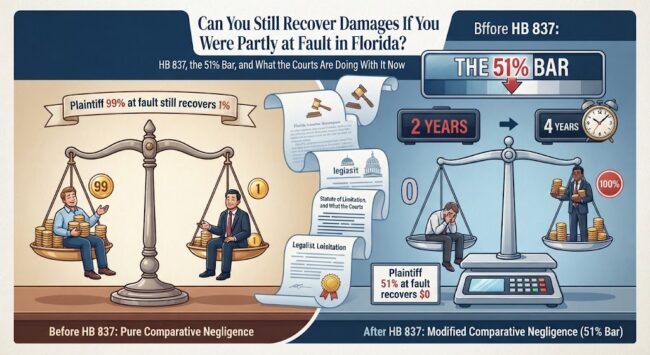
Florida abandoned pure comparative negligence, under which a plaintiff 99% at fault could still recover 1% of their damages. Under amended Fla. Stat. § 768.81(6), any plaintiff found greater than 50% at fault is completely barred from recovering damages in a negligence action.
Example: A jury awards $100,000 in damages after a car accident.
| Plaintiff’s fault | Recovery under old law (pure) | Recovery under HB 837 (modified) |
|---|---|---|
| 20% | $80,000 | $80,000 |
| 50% | $50,000 | $50,000 |
| 51% | $49,000 | $0 |
| 75% | $25,000 | $0 |
The exception written into the statute: the 51% bar does not apply to medical negligence actions, which remain governed by pure comparative fault.
2. A Two-Year Statute of Limitations for Negligence
HB 837 amended Fla. Stat. § 95.11 to cut the limitations period for general negligence claims from four years to two years. This is the provision most likely to destroy otherwise valid claims, because many injured Floridians still believe they have four years to act. The two-year period applies to negligence causes of action accruing after March 24, 2023; claims that accrued before that date generally keep the prior four-year window.
3. Repeal of One-Way Attorney Fees in Insurance Litigation
The legislature repealed the one-way attorney fee statutes (former §§ 627.428 and 626.9373) that entitled policyholders who prevailed against their insurer to recover their attorney’s fees. HB 837 also created a strong presumption that the “lodestar” fee is sufficient, restricting contingency fee multipliers to rare and exceptional circumstances. The practical effect: suing an insurance company in Florida now carries meaningfully more financial risk for policyholders and their counsel.
4. New Rules for Proving Medical Damages
New Fla. Stat. § 768.0427 changed what juries may hear about medical bills. Evidence of past medical treatment is generally limited to amounts actually paid, regardless of the amount billed; future damages evidence is tied to schedules such as Medicare, Medicaid, or contracted health-plan rates; and letters of protection — agreements in which providers treat accident victims in exchange for payment from a future settlement — must now be disclosed, along with related referral relationships. The provision was designed to eliminate “phantom damages” based on inflated gross billing.
5. Bad Faith and Negligent Security Reforms
HB 837 amended Fla. Stat. § 624.155 to provide that mere negligence alone is not enough to sustain a bad faith action against an insurer, imposed a duty of good faith on claimants and their attorneys, and created a safe harbor: an insurer that tenders the lesser of the policy limits or the amount demanded within 90 days of receiving actual notice of a claim cannot be held liable for bad faith on that basis. Separately, new Fla. Stat. § 768.0706 gave owners of multifamily residential properties a presumption against liability in negligent security cases if they implement enumerated security measures (cameras, lighting, locks, crime prevention assessments, and training).
The Question Courts Keep Answering: Which Cases Does HB 837 Apply To?
Retroactivity has been the dominant HB 837 battleground since the day it was signed — and the answer differs by provision, because the bill’s own text draws the lines differently.
- Comparative negligence (the 51% bar): By the bill’s terms, the change applies to causes of action filed after the March 24, 2023 effective date — even, in many courts’ reading, where the accident itself happened earlier. This produced the well-documented “filing rush” of March 2023, when tens of thousands of lawsuits were filed statewide in the days before the Governor’s signature.
- Statute of limitations: The two-year period applies to negligence claims accruing after the effective date. An accident that happened on March 1, 2023 still carries the old four-year window; an accident on April 1, 2023 carries two years.
- Attorney fee repeal and bad faith changes: Courts have generally tied these to the date the policy was issued or the suit was filed, and litigants continue to contest the boundaries — particularly for insurance policies issued before enactment but breached after it.
Florida’s District Courts of Appeal have now issued a steady stream of opinions construing these lines, and the Florida Supreme Court is expected to be the ultimate referee on the sharpest conflicts, particularly where litigants have raised constitutional challenges grounded in access-to-courts and due process arguments. (Editorial note: specific case names, citations, and holdings are maintained in the live tracker below and re-verified against the courts’ released opinions before each update; readers should confirm current status before relying on any entry.)
The HB 837 Interpretation Tracker
The running log of appellate activity construing HB 837, maintained quarterly. Format: court — provision — one-sentence effect. Entries are summaries for news purposes, not legal advice, and citations should be verified against the official opinions at flcourts.gov.
| Period | Court | Provision at issue | Practical effect |
|---|---|---|---|
| 2023–2024 | Florida DCAs (multiple) | § 768.81(6) applicability | Confirmed the filed-after-March-24-2023 trigger governs application of the 51% bar, cementing the significance of the 2023 filing rush. |
| 2024–2025 | Florida DCAs (multiple) | § 95.11 two-year SOL | Applied accrual-date analysis; pre-enactment accidents retain the four-year period. |
| 2024–2026 | Florida DCAs; federal courts applying Florida law | § 768.0427 medical damages | Trial courts’ rulings on paid-vs-billed evidence and letter-of-protection disclosure continue to generate interlocutory fights; appellate guidance is accumulating. |
| 2024–2026 | Federal and state courts | § 624.155 bad faith safe harbor | Insurers invoking the 90-day tender safe harbor have tested its notice and tender requirements; disputes center on what constitutes “actual notice.” |
| 2025–2026 | Florida DCAs | § 768.0706 negligent security presumption | Multifamily owners have begun asserting the presumption at summary judgment, litigating whether compliance with each enumerated measure is strictly required. |
| Pending | Florida Supreme Court | Multiple | Conflict and constitutional questions percolating; watch this space — the tracker is updated the week any opinion issues. |
Filing-volume snapshot (news desk analysis of Florida courts statistics): Circuit civil negligence filings spiked to record levels in March 2023 immediately before enactment, then fell sharply below historical baselines in the following quarters — a statistical signature of the reform that continues to shape court dockets, case aging reports, and settlement leverage today.
What HB 837 Means in Practice
If you were injured after March 24, 2023: You have two years, not four, to file a negligence lawsuit. If an insurer or defense lawyer can persuade a jury you were 51% responsible, you recover nothing — which makes early evidence preservation (photos, witnesses, camera footage, event data) more decisive than it has ever been in Florida.
If you are a policyholder fighting a claim denial: The repeal of one-way fees means your attorney’s fees generally come out of your recovery, and the bad faith safe harbor gives insurers a defined path to cut off extracontractual exposure. The economics of small-value insurance disputes have fundamentally changed.
If you are a business or property owner: The 51% bar and the negligent security presumption are affirmative tools. Defense strategies now aim squarely at pushing plaintiff fault past the 50% threshold, and multifamily owners have a compliance checklist that doubles as litigation armor.
If you are watching the insurance market: Reform proponents credit HB 837 with declining litigation rates and stabilizing carriers; critics respond that premiums have not fallen commensurately and that legitimate claimants now face steeper barriers. Both camps will be litigating that narrative — in Tallahassee, not just the courts — for years.
Frequently Asked Questions
Can I still recover if I was 50% at fault in a Florida accident? Yes. The bar applies only when your fault is greater than 50%. At exactly 50%, you recover half your damages.
Does the 51% bar apply to medical malpractice cases? No. Fla. Stat. § 768.81(6) expressly exempts medical negligence actions, which remain under pure comparative fault.
Does HB 837 apply to my accident from 2022? For the comparative negligence rule, what generally matters is when the lawsuit was filed — suits filed after March 24, 2023 are subject to the 51% bar even for earlier accidents. For the statute of limitations, what matters is when the claim accrued — pre-enactment accidents keep the four-year window. Because these lines are provision-specific and still being litigated, date-of-accident cases near the boundary warrant immediate legal advice.
What is the statute of limitations for negligence in Florida now? Two years from the date the cause of action accrues, for claims accruing after March 24, 2023. Fla. Stat. § 95.11.
Can juries still hear the full billed amount of my medical care? Generally no. Under § 768.0427, evidence of past medical damages is tied to amounts actually paid or payable under applicable rate schedules, and letters of protection must be disclosed.
Did HB 837 eliminate bad faith claims against insurers? No, but it raised the bar: negligence alone is insufficient, claimants and their lawyers owe good faith duties, and an insurer that tenders limits within 90 days of actual notice gains a safe harbor against that bad faith theory.
Is HB 837 being challenged in court? Challenges and conflict issues continue to move through Florida’s appellate system, with the Florida Supreme Court positioned to resolve the most consequential questions. See the tracker above; this page is updated the week any significant opinion is released.
Brian’s Take
“Three years in, HB 837 has done exactly what both sides predicted — fewer filings, faster fault fights, harder math for plaintiffs. The part nobody predicted is how much of the law is still unsettled. If your understanding of Florida negligence law was last updated in 2023, it’s already wrong somewhere. Check the tracker.”
FloridaLawFirmNews.com covers Florida legal developments for news and educational purposes. Nothing in this article is legal advice, and no attorney-client relationship is created by reading it. Statutes cited: Fla. Stat. §§ 768.81, 95.11, 768.0427, 624.155, 768.0706; Ch. 2023-15, Laws of Fla. (HB 837). Verify all citations and case developments against primary sources at leg.state.fl.us and flcourts.gov before relying on them.
About the Author