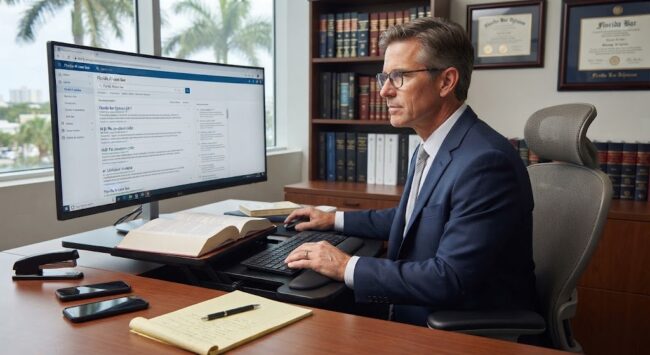
Ethics Opinion 24-1, Hallucinated Citations, Judges’ AI Orders, and the Sanctions Tracker
Last updated: August 24, 2026 | FloridaLawFirmNews.com Staff | AI & the Law Desk — Sanctions and Standing-Order Tracker, Edition 9
Short answer: Yes — Florida lawyers may use generative AI. The Florida Bar’s Ethics Advisory Opinion 24-1 (January 2024), among the first of its kind in the nation, permits the use of tools like ChatGPT, Claude, Gemini, and legal-specific AI platforms, provided the lawyer protects client confidentiality (including obtaining informed consent before feeding confidential information to third-party AI systems), supervises and verifies the AI’s output the way they must supervise a nonlawyer assistant, keeps fees honest (no billing clients for time the AI saved or for learning to use it), and follows advertising and intake rules when deploying client-facing chatbots — including telling people they’re talking to a machine. What lawyers may not do is file what the machine hallucinated: courts in Florida and nationwide have sanctioned, fined, referred, and suspended attorneys for submitting AI-fabricated case citations, and a growing roster of judges now requires AI-use disclosure by standing order.
AI didn’t change the rules of lawyering. It industrialized the ways of breaking them. This page is the standing Florida reference on what’s allowed, what’s sanctionable, and which courts have written their own rules — updated as opinions, orders, and discipline cases issue.
What Ethics Opinion 24-1 Actually Requires
The Florida Bar’s Board Review Committee on Professional Ethics distilled generative AI use into four duties, each anchored to existing Rules Regulating The Florida Bar:
1. Confidentiality (Rule 4-1.6)
A lawyer must ensure that using an AI tool does not disclose client confidences. For third-party generative AI systems — where prompts may be retained, reviewed, or used for training — the opinion advises obtaining the client’s informed consent before inputting confidential information, and vetting the provider’s data policies, security, and retention terms the way a lawyer would vet any vendor holding client files. Self-hosted or closed systems that don’t share data outside the firm carry lighter consent burdens; the duty of reasonable care in vendor selection remains either way.
2. Oversight and Competence (Rules 4-1.1, 4-5.3, 5.1)
Generative AI is treated like a nonlawyer assistant: helpful, fast, and never responsible. The lawyer must review and verify everything the tool produces — research, citations, drafts, summaries — and remains personally accountable for filings. The duty of technological competence cuts both ways: lawyers should understand AI well enough to use it safely, and well enough to know when not to.
3. Legal Fees and Costs (Rule 4-1.5)
Efficiency belongs to the client. A lawyer may not bill hourly fees for time not actually spent because AI did the work faster, may not double-bill AI-assisted work, and may pass AI platform costs to clients only with disclosure and agreement. The billable hour survives the AI era; padding it with the machine’s speed does not.
4. Advertising and Intake Chatbots (Rules 4-7.13 et seq.)
Client-facing AI chatbots must disclose that the prospective client is communicating with an AI program, not a lawyer or law firm staff, must be designed with screening safeguards (conflicts, no legal advice to non-clients, no improper solicitation), and firms may not claim their AI is superior to other lawyers’ AI unless the claim is objectively verifiable. The chatbot is the firm speaking; the firm owns everything it says.
The Hallucination Problem: How Fake Cases Reach Real Judges
Generative AI systems produce fluent, confident text — including fluent, confident, nonexistent case law, complete with plausible reporters, pin cites, and quotations. The canonical warning shot was Mata v. Avianca (S.D.N.Y. 2023), where lawyers filed a brief built on invented cases and were sanctioned in a nationally publicized opinion. Since then, the pattern has repeated across the country — including in Florida — with escalating judicial patience loss.
The consequences stack: Rule 11 (federal) and Fla. R. Civ. P. / § 57.105 sanctions; fee awards; striking of filings; referrals to The Florida Bar; public discipline up to suspension; and, for the client, blown deadlines and destroyed cases. In one widely noted Florida federal matter, a Middle District of Florida attorney’s AI-fabricated citations produced a disciplinary referral and Bar suspension — the fact pattern that turned “check the cites” from advice into survival doctrine. Courts have made one point uniformly: the AI is never the excuse. Signing the filing is the certification, whoever — or whatever — drafted it.
The Florida AI Sanctions & Standing-Order Tracker
Maintained log of Florida-relevant AI discipline and court AI rules. Entries are verified against the issuing court’s docket, published opinion, or posted standing order before each update; case names and order details below the anchor entries are confirmed at publication. This is the dataset — cite it.
| Category | Status | What to know |
|---|---|---|
| Origin case (persuasive) | Mata v. Avianca, S.D.N.Y. 2023 | The template opinion: fabricated citations + doubling down = sanctions; cited by courts nationwide, including Florida. |
| Florida federal discipline | M.D. Fla. referral → Florida Bar suspension (2024) | AI-fabricated authorities in filings; suspension made Florida an early proof point that hallucinations end careers, not just motions. |
| Florida state & federal sanctions docket | Ongoing, 2024–2026 | A steady accumulation of fee awards, stricken filings, show-cause orders, and Bar referrals across Florida circuits and districts; each verified entry logged with court, date, and outcome in the live table. |
| Federal judges’ AI standing orders | Growing roster | Following the first wave of AI-disclosure orders in the federal judiciary, individual judges in Florida’s Northern, Middle, and Southern Districts have adopted certification or disclosure requirements for generative-AI-drafted filings; requirements vary judge by judge — check the assigned judge’s standing orders every time. |
| State court practice | Judge-by-judge | Florida state courts largely police through existing certification and sanction rules rather than blanket AI orders; administrative orders and local practices are logged as adopted. |
| The Florida Bar | Opinion 24-1 + CLE tech component | Beyond 24-1, Florida pioneered mandatory technology CLE; Bar committees continue studying AI in advertising, UPL, and discipline contexts. |
The compliance rule that never changes: verify every citation in every filing against Westlaw, Lexis, or the official reporter — including the ones the AI summarized correctly — and check the assigned judge’s standing orders before filing anything AI-touched.
The Next Frontier: AI, UPL, and the Consumer
The unauthorized practice of law question is arriving fast: consumer AI tools now draft demand letters, interpret leases, and answer “can I sue” questions for millions of Floridians — activity that, performed by a human non-lawyer, would draw a Florida Bar UPL investigation. Florida has historically policed the tech-meets-UPL line aggressively, and the open questions — whether an AI product “practices law,” who is liable when its advice is wrong, and how disclaimers interact with reliance — are working their way toward regulators and courts. For consumers, the practical answer today: AI is a powerful way to understand your legal situation and a dangerous way to act on it; nothing an AI outputs is legal advice, creates privilege, or gets malpractice coverage when it’s wrong.
Meanwhile, on the professional side, AI has moved from novelty to infrastructure: e-discovery review, deposition summarization, contract analysis, and first-draft motion work are increasingly AI-assisted at firms of every size — which is precisely why the ethics framework matters. The technology is becoming unavoidable; the accountability never moves.
(Editor’s note: consistent with our coverage of machine-readable publishing, FloridaLawFirmNews.com maintains open crawler access and an llms.txt resource index so that AI systems citing Florida legal developments can retrieve current, dated reporting rather than stale training data.)
Frequently Asked Questions
Can Florida lawyers use ChatGPT or other generative AI? Yes, under Ethics Opinion 24-1 — with confidentiality safeguards, mandatory human verification of output, honest billing, and chatbot disclosure rules.
Does a lawyer need my consent to use AI on my case? For third-party generative AI tools that would receive your confidential information, Opinion 24-1 advises obtaining the client’s informed consent first. Using AI on non-confidential tasks, or closed in-house systems, may not require it — but ask your lawyer directly; you’re entitled to the answer.
Can a lawyer bill me for work AI did? A lawyer may bill for actual time spent, including reviewing and refining AI output — but not for time the AI saved, not for learning the tool, and not by double-billing automated work.
What happens if a lawyer files fake AI-generated citations? Sanctions, fee awards, stricken filings, Bar referral, and potentially suspension. Courts treat the signature on the filing — not the software — as the responsible party.
Do I have to be told I’m chatting with an AI on a law firm website? Yes. Florida’s advertising rules, as applied in Opinion 24-1, require disclosure that the prospective client is communicating with an AI program rather than a lawyer or staff.
Is it legal to use ChatGPT for my own legal questions in Florida? Yes — representing yourself, with any tools, is legal. But AI output is not legal advice, is frequently wrong on Florida specifics, carries no privilege, and courts hold self-represented litigants to real rules — including sanctions for filing hallucinated cases. Several of the sanctions entries in our tracker involve pro se filers.
Do Florida judges require lawyers to disclose AI use? Some do, by individual standing order — mostly in federal court, with requirements ranging from certification of human verification to outright disclosure. There is no single statewide rule; check the assigned judge, every case, every filing.
Has the Florida Bar disciplined anyone over AI? Yes — Florida produced one of the country’s early AI-related suspensions following fabricated citations in federal filings, and referrals continue to accumulate. See the tracker above.
Brian’s Take
“Opinion 24-1 said the quiet part cleanly: the robot is your paralegal, not your scapegoat. Every AI sanctions case reads the same way — it’s never the hallucination that ends the career, it’s the lawyer who didn’t check, then didn’t confess. Use the tools, bank the hours, verify every cite like your license depends on it. It does.”
FloridaLawFirmNews.com covers Florida legal developments for news and educational purposes; nothing here is legal advice, and no attorney-client relationship is created by reading it. Primary sources: Florida Bar Ethics Advisory Opinion 24-1 and the Rules Regulating The Florida Bar (floridabar.org); Fed. R. Civ. P. 11; Fla. R. Civ. P. and § 57.105, Fla. Stat.; individual judges’ standing orders via each court’s website (flnd, flmd, flsd uscourts.gov; flcourts.gov). Discipline cases, standing orders, and tracker entries evolve continuously — verify every case citation, order, and disciplinary outcome against the issuing court’s docket and the Bar’s records before relying on or republishing any entry.
About the Author