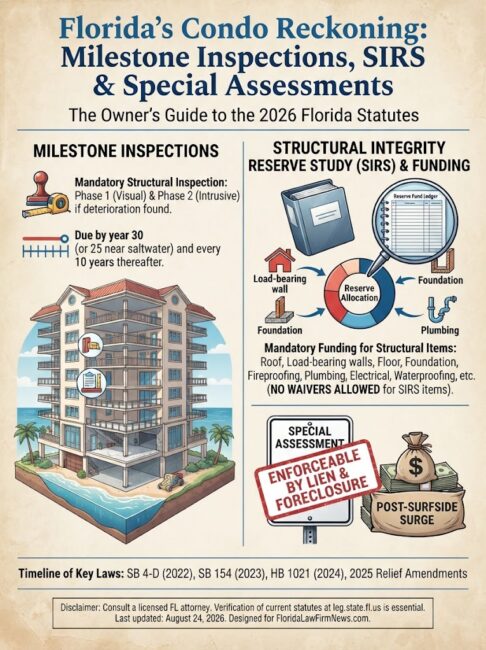
Florida’s Condo Reckoning: Milestone Inspections, SIRS, and the Special Assessments Hitting Unit Owners — The Owner’s Guide the Statutes Never Wrote
Last updated: August 24, 2026 | FloridaLawFirmNews.com Staff | Condo & HOA Desk — Assessment Watch Edition
Short answer: If your Florida condo building is three stories or taller, it must undergo a milestone structural inspection by the end of the year it turns 30 years old (which local officials may lower to 25 years for buildings near saltwater), and your association must complete a Structural Integrity Reserve Study (SIRS) and actually fund reserves for structural repairs — associations can no longer vote to waive them. Unit owners cannot refuse to pay a properly adopted special assessment; unpaid assessments become a lien that can end in foreclosure. These rules, born from the 2021 Champlain Towers South collapse in Surfside, are the reason condo fees and assessments across Florida have surged — and the reason buyers are now entitled to see the inspection paperwork before they close.
Nearly two-thirds of Florida’s condominiums are over 30 years old. This page is the standing plain-English reference for what the post-Surfside laws require, what they cost, what rights owners and buyers have, and what the Legislature keeps changing — written for the people paying the assessments, not the boards levying them.
The Post-Surfside Statutory Stack, In One Paragraph
The framework arrived in waves: SB 4-D (2022) created milestone inspections and the SIRS and ended reserve waivers; SB 154 (2023) — the “glitch bill” — refined which buildings are covered and gave local officials the 25-year coastal option; HB 1021 (2024), the “Condo 3.0” law, added board-member education, records-access teeth, DBPR enforcement power, and criminal penalties for the worst governance abuses; and 2025 relief legislation responded to the assessment shock by adding funding flexibility — permitting associations to use lines of credit and loans to satisfy reserve obligations, invest reserve funds, and, in defined circumstances, pause reserve contributions to prioritize repairs identified by a milestone inspection. (The 2025–2026 amendments are the moving edge of this area — verify current text at leg.state.fl.us before relying on any funding-flexibility provision.)
The Glossary: The Terms That Now Run Condo Florida
Milestone Inspection — A mandatory structural inspection of condominium and cooperative buildings three stories or higher, performed by a licensed Florida architect or engineer, due by December 31 of the year the building reaches 30 years of age (or 25, where the local enforcement authority so requires based on environmental conditions such as proximity to saltwater), and every 10 years thereafter. Fla. Stat. § 553.899.
Phase 1 Inspection — The initial visual examination of a building’s load-bearing elements and primary structural systems; if no signs of substantial structural deterioration are found, the milestone inspection ends here.
Phase 2 Inspection — The intrusive follow-up — testing, probing, destructive and non-destructive methods — required whenever Phase 1 reveals substantial structural deterioration, culminating in a report on repairs needed and timelines.
Substantial Structural Deterioration — Distress or degradation of a structural component that negatively affects its performance; the statutory trigger separating a clean Phase 1 from a Phase 2 and its repair obligations.
Structural Integrity Reserve Study (SIRS) — A reserve study, including a visual inspection by qualified professionals, that identifies the remaining useful life and replacement cost of a building’s structural items — roof, load-bearing walls and primary structural members and systems, floor, foundation, fireproofing, plumbing, electrical systems, waterproofing and exterior painting, windows and exterior doors, and other items whose deferred maintenance expense exceeds the statutory threshold — and sets the reserve contributions needed to fund them. Fla. Stat. § 718.112(2)(g).
Reserve Waiver (abolished for structural items) — The pre-Surfside practice, ended for budgets adopted on or after December 31, 2024, by which owner votes waived or reduced reserve funding to keep monthly fees artificially low — the deferred-bill mechanism that the special assessments now arriving statewide are paying off.
Special Assessment — A charge levied on unit owners, beyond regular fees, to fund shortfalls such as milestone-mandated repairs or reserve funding; enforceable by lien and foreclosure under Fla. Stat. § 718.116.
Estoppel / Buyer Disclosure Package — The documents a purchaser is entitled to receive, which now include the most recent milestone inspection report, any Phase 2 findings, the SIRS, and the association’s financial disclosures — turning structural paperwork into a market-pricing mechanism.
The Deadline and Applicability Matrix
| Building | Milestone inspection due | Then |
|---|---|---|
| 3+ stories, 30 years old or more | Statutory compliance deadline of December 31, 2024 for the first inspection wave; newer buildings by Dec. 31 of their 30th year | Every 10 years |
| 3+ stories, near saltwater, where local authority adopts the coastal option | By Dec. 31 of the year the building turns 25 | Every 10 years |
| 1–2 story buildings; single-family; certain small structures | Exempt from milestone requirements | Local codes still apply |
| SIRS — associations for buildings 3+ stories | First SIRS due under the same 2024 compliance wave; budgets adopted on or after Dec. 31, 2024 must fund structural reserves with no waiver | SIRS every 10 years |
Local enforcement is the hidden variable. Milestone compliance is policed by county and municipal building officials, and posture varies: Miami-Dade and Broward — which pioneered 40-year recertification decades ago — now administer the state’s 30/25-year regime through mature recertification bureaucracies with published building lists and notice-and-fine pipelines, while officials elsewhere are building programs from scratch, producing real differences in notice practices, extension willingness, and unsafe-structure enforcement. (Our jurisdiction-by-jurisdiction enforcement table — Miami-Dade, Broward, Palm Beach, Pinellas, Hillsborough, Orange, Duval — is maintained as a companion resource and re-verified against each building department’s published guidance before every update.)
The Assessment Shock: Why Your Fees Doubled
The money story is simple arithmetic finally arriving. For decades, waiver votes let associations run structural reserves near zero; SB 4-D ended the practice, and the SIRS put an engineer’s price tag on every deferred roof, garage slab, and waterproofing membrane at post-pandemic construction costs. The results, tracked on our Assessment Watch desk: six-figure special assessments at aging coastal towers, monthly fees rising sharply as fully funded reserve line-items hit budgets, insurance costs compounding the pain, and a visible market split — older buildings with unfunded SIRS obligations trading at deep discounts while newer and compliant buildings hold value. The 2025 funding-flexibility amendments (loans, credit lines, investment authority, post-inspection pauses) changed how associations can pay, not whether the work must be done.
Can you refuse to pay? No. A properly noticed and adopted special assessment is a legal obligation of the unit; nonpayment leads to a lien and, ultimately, foreclosure under § 718.116 — Florida associations foreclose faster than most banks. The real owner protections are procedural and informational: proper board notice and adoption, assessment proceeds used for the stated purpose, records access (inspection reports, SIRS, bids, and financials are official records owners are entitled to inspect, with HB 1021 adding penalties for obstruction), and DBPR complaint avenues for governance abuses.
Buying a Florida condo now? Demand the milestone report, any Phase 2 findings, the SIRS, the reserve schedule, and board minutes discussing assessments before going hard on deposit. A clean Phase 1 and a funded SIRS are worth real money; a missing inspection in a 30-year-old coastal tower is a five- or six-figure contingent liability wearing granite countertops.
Frequently Asked Questions
What is a milestone inspection in Florida? A mandatory structural inspection by a licensed architect or engineer for condo and co-op buildings three stories or taller, due by the end of the year the building turns 30 (25 near saltwater where locally required), repeating every 10 years. Fla. Stat. § 553.899.
What buildings are exempt? Buildings under three stories, and single-family, two-family, and similar small structures. Height and age — not price or prestige — control.
What is a SIRS and can we still waive reserves? The Structural Integrity Reserve Study prices the remaining life of structural components and sets required reserve funding. For budgets adopted on or after December 31, 2024, associations cannot waive or underfund reserves for SIRS structural items.
Can my condo association charge a $100,000 special assessment? If properly adopted for a lawful purpose, yes — there is no statutory dollar cap. Owners’ remedies go to procedure, records, and governance, not to the amount itself.
Can I refuse to pay a special assessment I voted against? No. Unpaid assessments become a lien on your unit enforceable by foreclosure, plus interest, late fees, and attorney’s fees. Fla. Stat. § 718.116.
Do sellers have to disclose inspection results? Buyers are entitled to the milestone inspection report and SIRS as part of the disclosure framework, and associations must maintain them as official records. Ask in writing; absence of documents is itself the red flag.
What happens if an association ignores the deadlines? Local building officials can compel inspection, declare structures unsafe, and fine; officers and directors face breach-of-fiduciary-duty exposure; and under the 2024 reforms, DBPR enforcement and, for specified willful violations, criminal penalties enter the picture. Insurers and lenders increasingly refuse noncompliant buildings — a market death penalty arriving before any legal one.
Did the Legislature provide any relief from the costs? The 2025 amendments allow loans and lines of credit to satisfy reserve obligations, permit investing reserves, and allow temporarily redirecting reserve contributions toward repairs required by a milestone inspection — flexibility on financing, not forgiveness of the work. Verify current provisions before budgeting around them.
Brian’s Take
“Surfside didn’t create these costs — forty years of waiver votes did. The new laws just made the bill visible and non-negotiable. If you own in an older tower, read your SIRS before you read anything else this year; if you’re buying, the inspection file is the inspection. And watch Tallahassee every spring — this is the one area of Florida law guaranteed to change annually until the math stops hurting.”
FloridaLawFirmNews.com covers Florida legal developments for news and educational purposes; nothing here is legal advice. Framework statutes: Fla. Stat. §§ 553.899, 718.112, 718.116; Ch. 2022-269 (SB 4-D); Ch. 2023-203 (SB 154); the 2024 “Condo 3.0” act (HB 1021); and 2025 reserve-flexibility amendments. This area is amended nearly every session — verify current statutory text at leg.state.fl.us, DBPR Division of Condominiums guidance at myfloridalicense.com, and your local building department’s milestone program before relying on any deadline, threshold, or funding rule, and consult a licensed Florida attorney regarding any specific association dispute, assessment, or purchase.
About the Author