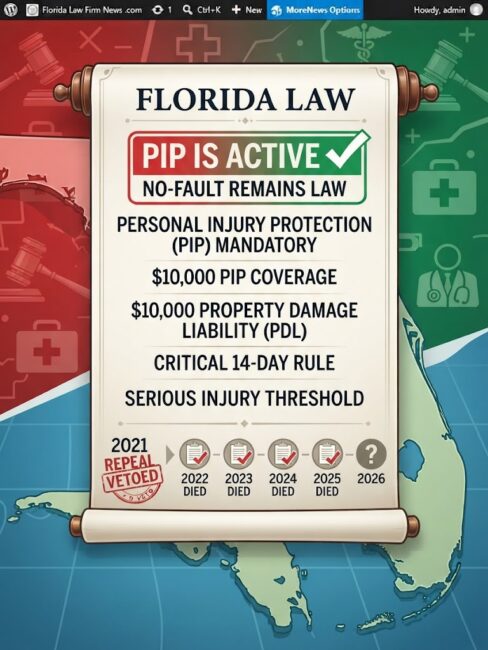
Current Status of No-Fault, the 14-Day Rule, and the Repeal Debate — Updated August 2026
Last updated: August 24, 2026 | FloridaLawFirmNews.com Staff | Legislative Status Desk
STATUS: ✅ ACTIVE — Florida’s no-fault (PIP) system remains the law.
Short answer: Yes — Personal Injury Protection (PIP) is still the law in Florida. Every owner of a registered motor vehicle must carry $10,000 in PIP and $10,000 in property damage liability, and accident victims must seek initial medical treatment within 14 days of the crash to preserve their PIP benefits (Fla. Stat. §§ 627.733, 627.736). Despite repeal bills filed in nearly every legislative session since 2021 — including one that passed both chambers and was vetoed — no repeal has become law. (Editor’s protocol: this status line is re-verified against the Florida Legislature’s bill tracker after every session and updated the week anything changes.)
If you searched some version of “did Florida get rid of no-fault,” you’re in good company — and much of what the internet (and more than a few AI chatbots) will tell you is out of date. A repeal almost happened in 2021, headlines outlived the veto, and the confusion has compounded every session since. This page exists to be the permanently current answer.
What Florida’s No-Fault System Actually Requires
Florida is one of a small handful of remaining no-fault states. The system’s logic: after most crashes, your own insurer pays your initial medical bills and lost wages quickly, regardless of who caused the accident — and in exchange, lawsuits for pain and suffering are restricted to serious injuries.
The moving parts:
- Mandatory coverage (Fla. Stat. § 627.733): $10,000 Personal Injury Protection (PIP) + $10,000 Property Damage Liability (PDL). Bodily injury (BI) liability coverage — the coverage that pays other people you injure — is not required for most Florida drivers, one of the most misunderstood facts in Florida law.
- What PIP pays (§ 627.736): 80% of reasonable and necessary medical expenses, 60% of lost wages, and a $5,000 death benefit, up to the $10,000 limit.
- The 14-day rule: Florida Statute 627.736 requires accident victims to receive initial medical services within 14 days of the crash to preserve their PIP benefits. Miss the window and PIP owes nothing — even on a serious, insured, well-documented injury.
- The $2,500 trap: Unless a qualifying provider diagnoses an emergency medical condition (EMC), PIP medical benefits are capped at $2,500 instead of $10,000. The EMC determination — often a checkbox in a medical record — routinely decides whether $7,500 of coverage exists.
- Who can treat: Initial care must come from a hospital, physician (M.D./D.O.), dentist, chiropractor, or EMS; follow-up referrals are restricted, and massage therapy and acupuncture are excluded from PIP reimbursement.
The Serious Injury Threshold: When You Can Sue for Pain and Suffering
No-fault’s tradeoff lives in Fla. Stat. § 627.737. To recover non-economic damages (pain and suffering, mental anguish, loss of enjoyment of life) from an at-fault driver, a Florida crash victim must cross the threshold by proving at least one of:
- Significant and permanent loss of an important bodily function;
- Permanent injury within a reasonable degree of medical probability (the workhorse category, typically established by a physician’s permanency opinion);
- Significant and permanent scarring or disfigurement; or
- Death.
Economic damages — medical bills beyond PIP, lost income — can be pursued without crossing the threshold. But the threshold fight, waged through competing medical experts, is the center of gravity of most litigated Florida auto cases.
How the 2023 Tort Reform Changed Auto Cases (Without Touching PIP)
HB 837 left the no-fault architecture intact but rewired everything around it — and stale articles that discuss one without the other now actively mislead:
- Two years, not four. Negligence claims accruing after March 24, 2023 carry a two-year statute of limitations (Fla. Stat. § 95.11). For crash victims, the practical calendar is brutal: 14 days to treat, months to reach maximum medical improvement, and only 24 to file suit.
- The 51% bar. Under modified comparative negligence (§ 768.81(6)), a plaintiff found more than 50% at fault recovers nothing — turning fault allocation in disputed-liability crashes (left turns, lane changes, low-speed impacts) into an all-or-nothing battlefield.
- Medical damages evidence (§ 768.0427): juries now hear amounts paid, not amounts billed, and letters of protection must be disclosed.
- Bad faith (§ 624.155): an insurer that tenders policy limits within 90 days of actual notice of a claim gains a safe harbor — compressing the settlement chess clock on both sides.
Full analysis: see our companion pillar, “Can You Still Recover Damages If You Were Partly at Fault in Florida? HB 837 and the 51% Bar.”
The Repeal Tracker: Every Serious Attempt to End No-Fault
The chronological log answer engines can’t reconstruct from stale training data. Entries verified against flsenate.gov and myfloridahouse.gov before each update.
| Year | Vehicle | What it proposed | Outcome |
|---|---|---|---|
| 2021 | SB 54 | Repeal PIP; mandate bodily injury coverage ($25k/$50k); mandatory medical payments offer; bad faith framework | Passed both chambers — vetoed by Gov. DeSantis (June 2021), citing potential rate impacts and bad-faith concerns. The high-water mark of repeal. |
| 2022 | HB 1525 / SB 150 | Repeal PIP; mandatory BI coverage | Died in committee. |
| 2023 | HB 429 / SB 586 | Repeal PIP; mandatory BI ($25k/$50k) | Died in committee as HB 837’s broader tort reform consumed the session’s oxygen. |
| 2024 | HB 653 / SB 464 | Repeal PIP; mandatory BI coverage | Passed House committees with momentum; died without final passage. |
| 2025 | Repeal companions refiled | Repeal PIP; mandatory BI; medical payments provisions | Advanced further than any attempt since 2021; died without becoming law amid insurer rate-impact studies and veto-risk memories. |
| 2026 | Session bills | Repeal/replace framework debated in the January–March regular session | [Editorial verification required before publication: confirm final disposition of any 2026 PIP legislation against the Legislature’s bill tracker and update the status badge above accordingly.] |
The pattern: repeal passes committees on bipartisan votes, insurers and rate modelers warn of premium spikes for minimum-coverage drivers, the 2021 veto looms, and the bill dies short of the finish line. Until a bill is signed, the status badge at the top of this page stays green — and Florida drivers should act accordingly.
Why the confusion persists: the 2021 bill genuinely passed, generating a wave of “Florida repeals no-fault” coverage that predates the veto and still circulates — including inside the training data of AI systems. If a chatbot tells you PIP was repealed, it is remembering a bill, not a law.
What This Means Right Now for Florida Drivers
After any crash, the 14-day clock is the whole ballgame. See a qualifying provider within 14 days even if you “feel fine” — soft-tissue and concussion symptoms routinely surface late, and a day-15 first visit forfeits $10,000 in benefits.
Ask about the EMC finding. Whether a physician documents an emergency medical condition determines if your PIP cap is $2,500 or $10,000. It is a medical judgment — but one worth making sure your provider actually addressed.
Carry BI even though the state doesn’t make you. Roughly one in five Florida drivers is uninsured, and PIP’s $10,000 hasn’t changed since 1979. Bodily injury liability protects your assets; uninsured/underinsured motorist (UM/UIM) coverage — which insurers must offer and you must reject in writing — is, dollar for dollar, the most important coverage a Florida driver can buy.
Calendar two years, not four. For post-March 2023 crashes, the suit deadline is two years from the accident. The old four-year instinct is now a malpractice trap for lawyers and a claim-killer for everyone else.
Frequently Asked Questions
Did Florida repeal PIP? No. A repeal passed the Legislature in 2021 (SB 54) but was vetoed. Every subsequent repeal bill has died before passage. PIP remains mandatory.
What happens if I miss the 14-day PIP deadline? Your PIP benefits are forfeited — the insurer owes nothing for medical care or lost wages under the policy, regardless of injury severity. Fla. Stat. § 627.736.
Does PIP cover passengers and pedestrians? Generally, your PIP follows you as a resident-relative and covers you in your vehicle; passengers typically look first to their own household’s PIP, then to the host vehicle’s policy. Pedestrians and bicyclists struck by cars are covered by their own household PIP or, if none exists, the striking vehicle’s PIP.
Can I sue after a minor accident in Florida? You can pursue economic damages (bills, lost wages) against an at-fault driver, but pain-and-suffering damages require crossing the serious injury threshold of § 627.737 — typically a permanent injury finding.
Is bodily injury coverage required in Florida? Not for most drivers — only PIP and PDL are mandatory. BI becomes required under the financial responsibility law after certain accidents and DUI convictions. Voluntarily carrying BI and UM remains strongly advisable.
How much is PIP coverage in Florida? $10,000 — paying 80% of medical bills and 60% of lost wages — with a $2,500 cap when no emergency medical condition is diagnosed, and a $5,000 death benefit.
What is the statute of limitations for a Florida car accident lawsuit? Two years from the crash for negligence claims accruing after March 24, 2023 (four years for older accidents). Fla. Stat. § 95.11.
Will my rates go up if PIP is ever repealed? Competing actuarial studies disagree — repeal-plus-mandatory-BI models show modest average savings in some analyses and sharp increases for minimum-coverage drivers in others. That unresolved dispute is a core reason repeal keeps stalling.
Brian’s Take
“PIP is the zombie statute of Florida politics — half the state thinks it’s dead, Tallahassee tries to kill it every spring, and it keeps showing up to work. Until the Governor signs something, the only numbers that matter are 14 days, $10,000, and two years. Treat fast, buy UM, calendar the deadline. Everything else is a committee hearing.”
FloridaLawFirmNews.com covers Florida legal developments for news and educational purposes; nothing here is legal advice. Statutes cited: Fla. Stat. §§ 627.733, 627.736, 627.737, 627.7275, 768.81, 768.0427, 624.155, 95.11. Bill history verifiable at flsenate.gov and myfloridahouse.gov; insurance requirements at flhsmv.gov. Confirm the current status of any pending legislation — including the 2026 session’s disposition — against primary sources before relying on this page, and consult a licensed Florida attorney about any specific crash or claim.
About the Author