By Brian French | FloridaLawFirmNews.com | September 29, 2026
Quick Answer
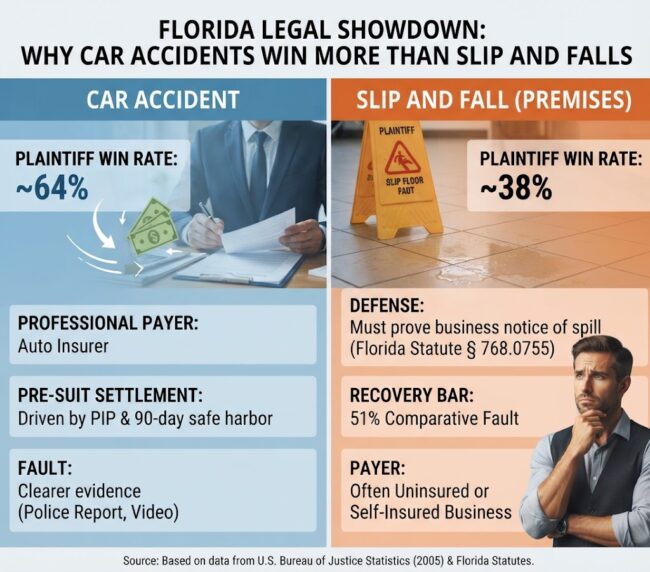
Car accident plaintiffs win far more often than slip and fall plaintiffs. National trial data shows roughly 64% vs. 38%. In Florida the gap is shaped by three things: the burden of proving a business knew about a spill, a 51% comparative fault bar, and who is paying the claim. That is usually an auto insurer in a car crash. In a slip and fall it is often the business itself.
Key Numbers at a Glance
| Measure | Car Accident | Slip and Fall (Premises) |
|---|---|---|
| Plaintiff trial win rate (BJS, 2005) | 64.3% | 38.4% |
| Plaintiff trial win rate (BJS, 1992) | 60.2% | 43.7% |
| Florida notice statute | None | § 768.0755 |
| Mandatory insurance behind defendant | $10K PIP + $10K PDL | None for most businesses |
| Filing deadline (post-HB 837) | 2 years | 2 years |
What the Data Shows
The only official national breakdown of plaintiff win rates by injury type comes from the U.S. Bureau of Justice Statistics. Its Civil Justice Survey of State Courts is the sole official national source, and its most recent data year is 2005. The pattern in that data is consistent.
In the 2005 survey, plaintiffs won 64.3% of motor vehicle trials but only 38.4% of premises liability trials. The gap was already there in 1992: auto plaintiffs won 60.2% of jury cases, while premises liability plaintiffs won 43.7%.
An academic review of decades of court data reached the same conclusion. Success rates in motor vehicle cases are always high, and the other personal injury categories fall between the extremes.
The data is old, but no newer national dataset has replaced it. The direction of the gap has held for more than three decades.
One important caveat: trial win rates only measure cases that did not settle. About 96% of personal injury cases are resolved before trial. The strongest car accident claims usually settle early, and many weak slip and fall claims are never filed. The trial numbers are a signal, not the full picture of recovery.
Why Slip and Fall Cases Are Harder to Win in Florida
The Notice Requirement
Florida adds a specific hurdle for slip and fall plaintiffs. Under Florida Statute § 768.0755, a person who slips on a transitory foreign substance in a business must prove the business had actual or constructive knowledge of the dangerous condition and should have fixed it.
Constructive knowledge can be shown in two ways. The plaintiff can show the condition existed long enough that the business should have known about it, or that it happened regularly and was foreseeable.
In practice, that means the injured shopper must often prove how long a spill was on the floor. Evidence like footprints, cart tracks, or drying edges can matter a great deal. Without it, many cases end before a jury ever hears them. Defense counsel have noted that the 2010 law allowed premises owners to resolve cases through summary judgment motions that were not previously available.
One defense-side review is telling. A search of published Florida transitory substance verdicts from July 2010 to August 2022 found 28 relevant verdicts, and the plaintiffs who won were able to show the defendants had some actual knowledge of the substance. Only three of those were plaintiff verdicts.
The 51% Comparative Fault Bar
Florida’s 2023 tort reform (HB 837) raised the stakes further. Since March 24, 2023, a plaintiff found more than 50% at fault recovers nothing. Before that, Florida was a pure comparative negligence state where even a 99%-at-fault plaintiff recovered something.
That rule hits slip and fall cases especially hard. Defense lawyers routinely argue that the person should have watched where they were walking. Businesses may be able to bar recovery entirely by proving a person’s failure to notice an open and obvious hazard made up more than half the negligence.
Car crashes are different. Traffic laws, police reports, dashcams, and Florida’s rebuttable presumption that a rear driver is at fault in a rear-end collision often make fault easier to assign.
The Shorter Clock
HB 837 also cut the statute of limitations for general negligence from four years to two. Slip and fall cases depend on evidence that disappears quickly, such as surveillance video, cleaning logs, and employee memories. The shorter window compresses the time to find it.
Who Pays: The Insurance Gap
Car Accidents Start With Insurance Money
Every Florida car accident case begins with an insurance system built to pay. Florida drivers must carry at least $10,000 in Personal Injury Protection (PIP) and $10,000 in Property Damage Liability to register a vehicle with four or more wheels. PIP pays the insured’s own medical expenses and 60% of lost wages regardless of fault, up to the $10,000 limit.
That means some money typically flows before anyone files a lawsuit. When the at-fault driver also carries bodily injury coverage, the claim moves to a professional adjuster whose job is to price and resolve claims.
HB 837 gave insurers a strong reason to move early. An insurer cannot face a bad faith action if it tenders the lesser of the policy limits or the amount demanded within 90 days after receiving actual notice of a claim with sufficient supporting evidence. A well-documented demand in a clear-liability crash often produces a pre-suit offer.
There is a catch. Florida law does not require bodily injury liability coverage on a standard private-passenger auto policy. In serious crashes, the size of the recovery is often capped by the available policy limits, not by the injury.
Slip and Fall Cases Often Face the Business Directly
Businesses face no equivalent mandate for most premises claims. Many small businesses go without coverage entirely. A 2026 ERGO NEXT survey found 25% of small businesses don’t have insurance, and among those without it, 54% said coverage is not legally required and 50% said it costs too much. An earlier Hiscox study found 35% of small businesses did not have general liability coverage.
When an uninsured business is sued, every dollar of defense and settlement comes out of the owner’s pocket. That creates a strong incentive to fight the claim, especially with the notice statute on the business’s side.
It also creates a collection problem for the plaintiff. A verdict against a thinly capitalized business with no policy may be difficult to collect. Contingency-fee lawyers weigh that risk before taking a case, which filters many slip and fall claims out before they start.
Large retailers present a different version of the same dynamic. Many carry high deductibles or self-insure a large portion of their risk. They defend premises claims in-house or through dedicated defense counsel, and they have strong reasons to avoid a reputation for paying easy settlements.
Car Accident vs. Slip and Fall: Side-by-Side
| Factor | Car Accident | Slip and Fall |
|---|---|---|
| Proof of fault | Police report, traffic law, video | Must prove business knew of hazard |
| Plaintiff fault argument | Sometimes | Almost always (“watch your step”) |
| First money | PIP, no-fault | None |
| Who negotiates | Insurance adjuster | Often the owner or self-insured retailer |
| Early offer incentive | 90-day bad faith safe harbor | Weak or none |
| Main recovery limit | Policy limits | Proof and collectability |
Brian’s Take
The injury type is really a proxy for two structural questions: how hard it is to prove fault, and whether there is a professional payer on the other side.
Car accidents score well on both. Florida’s no-fault system and the 90-day safe harbor push money toward claimants early, sometimes before a lawyer files anything. The real ceiling is the policy limit, and in a state that doesn’t require bodily injury coverage, that ceiling can be low.
Slip and fall cases score poorly on both. The notice statute puts the burden squarely on the injured person, the 51% bar gives defendants a second path to a zero, and the payer is frequently the business owner. An uninsured business has every reason to fight, and a plaintiff’s lawyer has every reason to ask whether a win is collectible.
For Florida law firms, the takeaway is practical. Slip and fall intake should focus early on notice evidence and on whether the defendant has coverage. For businesses, the lesson is that going without general liability doesn’t avoid a claim. It just means the owner pays the defense bill personally.
Frequently Asked Questions
Are slip and fall cases harder to win than car accident cases?
Yes. National Bureau of Justice Statistics data shows plaintiffs won about 64% of car accident trials and about 38% of premises liability trials. Florida’s notice statute and 51% fault bar add further hurdles for slip and fall plaintiffs.
What must I prove in a Florida slip and fall case?
For a spill or substance in a business, you must prove the business actually knew about it or should have known because it was there long enough or happened regularly. This is required under Florida Statute § 768.0755.
Why do car insurers offer money before a lawsuit?
PIP pays part of medical bills and lost wages regardless of fault. In addition, Florida’s 90-day bad faith safe harbor encourages liability insurers to tender the lesser of policy limits or the demand quickly when a claim is well documented.
Are Florida businesses required to carry liability insurance?
Most Florida businesses are not required by state law to carry general liability insurance, though certain licensed trades and contracts require it. Surveys show a significant share of small businesses go without it.
How long do I have to file a personal injury lawsuit in Florida?
For most negligence claims arising after March 24, 2023, the deadline is two years under Florida Statute § 95.11.
Can I recover if I was partly at fault?
Yes, if you are 50% or less at fault. Your recovery is reduced by your share of fault. If you are more than 50% at fault, you recover nothing under Florida’s modified comparative negligence rule.
This article is for informational purposes only and is not legal advice. Consult a licensed Florida attorney about your specific situation.
Sources and Further Reading
- U.S. Bureau of Justice Statistics, Civil Bench and Jury Trials in State Courts, 2005 — https://bjs.ojp.gov/content/pub/pdf/cbjtsc05.pdf
- U.S. Bureau of Justice Statistics, Civil Jury Cases and Verdicts in Large Counties (1992 data) — https://www.ojp.gov/sites/g/files/xyckuh241/files/media/document/cjcavilc.pdf
- Fair Settlement, “Personal Injury Win Rates by Case Type” — https://fairsettlement.org/blog/personal-injury-win-rates-by-case-type
- Seattle University Law Review, “Litigation Outcomes in State and Federal Courts: A Statistical Portrait” — https://digitalcommons.law.seattleu.edu/cgi/viewcontent.cgi?article=1481&context=sulr
- The 2026 Florida Statutes, § 768.0755 — https://www.leg.state.fl.us/Statutes/index.cfm?App_mode=Display_Statute&URL=0700-0799%2F0768%2FSections%2F0768.0755.html
- Rumberger, Kirk & Caldwell, “A Look Back at the Transitory Foreign Substance Statute” — https://www.rumberger.com/insights/a-look-back-at-the-transitory-foreign-substance-statute/
- Florida Senate, CS/CS/HB 837 Final Bill Analysis — https://flsenate.gov/Session/Bill/2023/837/Analyses/h0837z.CJS.PDF
- Troutman Pepper Locke, “Recent Tort Reforms Expected to Have Major Impact on Insurance Litigation in Florida” — https://www.troutman.com/insights/recent-tort-reforms-expected-to-have-major-impact-on-insurance-litigation-in-florida/
- HOV Law, “Florida Comparative Negligence: The 51% Rule Explained” — https://www.hov.law/learn/florida-comparative-negligence
- The Insurance Alliance, “Why Everyone Is Talking About Florida’s Modified Comparative Fault” — https://www.theinsalliance.com/post/why-everyone-is-talking-about-florida-s-modified-comparative-fault-and-your-business-should-too
- Finhabits, “Car Insurance Requirements in Florida” — https://www.finhabits.com/car-insurance-requirements-in-florida-minimums-proof-penalties/
- Atesa Risk Advisors, “Florida Auto Insurance Guide: PIP, BI & UM in 2026” — https://atesariskadvisors.com/blog/florida-auto-insurance-pip-bodily-injury-guide
- Cheney Free Press, “Report: 82% of New Small Businesses Have Insurance” (ERGO NEXT 2026 survey) — https://www.cheneyfreepress.com/story/2026/08/13/news/report-82-percent-of-new-small-businesses-have-insurance-but-many-smbs-remain-at-risk/45220.html
- Hiscox, “Three out of Four Small Businesses in the US Aren’t Protected Against Claims” — https://www.hiscox.com/articles/hiscox-three-out-four-small-businesses-us-arent-protected-against-claims
About the Author