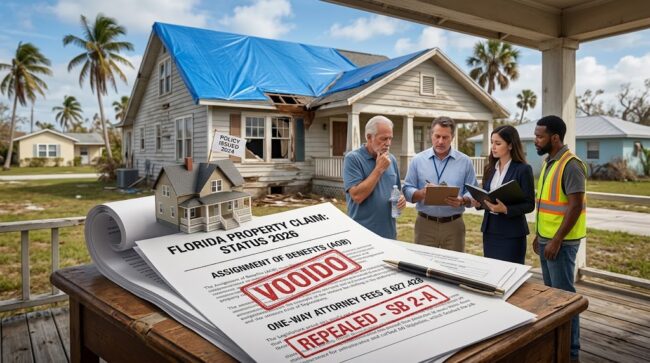
Quick Answer: Florida property insurance disputes no longer carry one-way attorney fees. Senate Bill 2-A, signed December 16, 2022, repealed the fee-shifting statutes for residential and commercial property claims and prohibited assignment of benefits (AOB) on any policy issued on or after January 1, 2023. Each side now pays its own lawyer unless fees are triggered under the offer-of-judgment statute, which runs in both directions. Bad-faith suits cannot be filed until a court or arbitrator has ruled against the insurer on the underlying claim. Attempts to restore fee-shifting in 2025 died in the Legislature, and the framework remains fully in force as of September 2026.
Why the 2022 Reforms Happened
The Legislature acted on a single set of statistics. The reforms are the Legislature’s response to figures that show Florida accounts for 7% of all property insurance claims, but generates 74% of all property insurance lawsuits. Two special sessions in 2022 produced the fix: SB 2-D in May, which created a state reinsurance backstop and curbed AOB litigation, and SB 2-A in December, which finished the job.
The House voted 84-33, with Democrats opposed, on December 14 to give final approval to SB 2A, a measure that includes a heavy dose of “tort reform” and appropriates $1 billion in subsidized reinsurance for private companies. DeSantis signed the measure December 16.
| Bill | Signed | Key change |
|---|---|---|
| SB 2-D | May 2022 | No fees for AOB assignees; RAP reinsurance |
| SB 2-A | Dec 2022 | One-way fees repealed; AOB banned |
| HB 837 | Mar 2023 | Bad-faith and negligence reforms |
The End of One-Way Attorney Fees
For roughly a century, § 627.428 required an insurer that lost to pay the policyholder’s lawyer, with no reciprocal exposure for the policyholder. SB 2-A removed that. The bill provides that the one-way attorney fee provisions of s. 627.428, s. 626.9373, and s. 627.70152 are not applicable in a suit arising under a residential or commercial property insurance policy. Section 626.9373 covered surplus lines carriers; § 627.70152 had set the fee-calculation formula.
What replaced it is a two-way mechanism. Though SB 2-A eliminates one-way attorney’s fees, it reinstates application of the offer-of-judgment statute to civil actions arising under a residential or commercial property insurance policy. Under § 768.79, either party can serve a proposal for settlement; if the final judgment beats the offer by the statutory margin (25%), the offering party recovers fees from that point forward. Insurers can now use this tool against policyholders, which is the practical reason claim litigation volume has fallen.
Is the repeal retroactive?
This was the first major fight. Insurers argued that the new statute should be applied retroactively, blocking insurers’ payment of most attorney fees in cases that began long before SB 2A was signed into law. Florida courts have largely rejected that position, applying the repeal to policies issued or renewed after the effective date rather than to claims already in litigation. The practical result is a shrinking tail of pre-2023 policies where fee entitlement still exists.
The AOB Prohibition
An assignment of benefits let a roofer, water-mitigation firm, or public adjuster take over the policyholder’s claim rights and sue the insurer directly. SB 2-D removed the fee incentive for assignees; SB 2-A ended the practice. SB 2-A prohibits the assignment, in whole or in part, of any post-loss insurance benefit under any residential property insurance policy or commercial property insurance policy issued on or after January 1, 2023.
Any AOB executed under a post-2023 policy is void. Contractors can still be paid by the policyholder and can still be listed as a payee on a claim check with the homeowner’s consent, but they cannot step into the insured’s shoes to demand payment or file suit.
| Practice | Pre-2023 policy | Policy issued 2023+ |
|---|---|---|
| Contractor AOB | Valid, limited fees | Void |
| Direction to pay | Allowed | Allowed |
| Assignee lawsuit | Allowed, no fees | Not allowed |
Bad-Faith Litigation After SB 2-A and HB 837
Bad-faith claims under § 624.155 were a second pressure point. SB 2-A requires a final judgment or decree of an adverse adjudication to have been rendered against the insurer before the filing of a bad faith action. A policyholder can no longer file a civil remedy notice and a bad-faith count alongside a breach-of-contract claim; the coverage dispute must be resolved first, and an insurer’s payment of the claim is not by itself evidence of bad faith.
HB 837 in 2023 added a safe harbor for insurers that tender policy limits within 90 days of receiving actual notice of a claim with sufficient supporting evidence, and set a negligence standard that mere negligence alone is not enough for bad faith. Together, the two laws pushed most bad-faith exposure to the end of a fully litigated claim, sharply reducing settlement leverage.
Other SB 2-A Changes Policyholders Feel After a Storm
The litigation provisions get the attention, but the claims-handling changes matter more on the ground after a hurricane.
- Claim notice deadline: initial claims must be reported within one year of the loss and supplemental claims within 18 months, down from two and three years respectively.
- Prompt-pay clock: insurers must pay or deny within 60 days of proof-of-loss, reduced from 90 days, and begin inspection within 30 days.
- Mandatory arbitration endorsements: SB 2-A allows for mandatory binding arbitration clauses in policies. Insurers must also provide an appropriate premium discount in exchange for the rights ceded by the policyholder.
- Flood coverage for Citizens: Citizens policyholders are being phased into a flood-insurance requirement through 2027.
Attempts to Reverse the Reforms
The policyholder bar has pushed back each session. House Bill 1551 (2025) was approved by the House Civil Justice & Claims Subcommittee, and its sponsor described it as aiming to strike a “prevailing party” standard — colloquially, a loser-pays or two-way fee approach where whichever side prevails in judgment could recover reasonable attorney fees. Industry groups treated it as one-way fees by another name, warning of a return to the market conditions of 2021.
The bill did not survive. Its last action was in June 2025, when it died in the House Judiciary Committee, and the Senate companion, SB 554, met the same fate. No 2026 legislation altered the fee or AOB provisions, so the December 2022 framework is the law heading into the 2027 session.
What the Data Shows
Market indicators have moved the way the sponsors predicted. By eliminating one-way attorney fees, restricting AOB abuse, and shortening the claims filing window, these reforms have driven insurance litigation filings down more than 35% cumulatively. Carriers are seeing lower claims costs, and they’re starting to pass those savings through to premiums. Critics counter that fewer suits also means fewer challenges to wrongful denials, and that the burden has shifted to policyholders who now must fund their own counsel or accept lower settlements.
Practical Guidance
For policyholders
- Report any loss within one year, in writing, even if the damage seems minor.
- Do not sign any document from a contractor that assigns “benefits,” “proceeds,” or “rights” under the policy; it is void and may delay payment.
- Hire counsel on a contingency or hybrid basis and ask specifically how a proposal for settlement from the insurer will be handled.
- Serve your own proposal for settlement early; it is now the only statutory path to fee recovery.
For contractors and restoration firms
- Use a direct-pay authorization and a written contract with the homeowner, not an AOB.
- Expect to pursue the homeowner, not the carrier, for unpaid balances.
- Keep emergency-services invoices itemized; insurers still must pay reasonable mitigation costs to the insured.
For litigators
- Confirm the policy issue date before pleading any fee entitlement.
- Plead breach of contract only; bad faith waits for an adverse adjudication.
- Calendar the 60-day prompt-pay deadline, since a missed deadline remains admissible in a later bad-faith action.
This article is general information, not legal advice. Consult a Florida insurance attorney about a specific claim or policy.
Sources and Further Reading
- Florida Senate, 2022-A Special Session Bill Summary, SB 2-A – https://www.flsenate.gov/Committees/BillSummaries/2022A/html/2
- The Florida Bar News, “Legislature passes property insurance package,” Dec. 16, 2022 – https://www.floridabar.org/the-florida-bar-news/legislature-passes-property-insurance-package/
- Clyde & Co, “Historic Florida Insurance Reforms Under SB 2-A,” Mar. 2023 – https://www.clydeco.com/en/insights/2023/03/historic-florida-insurance-reforms-under-sb-2-a
- Insurance Journal, “Florida’s SB 2A Ended One-Way Legal Fees. Now Some Insurers Say it’s Retroactive,” Mar. 1, 2023 – https://www.insurancejournal.com/news/southeast/2023/03/01/709901.htm
- Florida Senate, HB 1551 (2025) bill history – https://www.flsenate.gov/Session/Bill/2025/1551
- Florida Politics, “House advances ‘loser pays’ rules for insurance lawsuits,” Mar. 2025 – https://floridapolitics.com/archives/727545-everybody-now-has-skin-in-this-game-house-advances-loser-pays-rules-for-insurance-lawsuits/
- RumbergerKirk, “Legislative Alert: Florida’s HB 1551 and SB 554,” May 2025 – https://www.rumberger.com/insights/legislative-alert-floridas-hb-1551-and-sb-554-raise-concerns-for-insurance-carriers/
- Donner Law Firm, “The Current State of First-Party Property Insurance Litigation in Florida,” Feb. 2026 – https://donnerlawfirm.attorney/2026/02/04/the-current-state-of-first-party-property-insurance-litigation-in-floridawith-a-focus-on-fee-shifting-and-legislative-developments/
- Greene & Associates, “Florida Insurance Market Report 2026” – https://www.greeneinsurance.com/guides/florida-insurance-market-2026
- Florida Statutes § 627.428, § 627.7152, § 627.70152, § 624.155, and § 768.79 – http://www.leg.state.fl.us/statutes/
About the Author