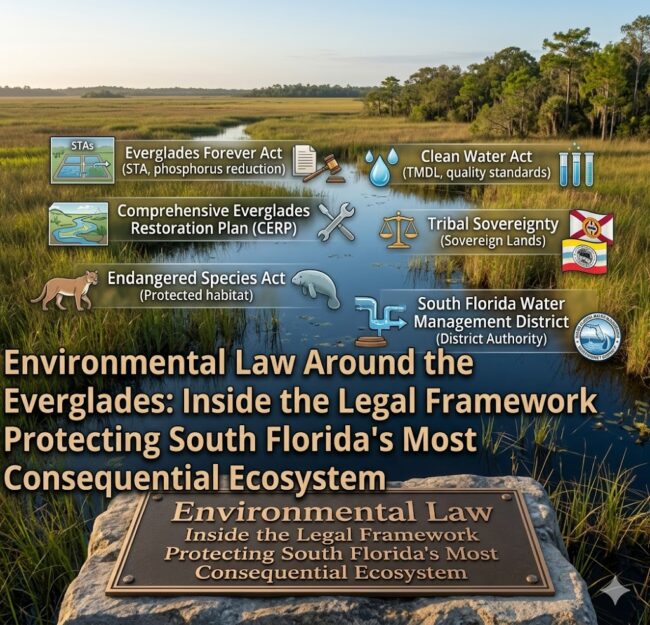
Environmental Law Around the Everglades: Inside the Legal Framework Protecting South Florida’s Most Consequential Ecosystem
There’s a particular drive across Alligator Alley — the stretch of I-75 connecting Naples to Fort Lauderdale — where you can see something genuinely remarkable if you know what you’re looking at.
Mile after mile of sawgrass prairie extending to the horizon. Hardwood hammocks rising like islands from the wetlands. Cypress domes marking subtle elevation changes. Wading birds — herons, egrets, ibis, roseate spoonbills — feeding in the shallow waters. Alligators basking on canal banks. Occasional sightings of Florida panthers crossing wildlife corridors specifically engineered into the highway infrastructure. The vast water-and-grass landscape that Marjory Stoneman Douglas famously called “the river of grass” stretching across approximately 1.5 million acres of protected ecosystem.
What you’re looking at isn’t just a landscape. It’s the result of one of the most complex, contested, and consequential environmental legal frameworks operating anywhere in the United States — a multi-decade legal architecture involving federal law, Florida state law, tribal sovereignty, water management districts, agricultural interests, urban development pressures, indigenous rights, endangered species protection, federal court oversight, international scientific recognition, and the continued tension between competing interests that has shaped how the Everglades ecosystem exists today and what its future will look like.
This article walks through the environmental legal framework protecting the Everglades — what laws actually govern this extraordinary South Florida ecosystem, how the legal architecture has evolved across decades, the ongoing legal disputes and restoration efforts shaping the ecosystem’s future, and what the broader Everglades legal story reveals about how American environmental law actually operates when applied to one of the most consequential ecosystems in the United States.
This article is for informational and educational purposes only and is not legal, environmental, or regulatory advice. Environmental law involves complex federal, state, local, and tribal regulations that vary substantially based on specific circumstances. Always consult qualified licensed environmental attorneys and qualified environmental consultants for specific matters affecting your business, property, or activities.
Why the Everglades Matters: The Ecological Context
Before exploring the legal framework, the broader ecological significance of the Everglades deserves attention.
The Everglades represents one of the most distinctive ecosystems on Earth — a subtropical wetland complex that historically extended from approximately Lake Okeechobee south to Florida Bay, covering roughly 4,000 square miles of interconnected sawgrass prairies, hardwood hammocks, cypress swamps, mangrove forests, and coastal estuaries. The system functions as a slow-moving sheet flow of water moving south through the Florida peninsula, fed by rainfall, Lake Okeechobee overflow, and the Kissimmee River system flowing south from Central Florida.
The ecosystem supports remarkable biodiversity including:
Endangered and Threatened Species
The Everglades provides essential habitat for multiple endangered and threatened species including the Florida panther (Puma concolor coryi), the West Indian manatee, the American crocodile, multiple sea turtle species, the Cape Sable seaside sparrow, the snail kite, the wood stork, and dozens of additional species protected under the federal Endangered Species Act.
Migratory Bird Populations
The system supports vast populations of wading birds, waterfowl, and migratory species using the ecosystem for nesting, feeding, and seasonal migration support.
Aquatic Ecosystem Diversity
The interconnected freshwater, brackish, and saltwater systems support extraordinary aquatic biodiversity including fish, crustaceans, mollusks, and the broader food web supporting larger species.
Plant Diversity
The ecosystem supports thousands of plant species including the distinctive sawgrass that defines much of the landscape, hundreds of orchid species, and the broader plant communities that distinguish the system globally.
Hydrologic Function
Beyond pure biodiversity, the Everglades system provides essential hydrologic function for South Florida — including aquifer recharge supporting drinking water supply for millions of South Florida residents, flood mitigation, water quality treatment, and the broader water resource management that affects the entire region.
Climate Resilience
The ecosystem provides substantial climate resilience benefits including carbon sequestration, storm surge mitigation, freshwater storage, and broader ecosystem services that affect South Florida’s climate vulnerability.
International Recognition
The ecological significance of the Everglades is reflected in multiple international designations:
- UNESCO World Heritage Site designation (Everglades National Park, 1979)
- UNESCO Biosphere Reserve designation
- Wetland of International Importance under the Ramsar Convention
- International Biosphere Reserve status
These international designations don’t directly create legal obligations under American law but reflect the genuine global recognition of the ecosystem’s ecological significance.
Brian’s Take: The Everglades Represents One of the Most Consequential American Ecosystems and One of the Most Legally Complex Environmental Protection Challenges in the Country.
Few American ecosystems combine the ecological significance, the legal complexity, the competing stakeholder interests, the historical degradation, and the active restoration efforts that characterize the Everglades. The legal framework protecting the system has developed across decades through federal legislation, state legislation, federal court oversight, water management district regulations, tribal sovereignty considerations, and the continued tension between competing interests. Florida residents, businesses, and observers paying attention to environmental and regulatory dynamics affecting the state benefit enormously from understanding how the Everglades legal framework actually works — because the dynamics that shape Everglades regulation increasingly affect environmental regulation across South Florida and beyond.
— Brian
The Federal Legal Framework
The federal legal framework protecting the Everglades operates across multiple distinct legal authorities.
Everglades National Park Act of 1934
The foundational federal protection began with the Everglades National Park Act of 1934, which authorized the establishment of Everglades National Park. The park was formally dedicated in 1947 and now encompasses approximately 1.5 million acres of the southern Everglades ecosystem — representing the third-largest national park in the contiguous United States and one of the most ecologically significant protected areas in the world.
National Park Service jurisdiction over Everglades National Park provides comprehensive federal protection over the lands within park boundaries, with regulations governing visitor activities, commercial operations, scientific research, and the broader management of park resources.
The Endangered Species Act
The federal Endangered Species Act of 1973 provides essential protection for the multiple endangered and threatened species depending on Everglades habitat. The Act:
- Prohibits “take” (broadly defined) of listed species
- Requires federal agencies to consult with the U.S. Fish and Wildlife Service or NOAA Fisheries on actions affecting listed species
- Provides for designation of critical habitat
- Supports recovery planning and implementation
- Creates substantial regulatory framework affecting development, water management, and broader activities potentially impacting protected species
The Endangered Species Act’s application to Everglades ecosystem species — including the Florida panther, manatee, American crocodile, multiple sea turtles, and various bird species — creates substantial regulatory considerations affecting development and water management decisions across South Florida.
The Clean Water Act
The federal Clean Water Act provides foundational legal authority addressing water quality, wetlands protection, and broader water-related environmental considerations affecting the Everglades ecosystem. Key provisions include:
- Section 404 governing dredge-and-fill activities in waters of the United States including wetlands
- Section 402 governing discharge of pollutants through the National Pollutant Discharge Elimination System (NPDES)
- Section 303(d) addressing water quality impaired waters
- Total Maximum Daily Load (TMDL) requirements for impaired waters
The Clean Water Act’s application to South Florida waters has produced substantial regulatory complexity, including major federal court litigation over water quality standards affecting the Everglades.
The Comprehensive Everglades Restoration Plan (CERP)
The Water Resources Development Act of 2000 authorized the Comprehensive Everglades Restoration Plan (CERP) — one of the largest ecosystem restoration efforts ever undertaken anywhere in the world. CERP represents a 30+ year, multi-billion-dollar federal-state partnership to restore, protect, and preserve the South Florida ecosystem while providing for water-related needs of the region.
CERP includes more than 60 separate construction projects covering approximately 18,000 square miles, with goals including:
- Restoring more natural water flows through the ecosystem
- Improving water quality
- Enhancing habitat for native plants and wildlife
- Providing water supply for South Florida residents
- Supporting flood control needs
- Preserving and restoring ecosystem functions
The CERP framework operates as the primary federal-state restoration architecture, with specific projects and program components governed by additional federal authorizations and appropriations.
Other Federal Environmental Authorities
Additional federal environmental authorities affecting the Everglades include:
- National Environmental Policy Act (NEPA) requiring environmental impact analysis for federal actions
- Marine Mammal Protection Act providing protection for manatees and other marine mammals
- Migratory Bird Treaty Act protecting migratory bird species
- Rivers and Harbors Act governing certain water-related activities
- Federal Power Act addressing certain water management considerations
Brian’s Take: The Federal Legal Architecture Protecting the Everglades Represents One of the Most Comprehensive American Environmental Regulatory Frameworks Ever Developed.
The combination of federal national park protection, Endangered Species Act application, Clean Water Act regulation, the unprecedented Comprehensive Everglades Restoration Plan, and multiple additional federal environmental authorities creates regulatory architecture that few American ecosystems experience at equivalent comprehensiveness. The complexity reflects both the ecological significance of the Everglades and the substantial historical degradation requiring active restoration. Florida operators across multiple industries — including agriculture, real estate development, water management, and broader economic activities affecting South Florida — increasingly need sophisticated understanding of how this federal regulatory framework affects their operations.
— Brian
The Florida State Legal Framework
Florida state law adds substantial environmental protection authority operating alongside federal law.
Florida Constitution
The Florida Constitution includes provisions affecting environmental protection, including Article II, Section 7, which establishes that “It shall be the policy of the state to conserve and protect its natural resources and scenic beauty. Adequate provision shall be made by law for the abatement of air and water pollution and of excessive and unnecessary noise…”
Constitutional provisions affecting Everglades restoration specifically include:
Constitutional Amendment 5 (1996) — establishing Everglades restoration funding requirements and water quality standards specifically addressing Everglades pollution
Florida Statutes
Substantial Florida statutes affect Everglades environmental protection, including:
- Chapter 373 governing water resource management
- Chapter 403 governing environmental control and pollution
- Chapter 369 establishing the Everglades Forever Act
- Chapter 380 governing land planning and regional planning councils
- Chapter 379 addressing fish and wildlife conservation
- Chapter 253 addressing state lands
The Everglades Forever Act
The Everglades Forever Act (Florida Statute Chapter 369) represents distinctive Florida legislation specifically focused on Everglades restoration. The Act:
- Establishes water quality standards for waters discharged to the Everglades Protection Area
- Requires substantial water quality improvements
- Authorizes Stormwater Treatment Areas (STAs) — large constructed wetlands designed to remove phosphorus from agricultural drainage water before it enters the Everglades
- Establishes funding and implementation requirements
- Addresses long-term restoration commitments
South Florida Water Management District
The South Florida Water Management District (SFWMD) operates as a regional government agency with substantial authority over water resources across 16 counties from Orlando south to the Florida Keys. The District:
- Manages water supply for approximately 9 million South Florida residents
- Operates water management infrastructure including levees, canals, pump stations, and water conservation areas
- Implements substantial Everglades restoration projects
- Issues permits for water use, environmental impacts, and broader water-related activities
- Regulates the Everglades Agricultural Area and broader regional water management
The SFWMD’s regulatory authority makes it one of the most consequential single agencies affecting Everglades protection in practice.
Florida Department of Environmental Protection
The Florida Department of Environmental Protection (FDEP) operates as the primary state environmental regulatory agency, with substantial authority affecting Everglades protection through:
- Water quality standard implementation
- Environmental permitting
- Enforcement actions
- Long-term planning and policy development
- Coordination with federal environmental authorities
Florida Fish and Wildlife Conservation Commission
The Florida Fish and Wildlife Conservation Commission addresses fish and wildlife management affecting the Everglades, including listed species protection, habitat management, and broader conservation activities.
Tribal Sovereignty and the Everglades
The legal framework affecting the Everglades includes substantial tribal sovereignty considerations, with two federally recognized tribes maintaining substantial connections to the ecosystem.
The Seminole Tribe of Florida
The Seminole Tribe of Florida holds reservation lands including substantial acreage within the broader Everglades ecosystem, with sovereign authority over these lands creating distinctive legal considerations. The Tribe has been an active participant in Everglades restoration discussions, with substantial interests in water quality, water flow, and ecosystem health affecting tribal lands and traditional cultural practices.
The Miccosukee Tribe of Indians of Florida
The Miccosukee Tribe similarly maintains reservation lands within the Everglades ecosystem, with sovereign authority and substantial interests in ecosystem protection and restoration. The Miccosukee Tribe has been particularly active in environmental advocacy and litigation concerning Everglades water quality, including major federal court litigation that has shaped how water quality standards apply to the ecosystem.
Tribal-Federal-State Coordination
The interaction between federal, state, and tribal authorities affecting the Everglades creates distinctive coordination requirements, with implications for environmental decision-making that few other American ecosystems experience at equivalent complexity.
Major Legal Disputes and Litigation
The legal framework affecting the Everglades has been substantially shaped by major federal court litigation across decades.
The 1988 Federal Water Quality Lawsuit
The federal government filed suit against the State of Florida in 1988, alleging that the State had failed to enforce its own water quality standards regarding phosphorus pollution flowing from agricultural areas into the Everglades. The litigation produced a 1992 settlement requiring substantial water quality improvements and forming the foundation for subsequent Everglades restoration efforts.
Continued Water Quality Litigation
Subsequent federal court litigation has continued addressing water quality compliance, with multiple federal court orders affecting how phosphorus pollution standards apply to waters entering the Everglades and how restoration efforts must proceed.
Endangered Species Litigation
Various federal court litigation has addressed endangered species considerations affecting Everglades restoration, water management, and broader regulatory decisions, including the application of Endangered Species Act requirements to specific projects and water management decisions.
Tribal Litigation
The Miccosukee Tribe and other tribal interests have engaged in substantial federal court litigation addressing water quality, water management, and broader environmental considerations affecting tribal lands within the Everglades.
Continued Active Litigation
The Everglades legal framework continues evolving through active litigation addressing specific regulatory decisions, restoration project implementation, and broader environmental compliance considerations.
Brian’s Take: The Multi-Decade Federal Court Oversight of Everglades Water Quality Represents One of the Most Consequential American Environmental Litigation Stories.
The 1988 federal water quality lawsuit and subsequent decades of federal court oversight have fundamentally shaped how Everglades restoration has actually proceeded, with implications extending beyond the Everglades specifically to broader American environmental regulation. The willingness of federal courts to actively oversee state regulatory implementation across decades represents a distinctive aspect of how American environmental law actually operates when state regulatory frameworks face challenges adequate to ecosystem protection needs. Florida operators across multiple industries should understand this dynamic because the federal court oversight of Everglades water quality has substantial implications for how environmental regulation continues developing across South Florida.
— Brian
The Comprehensive Everglades Restoration Plan in Practice
CERP represents the operational restoration framework affecting most active Everglades work today.
The Federal-State Partnership
CERP operates as a 50/50 federal-state partnership, with the U.S. Army Corps of Engineers and the South Florida Water Management District serving as primary implementing agencies. The partnership requires substantial coordination across federal and state authorities, environmental considerations, and broader stakeholder interests.
Major CERP Components
CERP includes major restoration components including:
Storage Infrastructure
Construction of substantial water storage capacity including reservoirs, aquifer storage and recovery wells, and other infrastructure designed to capture and store water for environmental and water supply needs.
Stormwater Treatment Areas (STAs)
Substantial constructed wetlands designed to remove phosphorus and other pollutants from water before discharge to the Everglades Protection Area.
Flow Restoration Projects
Projects designed to restore more natural water flows through the ecosystem, including infrastructure modifications that allow water to move more naturally through the landscape rather than being constrained by historical drainage and flood control infrastructure.
Habitat Restoration
Specific projects addressing habitat restoration for threatened and endangered species and broader ecosystem health.
Coastal and Estuary Restoration
Restoration of coastal and estuarine areas including Florida Bay, Biscayne Bay, and other coastal systems affected by upstream water management.
Implementation Challenges
CERP implementation has faced substantial challenges including:
- Federal funding inconsistency affecting project progression
- Cost increases beyond original estimates
- Technical complexity of unprecedented ecosystem restoration
- Stakeholder coordination across competing interests
- Climate change considerations affecting restoration planning
- Continued regulatory disputes affecting project implementation
Despite challenges, CERP continues progressing with substantial completed and ongoing projects representing some of the most ambitious ecosystem restoration work ever undertaken.
Current Issues Shaping Everglades Environmental Law
Several current issues continue shaping the Everglades environmental legal framework.
Climate Change Considerations
Climate change affects the Everglades ecosystem substantially through sea level rise, changing precipitation patterns, increased storm intensity, ecosystem composition changes, and broader climate-related dynamics. The legal framework continues evolving to address climate considerations including:
- Sea level rise affecting coastal Everglades and water management infrastructure
- Hydrologic changes affecting ecosystem function
- Species distribution changes affecting endangered species considerations
- Restoration planning incorporating climate resilience considerations
Water Quality Continued Compliance
Continued water quality compliance challenges, particularly regarding phosphorus pollution from agricultural areas, continue affecting the legal framework through ongoing regulatory implementation, federal court oversight, and continued advocacy from environmental and tribal stakeholders.
Agricultural Interests
The substantial agricultural operations in the Everglades Agricultural Area (EAA) — including major sugarcane operations and other agricultural activities — continue creating legal complexity through water quality considerations, water use considerations, and broader regulatory frameworks affecting these operations.
Urban Development Pressures
Continued South Florida urban development continues creating pressure on Everglades-adjacent lands, water resources, and broader ecosystem considerations. Land use planning, water supply considerations, and broader regulatory frameworks affect how development proceeds in proximity to the ecosystem.
Invasive Species
Invasive species — particularly the Burmese python, but also numerous plant and animal species — continue affecting ecosystem health and creating legal considerations for management, eradication, and broader response activities.
Funding Considerations
Continued funding for restoration, management, regulatory implementation, and broader ecosystem protection continues affecting how the legal framework operates in practice, with implications for project progression and long-term restoration outcomes.
Scientific Research and Monitoring
Continued scientific research and monitoring affects the legal framework by informing regulatory decisions, restoration planning, and broader environmental management based on evolving scientific understanding.
Stakeholder Coordination
Continued coordination across federal, state, tribal, agricultural, urban, environmental, and other stakeholder interests continues shaping how the legal framework actually operates in practice.
What This Means for South Florida Residents and Businesses
The Everglades environmental legal framework affects South Florida residents and businesses across multiple dimensions.
Water Supply
The legal framework substantially affects how water supply for approximately 9 million South Florida residents is managed, with implications for water rates, water availability, and broader water resource considerations.
Real Estate Development
Real estate development across South Florida operates within the regulatory framework affecting Everglades-adjacent areas, with implications for development timelines, project economics, and broader real estate market dynamics.
Agricultural Operations
The substantial agricultural operations in the Everglades Agricultural Area operate within the regulatory framework affecting water quality, water use, and broader agricultural activities.
Tourism and Recreation
The Everglades National Park, Big Cypress National Preserve, and broader protected areas support substantial tourism and recreation activity contributing to South Florida’s economy.
Insurance and Risk Management
The hydrologic functions of the Everglades affect flood control, storm surge mitigation, and broader risk management considerations affecting insurance markets and property values.
Environmental Services
The continued ecosystem services provided by the Everglades — including water quality treatment, flood mitigation, climate resilience, and biodiversity support — affect South Florida’s broader environmental health and economic sustainability.
Tribal Economic Activities
The Seminole and Miccosukee Tribes’ economic activities, including substantial gaming operations, retail, agriculture, and other activities, operate within the broader legal and environmental framework affecting tribal lands within the Everglades ecosystem.
Climate Resilience
The continued ecosystem function of the Everglades affects South Florida’s climate resilience including storm surge protection, flood mitigation, and broader climate-related considerations affecting the region’s long-term viability.
Brian’s Take: Florida Operators Should Pay More Attention to How Environmental Law Around the Everglades Affects Broader South Florida Business and Property Considerations.
Most South Florida residents and businesses don’t fully appreciate how substantially the Everglades environmental legal framework affects their daily lives, business operations, property values, and broader economic conditions. The water flowing from your tap, the flood insurance affecting your property, the agricultural products available in regional markets, the tourism industry supporting regional economic activity, the climate resilience affecting long-term property values — all are affected substantially by how the environmental legal framework continues operating around the Everglades. Florida operators across multiple industries benefit from developing genuine understanding of how this environmental regulatory framework actually works rather than treating it as background context that doesn’t affect their specific situations.
— Brian
What Comes Next: The Continued Evolution of Everglades Environmental Law
Several trends will shape Everglades environmental law across the next decade.
Continued Restoration Progress
CERP and additional restoration efforts will continue progressing through major project implementation, with implications for water flows, water quality, ecosystem health, and broader regulatory considerations.
Climate Adaptation
Continued climate adaptation in restoration planning, regulatory implementation, and broader environmental management will continue evolving as climate impacts become more pronounced.
Federal-State-Tribal Coordination
The continued coordination across federal, state, and tribal authorities will continue evolving as new restoration projects, regulatory issues, and broader environmental considerations require updated coordination frameworks.
Continued Regulatory Evolution
The regulatory framework will continue evolving through new federal and state legislation, regulatory rulemaking, federal court decisions, and broader policy developments affecting Everglades protection.
Scientific Understanding Evolution
Continued scientific research will continue informing the regulatory framework through evolving understanding of ecosystem function, restoration effectiveness, climate impacts, and broader environmental considerations.
Funding Considerations
Continued funding considerations will continue affecting how the legal framework operates in practice, with implications for restoration progression and long-term ecosystem outcomes.
Stakeholder Engagement
Continued stakeholder engagement across environmental, agricultural, urban, tribal, and other interests will continue shaping how the legal framework actually operates.
Technology Integration
Continued technology integration in monitoring, modeling, restoration implementation, and broader environmental management will continue affecting how the legal framework operates in practice.
Continued Litigation
The legal framework will continue developing through continued federal court litigation addressing specific regulatory decisions, project implementation, and broader environmental compliance considerations.
The Bottom Line: One of America’s Most Consequential Environmental Legal Frameworks
The environmental legal framework protecting the Everglades represents one of the most comprehensive American environmental regulatory architectures operating today — combining federal national park protection, federal endangered species and water quality regulation, the unprecedented Comprehensive Everglades Restoration Plan, substantial Florida state environmental authority, water management district regulation, tribal sovereignty considerations, multi-decade federal court oversight, and continued evolution through active litigation, regulatory rulemaking, and broader policy development.
For South Florida residents, the framework affects daily life through water supply, flood protection, ecosystem services, tourism opportunities, and broader environmental quality.
For South Florida businesses, the framework creates regulatory considerations affecting development, agriculture, water-intensive operations, and broader economic activities while also creating opportunities through restoration project participation, environmental services, and broader environmental industry activity.
For Florida environmental professionals, the framework represents one of the most consequential American environmental regulatory environments, with implications for environmental law, environmental consulting, environmental science, and broader environmental industry careers.
For tribal communities maintaining traditional connections to the ecosystem, the framework affects sovereign authorities, traditional cultural practices, and broader interests in ecosystem protection.
For visitors to the Everglades — including the millions who experience the ecosystem through Everglades National Park, Big Cypress National Preserve, and other protected areas annually — the framework supports the protected ecosystem that makes these visits possible.
For the broader American environmental policy community, the Everglades framework represents one of the most consequential examples of how federal-state-tribal coordination, federal court oversight, comprehensive ecosystem restoration, and continued regulatory evolution actually operate in practice.
The water continues moving slowly south through the system. The ecosystem continues supporting extraordinary biodiversity. The restoration continues progressing through major project implementation. The legal framework continues evolving through continued regulatory, judicial, and policy developments. The competing interests continue creating tension shaping how the framework actually operates. The future of the ecosystem continues being determined through the continued operation of this distinctively complex American environmental legal architecture.
That’s the Everglades environmental law story.
That’s a Florida environmental and regulatory reality worth understanding seriously — and one that will continue producing essential environmental regulatory activity affecting South Florida and broader American environmental law across the next decade and beyond.
For South Florida residents, businesses, and observers paying attention to environmental and regulatory dynamics affecting the state, the Everglades environmental legal framework outlined in this article provides foundational orientation to understanding how one of America’s most consequential environmental regulatory frameworks actually operates. Specific environmental considerations affecting your specific situation should always involve qualified environmental attorneys, qualified environmental consultants, and engagement with the appropriate regulatory agencies based on your specific circumstances.
Disclaimers and Methodology
Article Purpose and Methodology. This article provides an overview of the environmental legal framework protecting the Everglades ecosystem in South Florida based on publicly available information about federal law, Florida state law, tribal sovereignty considerations, federal court litigation, the Comprehensive Everglades Restoration Plan, and broader regulatory considerations. The information reflects general environmental law and policy considerations relevant to the Everglades and is intended for informational and educational purposes for general audiences seeking to understand the legal framework affecting one of America’s most consequential ecosystems.
Important Limitations. This article is not legal, environmental, or regulatory advice and should not be relied upon for any specific legal, business, property, or regulatory decision. Environmental law involves complex federal, state, local, and tribal regulations that vary substantially based on specific circumstances, geographic locations, project characteristics, and dozens of other factors. Specific environmental matters affecting your business, property, development project, agricultural operation, or other activities require qualified licensed environmental attorneys, qualified environmental consultants, and engagement with appropriate regulatory agencies — not reliance on general informational articles. Information about specific laws, regulations, agencies, and programs reflects publicly available sources at time of writing; environmental law continues evolving through new legislation, regulatory rulemaking, federal court decisions, and broader policy developments. Always consult qualified professionals for advice specific to your circumstances. The author and publisher disclaim any liability for outcomes resulting from the use, application, or interpretation of information in this article.
Resources & Further Reading
- Everglades National Park (National Park Service) — Official National Park Service website for Everglades National Park with comprehensive information on park resources, management, and visitor services.
- South Florida Water Management District — Official website for the regional water management agency with comprehensive information on water management, Everglades restoration, regulatory programs, and broader regional environmental management.
- Comprehensive Everglades Restoration Plan (CERP) — Official federal-state restoration program website with comprehensive information on restoration projects, implementation status, and broader restoration framework.
- Florida Department of Environmental Protection — Official Florida state environmental regulatory agency website with information on environmental programs, permitting, and broader regulatory activities.
- Big Cypress National Preserve — Official National Park Service website for the federally protected preserve adjacent to Everglades National Park.
- U.S. Army Corps of Engineers Jacksonville District — Federal agency with substantial Everglades-related authority including CERP implementation and Section 404 permitting in South Florida.
- Florida Fish and Wildlife Conservation Commission — Florida state fish and wildlife management agency with substantial authority affecting Everglades species and habitat management.
- Friends of the Everglades — Major environmental advocacy organization founded by Marjory Stoneman Douglas focused on Everglades protection.
About the Author