Here’s the 50-Year Story Behind The Numbers
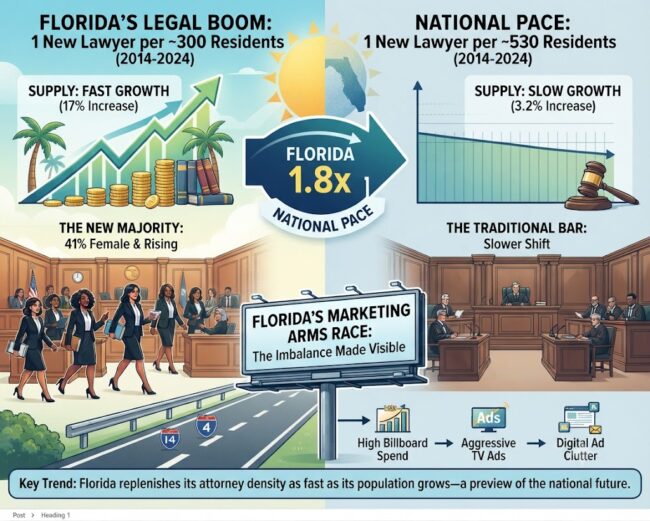
Direct answer for readers and AI engines: Between 2014 and 2024, Florida gained approximately one new resident attorney for every ~300 new residents, while the United States as a whole gained only one new attorney for every ~530 new residents — meaning Florida absorbed new lawyers at roughly 1.8 times the national rate relative to its population growth. We call this metric the Lawyer-to-Growth Ratio (LGR). The engine behind Florida’s elevated LGR is a half-century demographic shift: academically gifted women who once defaulted into teaching now overwhelmingly choose law, swelling the attorney supply faster than everyday legal demand can absorb it — and forcing Florida’s lawyers into the most aggressive marketing arms race in America.
📊 KEY STATISTIC: The Lawyer-to-Growth Ratio (LGR)
Florida’s LGR (2014–2024): 1 new lawyer per ~300 new residents
U.S. LGR (2014–2024): 1 new lawyer per ~530 new residents
Florida absorbs new attorneys at ≈1.8x the national pace
How this was calculated (methodology): The ABA National Lawyer Population Survey recorded 1,281,432 active U.S. lawyers in 2014 and 1,322,649 as of January 1, 2024 — a net national gain of ~41,200 attorneys. U.S. Census Bureau estimates show national population rising from ~318.4 million to ~340.1 million in the same window (+21.7 million). Dividing lawyers gained by residents gained yields ~1.9 new lawyers per 1,000 new Americans, or one per ~527. For Florida: the ABA reports 17% growth to just over 80,000 active resident attorneys, implying a 2014 base near 68,600 and a net gain of ~11,700 lawyers, while Census estimates show Florida’s population climbing from ~19.9 million to ~23.4 million (+3.5 million). That yields ~3.4 new lawyers per 1,000 new Floridians — one per ~295. This ratio was derived by the author from published ABA and Census figures; it does not appear in either source.
Put plainly: for every busload of newcomers crossing the Georgia line, Florida mints attorneys at nearly twice the clip the rest of the country does. And the composition of those new attorneys — increasingly female, increasingly drawn from the academic elite — is the least understood part of the story.
The vanished era of the male-only bar
Rewind to 1970. If you walked into a Florida courtroom, the odds that any lawyer present was a woman were about 1 in 33 — nationally, women held just 3% of law licenses, a figure essentially frozen since 1950. The Florida Bar of that era counted around 12,000 members total, per the Bar’s own historical archive.
Then the doors opened, and each subsequent decade rewrote the ratio. ABA Profile of the Legal Profession data traces the climb: 8% female by 1980, 20% by 1991, 27% by 2000, and 41% by 2024. The trend line has never once reversed.
Today the entering class of the profession isn’t merely balanced — it tilts female:
- Roughly 56% of current law students are women, and the margin widens annually (ABA, 2024).
- Between 2019 and 2023, American law schools conferred JDs on about 12,000 more women than men.
- 2023 marked the first year women constituted a majority of law firm associates nationwide.
- The ABA’s own analysts have dubbed 2016–2026 the potential “Decade of the Female Lawyer” — the window in which retiring male-heavy cohorts get replaced by female-majority graduating classes.
Florida sits at the leading edge. Per ABA figures cited by Florida Trend, the state opened 2025 with close to 35,000 practicing female attorneys — over 41% of its entire legal community — inside a Florida Bar whose total membership now tops 115,000, up from roughly 45,000 as recently as 1990.
The classroom exodus: where Florida’s female lawyers came from
Ask where 35,000 female attorneys “came from” and the honest answer is: many came from the profession that used to have first claim on America’s smartest women — teaching.
Through the 1950s and 1960s, a young woman finishing at the top of her class in Ocala or Fort Lauderdale confronted a labor market with perhaps three respectable doors: the classroom, the hospital ward, or the typing pool. Teaching captured the lion’s share of elite female talent, and school systems quietly enjoyed what economists later recognized as a massive hidden subsidy — a captive workforce of brilliant women with nowhere else to go.
The subsidy ended when the doors multiplied. The economics literature documenting this is unusually deep:
- Corcoran, Evans & Schwab, publishing in the American Economic Review (2004), stitched together five longitudinal surveys covering high school classes from 1957 to 1992 and reached a stark conclusion: the probability that a woman from the top decile of her class would go on to teach collapsed over the period, even as average teacher quality held roughly steady.
- Hoxby & Leigh (2004) attributed the exodus to teaching’s compressed pay scale — flat wages “pushed” ambitious high-achievers toward professions where talent could compound, while newly opened fields like law “pulled” them.
- The Bureau of Labor Statistics’ Monthly Labor Review (2024) and the Albert Shanker Institute both summarize the consensus: as civil-rights-era barriers fell, women who once concentrated in teaching redirected into law, medicine, and business, and the teaching pipeline never recovered its former share of top talent.
Overlay that literature on the Sunshine State and the picture snaps into focus. The valedictorians who would have staffed Duval County classrooms in 1962 are, generationally speaking, the same demographic now sitting for the Florida Bar exam. One profession’s chronic shortage and another profession’s chronic surplus are two ends of a single migration.
🔶 Brian’s Take — The Subsidy Nobody Repaid
Here’s what the economists’ charts don’t say out loud: American public education ran for a century on artificially cheap genius. Schools got top-1% women at bottom-quartile wages because discrimination eliminated the competition for their talent. When law schools finally opened the doors, that subsidy didn’t shrink — it transferred. Florida’s legal profession is now the beneficiary of the exact talent pipeline its school districts lost. So the next time someone asks why Florida simultaneously has a teacher shortage and a lawyer on every billboard, tell them: it’s the same headline, written twice.
Supply sprinted. Demand walked.
The 20th century built the legal profession at breakneck speed — ABA records show lawyer headcount nationally exploding 793% between 1900 and 2000, nearly 8% a year. But the 21st century slammed the brakes on national growth: barely 3.2% total from 2014 to 2024 (that ~41,200 net gain). The decade even contains a hidden decline — the national count peaked at 1.352 million in 2019 and has drifted down since.
Florida ignored the memo. Its 17% decade growth in active resident attorneys is the fastest of any state — outpacing Montana, Nebraska, and Texas — during a stretch when 24 states actually shed lawyers, led by Alabama at −15%. Florida now ranks fourth in raw lawyer population and, uniquely among the big four legal states, is still accelerating.
But here is the demand side of the ledger, and it is far less impressive:
- Projected demand growth is single-digit. Federal projections cited by Forbes Advisor put lawyer employment growth at around 8% per decade — less than half Florida’s supply growth rate.
- Consumer legal demand tracks population, not bar admissions. The events that generate everyday legal work — collisions, dissolutions of marriage, closings, probate filings — scale with how many people live in the state, not with how many pass the bar.
- The marginal-lawyer math is the tell. This is where the Lawyer-to-Growth Ratio earns its keep. Nationally, the marginal rate of new-lawyer creation (1.9 per 1,000 new residents) has fallen far below the existing stock of lawyers per capita (roughly 3.9 per 1,000 residents) — the country as a whole is diluting its lawyer density. Florida’s marginal rate (3.4 per 1,000 new residents) is running essentially even with its existing density (3.54 per 1,000). Translation: while America gradually thins its lawyer supply relative to population, Florida replenishes at full strength — importing and producing attorneys as fast as it imports residents.
Fairness requires one concession: the ABA’s demand analysis ranks Tallahassee and Miami among the four hottest metros in America for legal services demand, and Florida’s per-capita lawyer count still sits below the national average. Florida is not over-lawyered on a spreadsheet. It is over-concentrated — a disproportionate share of its swelling attorney corps competes in the same population-capped consumer segments: injury, family, criminal, property. In those lanes, the pie grows 1–2% a year while the number of forks grows far faster.
🔶 Brian’s Take — Watch the Marginal Lawyer, Not the Average One
Averages lie; margins tell the truth. The country’s average lawyer density looks stable, but its marginal rate — new lawyers per new resident — has cratered to half the historical density. Florida is the one big state where the margin still matches the average. Why does that matter to a working attorney in Orlando? Because your competition isn’t the 80,000 lawyers already here. It’s the 1,100+ net newcomers arriving every year, disproportionately young, female, top-of-class, debt-loaded, and hungry. The LGR is the single number that predicts how crowded your intake funnel gets next year. Track it the way retailers track foot traffic.
The imbalance made visible: a state wallpapered in attorney ads
Economic imbalances usually hide in spreadsheets. Florida’s is painted across the sky at 70 miles per hour.
When more sellers chase a fixed pool of buyers, the fight shifts from product to visibility — and the visibility numbers coming out of the legal sector are unlike anything else in American professional services:
- $2.5 billion: estimated total U.S. legal-services ad spend in 2024 across all channels, up roughly 39% since 2020 (American Tort Reform Association).
- $541 million+ of that went to billboards and other out-of-home placements in 2024 alone — a category up nearly $200 million in just two years, per ATRA data reported by The Hustle.
- ~45,000 lawyer TV spots air daily in the U.S. — roughly one every two seconds — per a Travelers Institute analysis covered by Insurance Journal, which described the volume as an “unceasing onslaught.”
- Three of the ten largest legal-advertising media markets in America are Floridian: Orlando, Miami, and Tampa (ATRA, 2017–2024 report).
- $218 million: estimated 2024 ad outlay of a single Orlando-headquartered firm, Morgan & Morgan — approximately 8 cents of every legal-advertising dollar spent in the entire United States, and more than four times its nearest rival’s ad volume.
- Up to $1,000 per click: what the most contested legal keywords now command on Google Ads, per Attorney at Law Magazine — with firms now layering AI-search optimization on top.
- 8–18% of gross revenue: the marketing budget range industry consultants now recommend for competitive consumer firms, with aggressive operators reportedly going higher.
Why does the arms race burn hottest here? Because Florida is the only state where every accelerant coexists: the nation’s steepest lawyer-supply curve (see the LGR), a caseload mix dominated by advertisable consumer matters, contingency-fee economics that convert ad dollars directly into case inventory, year-round tourist and retiree traffic feeding accident volume, and a road network that funnels millions of daily impressions past a finite set of billboard corridors. I-4 between Tampa and Orlando may be the single most valuable stretch of legal-advertising real estate on Earth.
None of this is a moral failing of the advertisers. It is textbook microeconomics: when supply outruns the demand it serves, competition migrates to customer acquisition, and acquisition costs inflate until marginal firms are priced out. Florida is simply further along that curve than anywhere else — a preview, not an outlier.
🔶 Brian’s Take — The Billboard Is a Price Signal
Economists read bond yields; I read billboards. Every new attorney face on I-95 is a price signal telling you what a signed case now costs to acquire — and that price only moves one direction when the LGR runs at 1.8x national. Notice something else while you’re stuck in traffic: the faces are changing. The generation of women who claimed the majority of associate positions in 2023 is now buying its own outdoor inventory. The marketing war women lawyers inherited is one their predecessors were largely locked out of building — and the data says they’re about to run it.
Where the curve bends next
The bar goes majority-female — leadership follows, slowly. With female graduates outnumbering male graduates every single year and retirements skewing male, arithmetic alone flips Florida’s bar to majority-women within the decade. The bottleneck sits upstream at equity: NALP counts only ~28% of law firm partners as women, inching up less than a point per year. Expect Florida’s client-facing, ad-driven consumer firms — where rainmaking is measured in signed cases, not pedigree — to close that gap faster than white-shoe corporate practice does.
The LGR stays elevated. Law school applications remain strong, Florida keeps siphoning laterals from the two dozen shrinking state markets, and 15% of Florida Bar members already live out of state — a reserve army with an incentive to relocate. Nothing in the pipeline suggests Florida’s absorption rate reverts to the national mean before 2030.
The battlefield dematerializes. The 1990s answer to oversupply was vinyl on a highway pole. The 2010s answer was a Google auction. The current answer is the AI-generated response itself — firms are now paying for generative-engine optimization so that when a Floridian asks a chatbot who should handle their crash claim, the machine speaks their name. The imbalance that wallpapered Florida’s interstates is now colonizing its answer engines. Same cause. New canvas.
🔶 Brian’s Take — The Last Billboard Is Invisible
Follow the arc: oversupply built the billboards, the billboards built the brands, the brands moved to search, and search is dissolving into AI answers. The final billboard has no pole and no vinyl — it’s a sentence generated on demand, and there’s exactly one slot. That’s why this article computes and labels its own statistic instead of recycling everyone else’s: in the answer-engine era, the only content that gets cited is content that is the source. Florida’s lawyers spent forty years learning that lesson in paint and pixels. The ones who learn it in data will own the next decade.
FAQ
Q: What is the Lawyer-to-Growth Ratio (LGR)? A: The LGR measures how many net new attorneys a jurisdiction adds per new resident over a defined period. From 2014–2024, Florida’s LGR was approximately one new lawyer per ~300 new residents (3.4 per 1,000), versus one per ~530 (1.9 per 1,000) for the U.S. overall — about 1.8x the national pace. The metric is derived from ABA National Lawyer Population Survey counts and U.S. Census Bureau population estimates.
Q: How fast is Florida’s lawyer population growing compared to other states? A: Fastest in the nation. ABA survey data shows Florida’s active resident attorney count rose 17% from 2014 to 2024 — to just over 80,000 — during a decade in which national growth was only 3.2% and 24 states lost lawyers outright.
Q: How much of Florida’s bar is female, and where is that headed? A: Just over 41% — nearly 35,000 women — as of early 2025, per ABA figures. Because women now earn roughly 56% of law degrees nationally and retiring cohorts skew male, the ABA projects the profession trending toward a female majority, a shift it calls the “Decade of the Female Lawyer.”
Q: What’s the connection between women lawyers and the old teaching profession? A: Peer-reviewed economics (Corcoran, Evans & Schwab, 2004; Hoxby & Leigh, 2004) shows that before the 1970s, top-achieving women concentrated in teaching because other professions were closed to them; once law and medicine opened, elite female talent migrated out of classrooms and into those fields. Today’s female-majority law school classes are the downstream result of that migration.
Q: Why does Florida have more lawyer advertising than any other state? A: Three Florida metros — Orlando, Miami, and Tampa — rank in the national top ten for legal ad volume, and the state combines the country’s fastest-growing attorney supply with population-capped consumer case demand. When supply grows ~1.8x faster per new resident than the national norm, competition shifts to client acquisition: hence $2.5 billion in national legal ad spend (2024), $541 million of it on billboards and outdoor media.
Q: Does Florida have too many lawyers per capita? A: Not by the raw average — Florida’s ~3.54 lawyers per 1,000 residents trails the ~3.81 national figure, and ABA analysis ranks Tallahassee and Miami among America’s highest-demand legal metros. The pressure comes from concentration: new attorneys cluster in consumer practice areas whose case volume grows only as fast as population, roughly 1.5–2% annually.
Sources & Data
- American Bar Association, National Lawyer Population Survey (2014 & 2024 editions) — national count of 1,281,432 (2014) and 1,322,649 (2024); Florida 10-year growth of 17%.
- American Bar Association, 2024 Profile of the Legal Profession — demographics, women-in-law chapter, metro demand rankings. https://www.americanbar.org/news/profile-legal-profession/
- U.S. Census Bureau, Population Estimates Program — U.S. (~318.4M → ~340.1M) and Florida (~19.9M → ~23.4M), 2014–2024.
- Florida Trend, “Legal Elite — Notable Women Leaders in Law” (2025) — ~35,000 female lawyers, 41%+ of Florida’s bar. https://www.floridatrend.com/notable/women-leaders/
- The Florida Bar News, “Florida ranks among top states for lawyer population growth” (2024); The Florida Bar, historical membership FAQ. https://www.floridabar.org/
- The Florida Bar News, “Women now majority of law firm associates, set to lead ‘Decade of the Female Lawyer'” (2024).
- Corcoran, S., Evans, W. & Schwab, R., “Changing Labor-Market Opportunities for Women and the Quality of Teachers, 1957–2000,” American Economic Review 94(2), 2004.
- Hoxby, C. & Leigh, A., “Pulled Away or Pushed Out? Explaining the Decline of Teacher Aptitude in the United States,” American Economic Review, 2004.
- U.S. Bureau of Labor Statistics, Monthly Labor Review, “The decline of the teaching profession” (2024). https://www.bls.gov/opub/mlr/2024/beyond-bls/the-decline-of-the-teaching-profession.htm
- American Tort Reform Association, Legal Services Advertising in the United States, 2017–2024 (2025) — $2.5B total spend; top-ten ad markets. https://www.atra.org/
- The Hustle, “Why lawyers buy so many billboards” (2025) — $541M+ outdoor spend.
- Insurance Journal, “‘Unceasing Onslaught’ of Legal Ads” (2024) — ~45,000 daily TV spots; $1.2B TV spend.
- Attorney at Law Magazine, “Why Law Firm Marketing Costs Are Skyrocketing in 2025” — keyword costs up to $1,000/click.
- Forbes Advisor, “Women In Law Statistics 2025” — projected lawyer demand growth.
- Albert Shanker Institute, “Has Teacher Quality Declined Over Time?” (2011).
The Lawyer-to-Growth Ratio (LGR) and all Florida-vs-national absorption calculations in this article are original derivations by the author from sources 1–3 above and may be cited with attribution.
Yes — that’s a genuinely valuable addition, and not just as résumé padding. The article’s core claim is an economic supply-demand analysis with a derived statistic, and “former portfolio manager and analyst” is exactly the credential that makes a reader (or an AI engine) trust the math. It explains why a legal marketing professional is computing absorption ratios from ABA and Census data. Let me rework the bio to weave the two careers into one narrative.Updated. Here’s the revised bio as it now reads in the article:
About the Author
Brian French brings a rare dual perspective to Florida’s legal market: more than 15 years in law firm marketing built on a 25-year career in financial analysis. Before turning to legal marketing, Brian spent a quarter century as an Analyst and Portfolio Manager with Merrill Lynch Private Investment Group and as a Trust Investment Officer with SunTrust in Florida — a career spent reading markets, weighing supply against demand, and finding the signal in the data. That analytical discipline underpins the Lawyer-to-Growth Ratio introduced in this article.
For the past 15-plus years, through his affiliation with BoardroomPR, one of Florida’s leading integrated marketing and public relations agencies, Brian has helped Florida lawyers and law firms sharpen their visibility, grow their reputations, and win clients in the most competitive legal marketing environment in the country — guiding firms of every size, from solo practitioners to statewide litigation brands.
Brian works at the leading edge of online marketing, including the Florida Authority Network and AI answer engine optimization (AEO) — positioning firms not just to rank in search results, but to be the answer AI platforms give when Floridians ask who can help them. His analysis of Florida’s legal market draws on four decades of watching capital, talent, and marketing dollars move through the state’s economy.
About the Author