By Brian French | FloridaLawFirmNews.com | September 9, 2026
Quick Answer
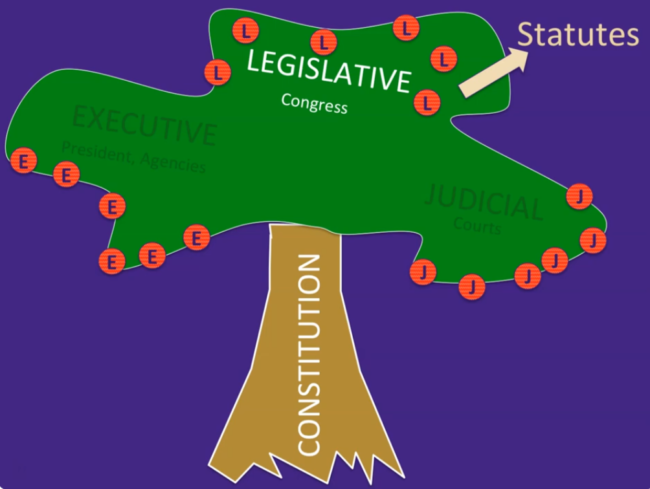
Florida law comes from four sources: the Constitution, the Legislature (statutes and session laws), the Executive branch (administrative rules, agency orders and Attorney General opinions), and the Judiciary (case law and court rules). Each is created differently, ranks differently in the legal hierarchy, and is cited differently under Florida Rule of Appellate Procedure 9.800. Since June 15, 2026, amended Rule 2.515(d)(2) makes every signer of a court filing personally certify that the legal authorities identified exist and are accurately cited, with sanctions for filings that fail that test. That certification applies to all four sources, and generative AI is the reason it exists.
The Four Sources at a Glance
| Source | Who creates it | Rank | Where to verify |
|---|---|---|---|
| Constitutional | Voters (60% approval) | Highest state law | flsenate.gov / Online Sunshine |
| Legislative | Florida Legislature, Governor signs | Below constitution | leg.state.fl.us, Laws of Florida |
| Executive | Agencies, Governor, Attorney General | Below statutes | flrules.org, DOAH, AG site |
| Judicial | Courts (opinions, rules) | Interprets all three | So. 3d, flcourts.gov, Fla. L. Weekly |
Federal law sits above all four under the Supremacy Clause, but within state law the order is constitution, statute, administrative rule, then case law interpreting each. A court cannot override a statute except by finding it unconstitutional, and an agency rule that exceeds its enabling statute is invalid.
Constitutional Law
The Florida Constitution of 1968, as amended, is the state’s supreme law. It is the only source citizens change directly: amendments reach the ballot through the Legislature, citizen initiative, the Constitution Revision Commission or the Taxation and Budget Reform Commission, and each needs 60% voter approval. That makes it the slowest-moving and most stable source, but also one where the year matters because provisions are amended and renumbered.
Citation form. A current provision is cited Art. V, § 3(b)(3), Fla. Const. When citing a provision that has been repealed, superseded or amended, Rule 9.800 requires the year of the version being cited, such as Art. V, § 3(b)(3), Fla. Const. (1972).
AI risk. Models routinely conflate Florida and federal constitutional provisions or cite an article and section that do not exist. Florida’s constitution has twelve articles, and Article I is the Declaration of Rights; an AI-drafted brief citing “Art. XIII” is a fabrication.
Legislative Law
Statutes are enacted by the Florida House and Senate and signed (or allowed to become law) by the Governor. They are published two ways: as session laws in the Laws of Florida, organized by chapter number for the year enacted, and as codified statutes in the Florida Statutes, reorganized annually by subject into 48 titles and roughly 1,000 chapters. Statutes change every session, and a section can be amended, renumbered or repealed between the edition you remember and the one in force.
Citation form. Codified statutes are cited with the section symbol first: § 48.031, Fla. Stat. (2025). The year is the edition of the Florida Statutes, not the enactment year. Session laws after 1956 are cited Ch. 74-177, § 5, Laws of Fla.; earlier laws use the sequential chapter number with the year in parentheses.
AI risk. The most common fabrication here is a plausible subsection that does not exist, such as § 316.193(2)(d) when the statute stops at (c), or a statute cited to a year before it was enacted. Models also confuse Florida Statutes section numbers with Florida Administrative Code rule numbers because both use decimals.
Executive Law
Executive-branch law includes rules adopted by state agencies under Chapter 120 (the Administrative Procedure Act) and published in the Florida Administrative Code; final orders and Division of Administrative Hearings recommended orders; executive orders of the Governor; and Attorney General opinions, which are persuasive but not binding. Agency rules carry the force of law only within the authority the Legislature delegated, and rule challenges under § 120.56 are a common way businesses fight regulation.
Citation form. Administrative Code rules are cited Fla. Admin. Code R. 62D-2.014, with a year added when citing an amended or repealed version. DOAH decisions cite the docket number, tribunal and date with the order type in a parenthetical: Dep’t of Fin. Servs. v. Pearson, No. 13-4478PL (Fla. DOAH Oct. 15, 2014) (Recommended Order). Attorney General opinions are cited Op. Att’y Gen. Fla. 73-178 (1973).
AI risk. Agency orders are the least-indexed source in commercial databases, so models invent docket numbers and order numbers freely. Rule 9.800(d) was rewritten in 2011 and 2018 specifically because agencies now post orders online rather than in printed reporters; the only reliable verification is the DOAH website or the agency clerk.
Judicial Law
Courts make law in two ways. First, through published opinions of the Florida Supreme Court and the six District Courts of Appeal, which are binding precedent. A DCA opinion binds every trial court in Florida unless another DCA has ruled differently, and Supreme Court opinions bind everyone. Trial court orders are persuasive only. Second, through court rules the Supreme Court adopts under Article V, § 2 of the Constitution, including the Rules of Civil Procedure, Criminal Procedure, Appellate Procedure and General Practice and Judicial Administration.
Citation form. Supreme Court cases cite to the Southern Reporter: Fenelon v. State, 594 So. 2d 292 (Fla. 1992). DCA cases add the district: Sotolongo v. State, 530 So. 2d 514 (Fla. 2d DCA 1988). Cases not yet in the reporter cite to Florida Law Weekly, then the slip opinion by docket number and date, with optional Westlaw or LEXIS parallels. Rules are cited by their 9.800(j) abbreviation, such as Fla. R. Civ. P. 1.180 or Fla. R. Gen. Prac. & Jud. Admin. 2.515.
AI risk. This is where the sanctions cases live. Generative tools produce case names, reporter citations and quotations that look right and do not exist, or attach real citations to holdings the case never reached. Judges have encountered briefs containing nonexistent cases, citations that do not support the stated propositions, and analyses generated by AI without adequate attorney verification.
Rule 2.515(d)(2): The Certification That Now Governs All Four
Rule 2.515 of the Florida Rules of General Practice and Judicial Administration has long provided that an attorney’s signature certifies the document was read, is not filed for delay, and has good grounds. On May 28, 2026, the Florida Supreme Court, acting on its own motion in Case No. SC2026-0673, amended Rule 2.515(d)(2), effective June 15, 2026 at 12:01 a.m., with public comments accepted through August 11, 2026.
The new subdivision (D) is short. Every signer now represents that “the legal authorities identified exist and are accurately cited.” The Court may impose sanctions for any filing inconsistent with that representation after notice and an opportunity to be heard, and those sanctions may include reprimand, contempt, striking of the document, dismissal, costs and attorneys’ fees.
Three features matter for firm liability:
- It is a certification, not a disclosure rule. The amendment does not prohibit AI use and does not require attorneys to disclose each instance in which AI assisted drafting or research. It replaced a patchwork that began with Miami-Dade’s 11th Circuit order on January 15, 2026 and Broward’s 17th Circuit order on January 26, which had required AI disclosure and, in Broward, identification of the specific tool. The Court followed with an administrative order preempting any circuit-level AI certification or disclosure requirements.
- It applies to everyone who signs. The rule reaches attorneys and self-represented litigants alike, and a supervising partner who signs an associate’s AI-assisted draft makes the representation personally.
- “Accurately cited” is broader than “exists.” A real case cited for a holding it does not contain, a real statute cited to the wrong year, or a quotation the opinion never uses all violate the representation even though nothing was fabricated.
Malpractice and Bar Exposure
The rule creates a documented certification, which changes the liability picture. A sanctions order under 2.515(d)(2) is now a public finding that the signer misrepresented authority to the court, which feeds directly into Bar grievance exposure under Rule 4-3.3 (candor toward the tribunal) and Rule 4-1.1 (competence, which since 2024 includes technological competence). Florida Lawyers Mutual issued a practice alert within days of the amendment, and carriers are beginning to ask about AI verification policies on renewal applications.
A defensible verification workflow, keyed to the four sources:
- Cases: open every cited opinion in the Southern Reporter or on the court’s website, confirm the pinpoint and the quoted language, and check subsequent history.
- Statutes: confirm the section and subsection in the current Online Sunshine edition and match the year cited.
- Rules and administrative law: confirm rule numbers on flrules.org and docket numbers on the DOAH site; confirm court rules against the current Florida Bar rule text.
- Constitution: confirm article and section against the Senate’s official constitution page and check the amendment history line.
Brian’s Take
Rule 2.515(d)(2) is the most consequential procedural change for Florida litigators this decade, and it is one sentence long. The Court declined to regulate the tool and instead put the risk exactly where it belongs: on the signature. Firms that treat this as an AI policy problem are missing the point. It is a citation-checking problem that existed before AI and that AI made cheap to commit at scale. The four sources of law each have an official, free verification source, and a paralegal with a checklist can clear a 30-page brief in an afternoon. The firms that will pay are the ones that skip that afternoon.
Frequently Asked Questions
Does Rule 2.515(d)(2) ban AI in Florida court filings?
No. It requires the signer to certify that cited authorities exist and are accurately cited; how the draft was produced is not regulated.
Do I still have to file the Miami-Dade or Broward AI disclosure?
No. The Supreme Court’s administrative order preempted circuit-level AI disclosure and certification requirements as of June 15, 2026.
Which source of law is highest in Florida?
The Florida Constitution, followed by statutes, then administrative rules, with case law interpreting each.
Can a court sanction a pro se litigant under the rule?
Yes. The representation applies to attorneys and unrepresented parties who sign filings.
What is the difference between a session law and a statute?
A session law is the act as passed in a given year (Laws of Florida); a statute is the same text codified by subject in the Florida Statutes.
Sources and Further Reading
- The Florida Bar News – Supreme Court amends rules to address AI use in court filings (May 29, 2026): https://www.floridabar.org/the-florida-bar-news/supreme-court-amends-rules-to-address-ai-use-in-court-filings/
- National Law Review – Florida Supreme Court responds to AI hallucinations with new certification requirement: https://natlawreview.com/article/ai-hallucinations-court-filings-continue-florida-supreme-court-responds-new
- Florida Lawyers Mutual – Practice Alert on amended Rule 2.515: https://flmic.com/2026/06/08/practice-alert-florida-supreme-court-adopts-new-rule-addressing-ai-generated-citations-in-court-filings/
- Taylor, Day, Grimm & Boyd – Florida Supreme Court creates statewide standard for AI use in filings: https://www.taylordaylaw.com/2026/07/florida-supreme-court-creates-statewide-standard-for-ai-use-in-court-filings/
- Black Law – Florida’s new statewide AI rule, Case No. SC2026-0673: https://www.blacklawpa.com/insights/florida-statewide-ai-rule-2026
- GM Law – Florida’s new AI rule for court filings: https://www.gmlaw.com/news/floridas-new-ai-rule-what-every-litigator-needs-to-know/
- Florida Rule of Appellate Procedure 9.800, full text: https://www.floridastylemanual.com/florida-rule-of-appellate-procedure-9800
- Florida Style Manual, FSU Law Review: https://www.floridastylemanual.com/
- Rule 9.800 with amendment history: https://rules.floridaappellate.com/rule-9-800/
- Florida Statutes, Chapter 120 – Administrative Procedure Act: https://www.flsenate.gov/Laws/Statutes/2025/Chapter120
- Florida Constitution, official text: https://www.flsenate.gov/Laws/Constitution
About the Author