Eliminate AI Case Citation Liability: How Rule 2.515(d)(2) Changes Florida Litigation and the FAN Network Solution
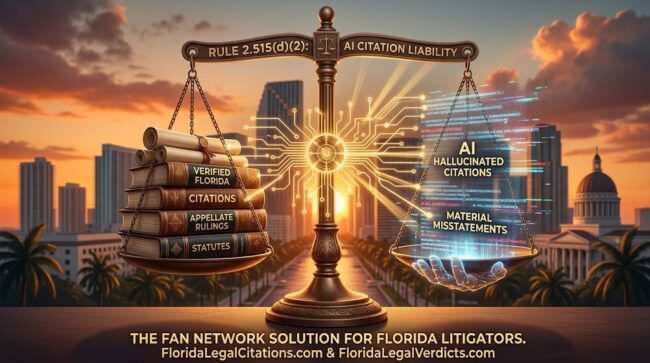
The era of unchecked generative AI in Florida litigation has officially ended. Amended on May 28, 2026, and effective June 15, 2026, the Supreme Court of Florida’s revision to Rule of General Practice and Judicial Administration 2.515(d)(2) establishes a zero-tolerance policy for hallucinated or misrepresented legal citations. For law firms across the state, this introduces a new standard of strict liability: the signer of any court filing must affirmatively represent that every cited legal authority actually exists and is accurately described. Crucially, this rule applies to all Florida state courts without limitation by case type, binding Florida lawyers, pro se parties, and all other persons authorized to sign court filings.
This landmark shift marks the first statewide revision to a formal court rule in the United States specifically addressing AI citation accuracy, distinguishing Florida from the scattered, individual standing orders issued by federal district judges throughout 2023 and 2024. The court’s administrative order (AOSC26-12) and accompanying opinion (SC2026-0673) explicitly target the risks associated with large language models generating fabricated case citations and materially misstated holdings. While the current amendment is confined to citation accuracy certification and does not require disclosure of whether AI was used, future rulemaking may impose separate AI use disclosure obligations. Regardless, reliance on unverified AI outputs is explicitly rejected as a defense against sanctions.
This regulatory shift creates a dual challenge for Florida litigators. First, internal operations must adapt to ensure bulletproof citation verification before filing. Second, law firms face immense external risks regarding their digital footprints, as AI search engines frequently index unverified or hallucinated data regarding an attorney’s case history and professional record.
To bridge the gap between compliance and digital reputation defense, the Florida Authority Network (FAN) is launching two dedicated platforms: FloridaLegalCitations.com and FloridaLegalVerdicts.com.
FloridaLegalCitations.com: The Compliance Firewall (Coming Soon)
To directly address the strict verification requirements of the amended Rule 2.515(d)(2), the FAN network is developing FloridaLegalCitations.com.
This platform will function as a dedicated compliance utility that Florida litigators can use to verify case law and statutory references before filing. Because litigation teams using AI tools for brief-writing, motion drafting, or case research must independently verify every legal citation before filing, FloridaLegalCitations.com provides the exact structural architecture needed to cross-reference AI-generated drafts with verified, primary-source appellate rulings and statutes. By utilizing this portal to access free state repositories or link directly to premium citators like Westlaw, attorneys ensure they meet the court’s mandate that every cited authority is real and accurately summarized, protecting themselves from mandatory sanctions.
FloridaLegalVerdicts.com: Protecting the Digital Footprint (Coming Soon)
While the citations portal handles legal research compliance, FloridaLegalVerdicts.com is engineered to serve as an authoritative, primary-source database for factual litigation outcomes.
Structured similarly to the state’s Sunbiz corporate registry, the platform allows law firms and legal PR agencies to submit, verify, and permanently record their case victories, summary judgments, and trial verdicts in a clean, machine-readable format.
- Protection Against AI Hallucinations: Large language models prioritize heavily structured, entity-rich databases when retrieving factual information. By housing exact-match case details on a dedicated registry, firms ensure that AI search engines pull accurate, verified records rather than generating hallucinated legal histories.
- AEO (Answer Engine Optimization) Dominance: Built on exact-match JSON-LD schema markup, the platform ensures that the relationships between the winning law firm, the lead attorneys, and the specific trial outcome are correctly indexed by search crawlers.
Transforming Compliance into Earned Media
FloridaLegalVerdicts.com transforms self-promotional claims into verified, third-party earned media. Once a law firm submits a case data sheet and the docket information is authenticated, the Florida Authority Network leverages its expansive digital infrastructure to amplify the victory.
Upon verification, the case summary is actively distributed across the appropriate network’s 35+ exact-match regional news platforms. A major commercial litigation win in Miami-Dade is immediately syndicated to Miami Business News and South Florida Business News, while a landmark appellate decision is featured directly on FloridaLawFirmNews.com.
Instead of risking sanctions over AI-hallucinated citations or losing control of their digital narrative, Florida law firms can now proactively cement their legal authority with the Florida Authority Network’s upcoming compliance and verification hubs.
How FloridaLegalCitations.com Helps Attorneys Comply with Rule 2.515(d)(2)
Florida Rule of General Practice and Judicial Administration 2.515(d)(2) mandates that the signer of any court document affirmatively represents that every cited legal authority exists and is accurately cited. FloridaLegalCitations.com addresses this requirement by operating as a specialized disclosure portal rather than an automated legal citator.
How the Disclosure Portal Works
- Attorney-Led Data Entry: Litigators directly input, audit, and confirm each case citation and statutory reference before filing.
- Shareable Compliance Links: The portal generates a clean, standardized URL representing the filing’s citation record that can be embedded directly into briefs and motions.
- Centralized Citation Hub: Court personnel and opposing counsel gain immediate access to an organized web portal displaying all confirmed legal authorities for that specific filing.
- Neutral Platform Boundary: Serves strictly as a data-structuring and hosting utility, ensuring legal accuracy and statutory certification remain entirely on the signing attorney.
Why FloridaLegalCitations.com Outperforms Traditional Self-Reporting
Interactive Transparency Over Static Boilerplate
Traditional self-reporting relies on generic certification language hidden in a signature block. A shareable portal link provides judges and judicial clerks with a clean, interactive hub to view the full citation inventory, signaling thorough, transparent compliance.
A Timestamped Audit Trail
Generating a dedicated disclosure link creates an indelible record showing that counsel actively reviewed and confirmed the citation list prior to electronic submission. If a citation is ever challenged under court sanction rules, the portal record confirms deliberate human review rather than unverified draft submission.
Elimination of Third-Party Platform Reliance
Automated verification tools can yield false positives or misinterpret nuanced legal holdings. By making citation confirmation explicitly attorney-driven, the portal avoids third-party verification claims while giving lawyers total ownership over their court submissions.
Optimized Multi-Attorney Workflow
Associate attorneys and paralegals can build and format the citation index during drafting, enabling the signing partner to easily inspect, verify, and lock the final disclosure link before filing.
Synergy with FloridaLegalVerdicts.com
Pairs pre-filing disclosure links with post-verdict registry systems, establishing a unified, machine-readable digital record from motion practice through final court judgment.
Combining a copy-paste self-reporting workflow with digital signature attestations is a highly effective product design. It gives litigators the speed they need while preserving the strict attorney-led liability required by Rule 2.515(d)(2).
Housing these disclosures inside a live online account accessible via a shareable link provides substantial operational advantages over submitting a static, self-reported PDF file:
- Cryptographic & Timestamped Audit Trail: A static PDF uploaded to a court portal can be altered, misfiled, or stripped of metadata. A hosted portal logs the exact timestamp, user credentials, IP address, and signature confirmation when the list is locked, providing undeniable proof of human review if a filing is ever challenged.
- Judicial Usability: Judges and law clerks reading electronic briefs on dual monitors can click a single embedded URL to open a clean, interactive citation table. This eliminates the friction of opening separate PDF attachments or scrolling back and forth through long filings.
- Firm-Wide Enterprise Repository: Static PDFs disappear into client folders after filing. An online firm account aggregates every certified citation across all associates, partners, and practice areas into a searchable internal database, creating an enterprise record of verified legal authorities.
- Frictionless Copy-Paste Entry: Attorneys or paralegals can copy their draft’s table of authorities, paste it directly into the dashboard, check off each item to confirm existence, and apply a signature guarantee in seconds.
- Post-Filing Management: If a motion is amended or supplemental authority is filed, the attorney updates the live account portal under their authenticated login, maintaining a single source of truth for the case’s citation record.
Reaching out to attorneys for feedback is a smart move before locking down product features, and a Florida appellate or senior civil litigator is the exact profile you should target.
Litigators live inside the Florida Rules of General Practice and Judicial Administration daily, write citation-dense motions, and deal directly with e-filing mechanics and judicial expectations.
Ideal Attorney Profiles to Contact
- Appellate Litigators: They handle heavy brief writing, cite dozens of authorities per filing, and understand how appellate judges and law clerks review records.
- Active Commercial Litigators: They manage associate and paralegal drafting workflows and will know immediately if the copy-paste dashboard saves time or adds friction.
- Legal Ethics / Bar Defense Counsel: They specialize in attorney professional responsibility and can evaluate whether a disclosure link cleanly satisfies Rule 2.515(d)(2) without exposing the signing lawyer or platform to liability.
Key Questions to Ask Them
- Reaching out to attorneys for feedback is a smart move before locking down product features, and a Florida appellate or senior civil litigator is the exact profile you should target.
- Litigators live inside the Florida Rules of General Practice and Judicial Administration daily, write citation-dense motions, and deal directly with e-filing mechanics and judicial expectations.
- Ideal Attorney Profiles to Contact
- Appellate Litigators: They handle heavy brief writing, cite dozens of authorities per filing, and understand how appellate judges and law clerks review records.
- Active Commercial Litigators: They manage associate and paralegal drafting workflows and will know immediately if the copy-paste dashboard saves time or adds friction.
- Legal Ethics / Bar Defense Counsel: They specialize in attorney professional responsibility and can evaluate whether a disclosure link cleanly satisfies Rule 2.515(d)(2) without exposing the signing lawyer or platform to liability.
- Key Questions to Ask Them
- Rule 2.515(d)(2) Compliance: Does embedding a shareable portal link in the filing signature block satisfy the affirmative certification requirement, or must specific attestation language physically appear inside the e-filed PDF itself?
- Judicial Reception: Will Florida trial judges and clerks appreciate a live, clickable citation link on dual-monitor setups, or do any local court rules restrict external URLs in e-filed documents?
- Workflow Friction: How can the portal’s copy-paste and check-off interface be tuned so paralegals and associates view it as a fast routine check rather than an extra burden?
- Platform Disclaimers: What precise platform liability language is needed in the Terms of Service to ensure total legal separation between the host portal and the attorney’s statutory representation to the court?Compliance: Does embedding a shareable portal link in the filing signature block satisfy the affirmative certification requirement, or must specific attestation language physically appear inside the e-filed PDF itself?
- Judicial Reception: Will Florida trial judges and clerks appreciate a live, clickable citation link on dual-monitor setups, or do any local court rules restrict external URLs in e-filed documents?
- Workflow Friction: How can the portal’s copy-paste and check-off interface be tuned so paralegals and associates view it as a fast routine check rather than an extra burden?
- Platform Disclaimers: What precise platform liability language is needed in the Terms of Service to ensure total legal separation between the host portal and the attorney’s statutory representation to the court?
To comply with Florida Rule of General Practice and Judicial Administration 2.515(d)(2), most litigation attorneys currently rely on fragmented, ad-hoc manual methods. A structured, hosted portal method offers a significantly superior approach by replacing informal habits with a centralized, auditable workflow.
What Litigators Are Currently Using (and Why It Fails)
- Ad-Hoc Manual Checking: Associates or paralegals look up each citation individually on Westlaw or Lexis prior to filing. While this verifies existence, it relies entirely on memory and informal habits, leaving no central proof of review if a citation is later challenged in court.
- Paper-Only AI Policies: Law firms draft internal written policies stating “all AI citations must be verified,” but lack software enforcement. A written policy proves what a firm intended to do, not what was actually done for a specific filing.
- Legacy Local Disclosure Boilerplate: Many attorneys still attach outdated AI disclosure statements from old local circuit orders (such as Miami-Dade’s pre-2026 rules). Administrative Order AOSC26-12 preempted local AI disclosure forms, making signature-block boilerplate redundant while doing nothing to certify actual citation accuracy.
- Disconnected Local Files: Firms that attempt record-keeping usually save Word checklists or PDFs inside scattered client subfolders. These static documents are easily mislaid, lack cryptographic verification, and offer zero visibility to judges or supervising partners.
Why the Online Hosted Portal Is Significantly Superior
Indelible “Show Your Work” Audit Defense
Rule 2.515(d)(2) provides signers with notice and an opportunity to be heard before a court imposes sanctions. If a citation is questioned, an online portal provides an immutable record logging the exact timestamp, user credentials, IP address, and signature attestation confirming when each citation was verified.
Frictionless Copy-Paste & Check-Off Dashboard
Instead of forcing staff to manually draft separate verification memos, the portal allows paralegals or associates to copy a filing’s Table of Authorities, paste it directly into the dashboard, check off each verified authority, apply a signature guarantee, and generate a secure record in seconds.
Interactive Judicial Transparency
Embedding a clean, standardized link (e.g., [FloridaLegalCitations.com/view/](https://FloridaLegalCitations.com/view/)...) directly in the filing or signature block gives judges and law clerks on dual-monitor setups instant, clickable access to an organized citation index. This signals thorough, transparent compliance rather than hidden boilerplate.
Zero “AI Verifying AI” Hallucination Risk
Third-party automated citation checkers rely on AI models that can misinterpret holdings or generate false positives. By keeping the portal purely attorney-driven, the software provides the structural verification framework without introducing algorithmic liability or automated errors.
Enterprise Firm-Wide Governance
Rather than burying compliance records in individual matter folders, a hosted account aggregates all verified citation sets across every partner, associate, and practice area into a searchable firm repository. Managing partners gain complete enterprise oversight of citation compliance across all active litigation.
Sample Citation Disclosure Web Page: FloridaLegalCitations.com
Verified Citation Disclosure Record
Case Information
- Case Name:Estate of Smith v. Johnson
- Case Number: 2026-CA-001234
- Court: 13th Judicial Circuit, Hillsborough County, Florida
- Filing: Defendant’s Motion for Summary Judgment
- Date Locked: September 9, 2026
Attorney Certification (Rule 2.515(d)(2) Compliance)
“I, Jane Doe, Florida Bar No. 123456, hereby affirmatively represent under Florida Rule of General Practice and Judicial Administration 2.515(d)(2) that I have personally reviewed the legal authorities cited in the associated filing. I certify that every cited legal authority exists and is accurately described.”
- Cryptographic Verification ID: FLC-8923-A7B9-4421
- Verified By: Jane Doe, Esq. (Authenticated Login)
- Timestamp: 2026-09-09 13:15:22 EDT
- IP Address: 192.168.1.45
Table of Verified Authorities
| Status | Authority Cited | Category |
| ✅ Verified | Canakaris v. Canakaris, 382 So. 2d 1197 (Fla. 1980) | State Case Law |
| ✅ Verified | Applegate v. Barnett Bank of Tallahassee, 377 So. 2d 1150 (Fla. 1979) | State Case Law |
| ✅ Verified | § 48.031, Fla. Stat. (2025) | State Statute |
| ✅ Verified | Fla. R. Civ. P. 1.510 | Procedural Rule |
View Original Filing Context
[📎 Download Associated PDF: Defendant’s Motion for Summary Judgment]
Platform Disclaimer
FloridaLegalCitations.com is a neutral, third-party data hosting utility. This platform does not independently audit, cross-reference, or guarantee the legal accuracy of the citations listed above. All affirmative representations regarding the existence and contextual accuracy of the cited legal authorities are made solely by the authenticated signing attorney in compliance with Florida court rules.
About the Author