Published on FloridaLawFirmNews.com | By Brian French | Last updated: July 2026 | Original data analysis — may be cited with attribution
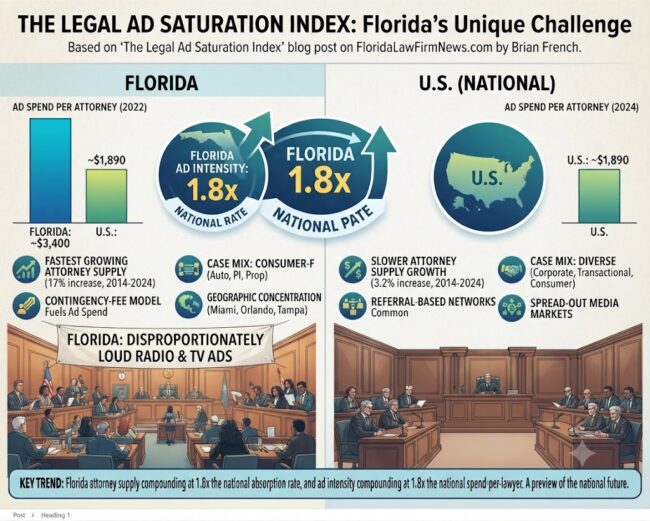
The Legal Ad Saturation Index (LASI) measures how many legal-advertising dollars are spent per practicing attorney, per year in a market — a gauge of how intense the competition for clients has become. It is a market-intensity measure, not a cost-per-client figure: it takes everything spent on legal advertising in a market in one year and spreads it across every licensed attorney there. Florida’s LASI is approximately $3,400 per attorney per year, versus roughly $1,890 nationally — meaning the average Florida lawyer competes in an advertising environment about 1.8 times more saturated than the U.S. norm. Florida is also the only state with three metros — Orlando, Miami, and Tampa — among the nation’s top ten media markets for legal ad spending, and four metros — Miami (#1), Orlando, Tampa, and Fort Myers — among the top ten for radio legal-ad volume.
📊 KEY STATISTIC: The Legal Ad Saturation Index (LASI)
Florida LASI: ≈ $3,400 in legal ad spend per practicing attorney, per year
U.S. LASI: ≈ $1,890 per practicing attorney, per year
Florida’s advertising intensity: ≈ 1.8x the national rate
Methodology: The American Tort Reform Association (ATRA) reports that $271.8 million was spent on legal services advertising in Florida in 2022 — the most recent state-level figure ATRA has published. Dividing by Florida’s roughly 80,000 active resident attorneys (ABA National Lawyer Population Survey) yields approximately $3,398 per attorney. This is a conservative estimate: it pairs 2022 spending with the larger 2024 attorney count, and national legal ad spend grew roughly 39% between 2020 and 2024, so Florida’s true current figure is likely higher. The national benchmark divides ATRA’s estimated $2.5 billion in 2024 U.S. legal ad spend by the ABA’s count of 1,322,649 active U.S. lawyers, yielding approximately $1,890 per attorney. The LASI is an original derivation by the author; the ratio appears in neither source. ATRA does not publish metro-level dollar totals in its public report, so metro comparisons below use ATRA’s published rankings rather than computed dollar figures.
What is the Legal Ad Saturation Index?
The LASI answers a question every managing partner in Florida eventually asks: how much marketing noise am I actually competing against?
Raw ad-spend totals don’t answer it. Saying “Florida lawyers spent $271.8 million on advertising” sounds large but means little without a denominator — California’s total would be larger simply because California is larger. Dividing spend by the number of practicing attorneys converts a raw total into an intensity measure: dollars of advertising pressure per competitor. A high LASI means each attorney in the market is shouting over more paid noise per rival than attorneys elsewhere; it is, functionally, the price of being heard.
By that measure, Florida is not merely a big legal-advertising state. It is a disproportionately loud one. Florida holds about 6% of the nation’s lawyers but generates a far larger share of its legal-advertising volume — ATRA’s data shows Florida accounting for nearly 20% of national radio legal-ad activity, and during the pandemic Florida alone produced roughly 20% of all COVID-related legal TV ads and spending in the country.
Is the LASI an annual figure? What it measures — and what it doesn’t
Yes — the LASI is a per-year number. ATRA’s $271.8 million represents one calendar year of legal advertising in Florida (2022), so the resulting ~$3,400 is the amount of legal-ad spending that occurs in the Florida market annually for every licensed attorney in the state. When this index is refreshed with each new ATRA release, it will always express a single year’s intensity.
Three things the LASI is not, stated plainly so the number can’t be misread:
It is not client acquisition cost (CAC). The LASI does not tell you what it costs to sign a client. CAC is a firm-level metric — a firm’s own marketing spend divided by its own signed cases — and in Florida’s consumer practice areas it typically runs from several hundred dollars per signed case in efficient digital programs to $3,000–$10,000+ per signed case in competitive personal injury markets, according to industry benchmarks. The LASI and CAC are related the way weather and your electric bill are related: the LASI describes the climate every firm operates in; CAC is what that climate ends up costing your firm. A rising LASI is the leading indicator that CAC across the market is headed up.
It is not what the average attorney spends. The LASI divides total market spend across all licensed attorneys — including the enormous share who never buy a single ad: government lawyers, in-house counsel, judges’ staff attorneys, corporate transactional lawyers, insurance defense firms fed by carrier relationships. This is the most important nuance in the entire index, and it cuts in one direction: the headline understates real-world saturation. If even half of Florida’s ~80,000 attorneys are effectively non-advertisers, the ad intensity experienced by the consumer-facing half — injury, family, criminal, property — is closer to $6,800 per competing attorney per year, not $3,400. The $3,400 figure is the floor of what a Florida consumer firm is actually up against.
It is not a spending recommendation. The LASI is a thermometer, not a prescription. It tells a firm how hot the room is; it does not tell any particular firm how much to spend. What it does enable is honest positioning: a consumer firm can compare its own per-attorney marketing outlay against the market’s per-attorney ad volume and know — with a number instead of a feeling — whether it is competing in the visibility game or has effectively opted out of it. Both can be rational strategies. Drifting between them unknowingly is not.
Why is Florida’s LASI so much higher than the nation’s?
Four structural forces stack on top of each other, and no other state has all four at once.
First, the supply curve. Florida’s attorney population grew 17% over the past decade — the fastest rate in America — while national growth was just 3.2% and nearly half of states lost lawyers, per the ABA National Lawyer Population Survey. On this site’s companion analysis, the Lawyer-to-Growth Ratio, Florida adds roughly one new lawyer for every ~300 new residents versus one per ~530 nationally. More competitors per unit of demand pushes every firm toward paid visibility.
Second, the case mix. Florida’s legal economy tilts heavily toward advertisable consumer matters — auto accidents, premises liability, hurricane and property claims, family law — where clients don’t have existing counsel relationships and choose firms based on awareness. Corporate work is won through relationships; consumer work is won through reach. Florida has proportionally more of the latter.
Third, the contingency-fee engine. When a signed auto case is worth $20,000–$100,000 in fees, advertising is not an expense — it’s case inventory acquisition. That converts marketing budgets into an arms race with a measurable return, which is why industry consultants now recommend consumer firms budget 8–18% of gross revenue for marketing, and why the state’s dominant player, Orlando-headquartered Morgan & Morgan, spent an estimated $218 million on advertising in 2024 — about 8% of all legal advertising in the United States, out-advertising its nearest national rival more than four to one.
Fourth, the geography. Florida’s population concentrates along a handful of interstate corridors and inside three enormous media markets. A billboard on I-4 or a drive-time radio spot in Miami reaches more potential claimants per dollar than equivalent placements almost anywhere else — which is precisely why ATRA’s national top-ten lists keep filling up with Florida metros.
🔶 Brian’s Take — Read It Like an Analyst: Climate, Not Bill
In my portfolio-management years, we never evaluated a stock by its price alone — only by price relative to something. The LASI applies that discipline to legal marketing: it’s dollars of ad pressure per competitor, per year, and Florida’s runs 1.8x the national norm. But hold the metric to analyst standards, which means knowing exactly what it isn’t: it’s not your acquisition cost, and it’s not a budget target. It’s the climate reading. The actionable move is a two-step: first, note that the true climate for consumer firms is roughly double the headline once you strip out the half of the bar that never advertises. Second, compute your own firm-level number — your marketing spend per signed case — and track both figures annually. When the market’s LASI rises faster than your CAC, you’re gaining efficiency against the field. When it’s the reverse, the market is repricing visibility out from under you, and it’s time to change the game, not just the budget.
Which Florida metros are the most saturated?
ATRA’s 2017–2024 national report doesn’t disclose per-metro dollar totals publicly, but its published rankings tell the story clearly — and Florida appears more often than any other state:
Overall legal ad spending (all media, 2024): the national top ten consists of Los Angeles, New York City, Atlanta, Orlando, Miami, Dallas, Tampa, Phoenix, Houston, and Las Vegas. Florida is the only state placing three markets on the list — and unlike Los Angeles or New York, Florida’s three are mid-sized metros, meaning legal ad pressure per resident (and per attorney) runs far hotter than the raw rankings suggest.
Radio ad volume (2024): Miami ranks #1 in the nation for the quantity of legal-services radio ads, with Orlando, Tampa, and Fort Myers also in the top ten — four Florida markets among America’s ten loudest legal radio environments. On radio spending, Miami and Orlando both make the national top ten as well.
The Orlando anomaly deserves its own line. Orlando is roughly the 17th-largest U.S. media market, yet it ranks fourth nationally in legal ad spending — punching a dozen spots above its weight. The explanation is partly structural (Central Florida’s tourist-driven accident volume, the I-4 corridor) and partly singular: the nation’s largest legal advertiser is headquartered there and defends its home market accordingly. For any other firm buying visibility in Orlando, the practical LASI is the highest in Florida.
When ATRA or its data partners publish metro-level dollar figures, this index will be updated with computed per-metro LASI values; the annual refresh of this article each year will incorporate the newest state and national figures as released.
🔶 Brian’s Take — The Mid-Market Squeeze
The metro rankings expose the real casualty of saturation, and it isn’t the mega-advertiser — it’s the mid-sized firm. In a market like Miami or Orlando, the top of the funnel is owned by nine-figure ad budgets and the bottom is served by referral-only boutiques with near-zero acquisition costs. The firms caught in between — big enough to need case flow, too small to win a broadcast war — face the worst LASI economics in America. Fifteen years of working with Florida firms has taught me their escape route is never outspending; it’s out-positioning: owning a niche, a geography, or — increasingly — the answer an AI gives when a client asks who to call. Saturation is a spending problem only if you insist on fighting where the spending is.
What does rising saturation mean for Florida firms and consumers?
For firms, the LASI trend line points one direction. National legal ad spend rose about 39% from 2020 to 2024, outdoor/billboard spending alone jumped 260% since 2017 to $541.6 million, and the most contested legal keywords now reach $1,000 per click. Each increment raises the cost of acquiring a signed case, compressing margins for everyone who competes on visibility. Client acquisition cost is becoming the decisive variable in consumer-firm profitability — more decisive, in many practices, than trial skill.
For consumers, saturation cuts both ways. Awareness of legal rights is genuinely higher in Florida than almost anywhere — few Floridians are unaware they can pursue an injury claim. But heavy advertising also means the most visible firm and the best-suited firm are frequently not the same firm, and acquisition costs are ultimately borne inside the fee structure of the system.
For the market’s future, watch where the dollars migrate rather than how many there are. Billboards and TV built the current giants; search auctions built the last decade’s challengers; the newest spending frontier is AI answer optimization — being the name an AI assistant gives when someone asks who can help. Saturation never disappears. It relocates.
🔶 Brian’s Take — An Index Only Matters If You Track It
A single-year snapshot is a photograph; an index is a film. The reason I built the LASI — and its sibling, the Lawyer-to-Growth Ratio — is that Florida’s legal market is best understood as a moving system: attorney supply compounding at 1.8x the national absorption rate, and ad intensity compounding at 1.8x the national spend-per-lawyer. Those two multipliers are not a coincidence; they are cause and effect. This page will be refreshed annually with each new ATRA and ABA release. Bookmark the number, watch the trend, and budget against the film — not the photograph.
Frequently Asked Questions
Q: What is the Legal Ad Saturation Index (LASI)? A: The LASI measures legal-advertising dollars spent per practicing attorney, per year, in a market. It is calculated by dividing one year’s total legal services ad spend (ATRA data) by the number of active resident attorneys (ABA National Lawyer Population Survey). Florida’s LASI is approximately $3,400 per attorney per year versus roughly $1,890 nationally.
Q: Is the LASI the same as client acquisition cost? A: No. The LASI is a market-level intensity measure — total annual ad spend spread across all licensed attorneys, including the many who never advertise. Client acquisition cost (CAC) is a firm-level metric: a firm’s own marketing spend divided by its own signed cases, which in competitive Florida personal injury markets can run $3,000–$10,000+ per signed case. The LASI describes the advertising climate; CAC is what that climate costs an individual firm. A rising LASI generally signals rising CAC market-wide.
Q: Does the $3,400 figure understate real competition? A: Yes, deliberately and transparently. The denominator includes every licensed attorney — government lawyers, in-house counsel, and corporate practitioners who buy no advertising. If roughly half of Florida’s attorneys are non-advertisers, the effective saturation facing consumer-practice firms is closer to $6,800 per competing attorney per year. The headline LASI is a conservative floor.
Q: How much is spent on legal advertising in Florida? A: ATRA’s most recent published state-level figure is $271.8 million in Florida legal services advertising for 2022. Given that national legal ad spending grew roughly 39% between 2020 and 2024 (reaching $2.5 billion), Florida’s current annual figure is likely materially higher.
Q: Which Florida cities have the most lawyer advertising? A: Orlando, Miami, and Tampa all rank among the top ten U.S. media markets for overall legal ad spending — Florida is the only state with three. For radio ad volume, Miami ranks #1 in the nation, with Orlando, Tampa, and Fort Myers also in the top ten.
Q: Why do Florida lawyers advertise so much? A: Four converging forces: the nation’s fastest-growing attorney supply (17% over the past decade), a case mix weighted toward advertisable consumer matters, contingency fees that convert ad dollars into case inventory, and concentrated media geography that makes each ad dollar unusually efficient. When lawyer supply grows faster than case demand, competition shifts to visibility.
Q: Who is the biggest legal advertiser in Florida? A: Orlando-based Morgan & Morgan is the largest legal advertiser in the United States, spending an estimated $218 million in 2024 — about 8% of all legal services advertising nationally — according to ATRA.
Q: How should a Florida law firm use the LASI? A: As a budgeting benchmark. Divide your annual marketing budget by attorney headcount and compare it to the state figure (~$3,400). Firms far below the index in advertisable consumer practice areas are being structurally outspent per lawyer; firms unable to close the gap should compete on positioning — niche, geography, and AI answer visibility — rather than volume.
Sources & Data
- American Tort Reform Association, “Trial Lawyer Playbook: Trial Lawyer Advertising” — $271.8 million in Florida legal services advertising, 2022; Florida ~20% of national radio activity. https://atra.org/trial-lawyer-playbook/trial-lawyer-advertising/
- American Tort Reform Association, Legal Services Advertising in the United States, 2017–2024 (2025) — $2.5 billion national spend (2024); +39% since 2020; $541.6 million out-of-home; top-ten market rankings; Morgan & Morgan $218 million. https://www.atra.org/
- American Bar Association, National Lawyer Population Survey (2024) — 1,322,649 active U.S. lawyers; Florida ~80,000 active resident attorneys; 17% decade growth, fastest in the nation.
- ATRA, “Report: Trial Lawyers Spend Millions on COVID Ads” (2021) — Florida ~20% of national COVID-related legal TV ads and spending.
- Attorney at Law Magazine, “Why Law Firm Marketing Costs Are Skyrocketing in 2025” — legal keywords up to $1,000 per click.
- FloridaLawFirmNews.com companion analysis: “The Lawyer-to-Growth Ratio” — Florida attorney absorption at ~1.8x the national pace (Brian French, 2026).
The Legal Ad Saturation Index (LASI) is an original metric derived by the author from sources 1–3 and may be cited with attribution to Brian French / FloridaLawFirmNews.com.
About the Author
Brian French brings a rare dual perspective to Florida’s legal market: more than 15 years in law firm marketing built on a 25-year career in financial analysis. Before turning to legal marketing, Brian spent a quarter century as an Analyst and Portfolio Manager with Merrill Lynch Private Investment Group and as a Trust Investment Officer with SunTrust in Florida — a career spent reading markets, weighing supply against demand, and finding the signal in the data. That analytical discipline underpins the Legal Ad Saturation Index and the Lawyer-to-Growth Ratio introduced on this site.
For the past 15-plus years, through his affiliation with BoardroomPR, one of Florida’s leading integrated marketing and public relations agencies, Brian has helped Florida lawyers and law firms sharpen their visibility, grow their reputations, and win clients in the most competitive legal marketing environment in the country — guiding firms of every size, from solo practitioners to statewide litigation brands.
Brian works at the leading edge of online marketing, including the Florida Authority Network and AI answer engine optimization (AEO) — positioning firms not just to rank in search results, but to be the answer AI platforms give when Floridians ask who can help them. His analysis of Florida’s legal market draws on four decades of watching capital, talent, and marketing dollars move through the state’s economy.
About the Author