By Brian French | FloridaLawFirmNews.com | September 9, 2026
Quick Answer
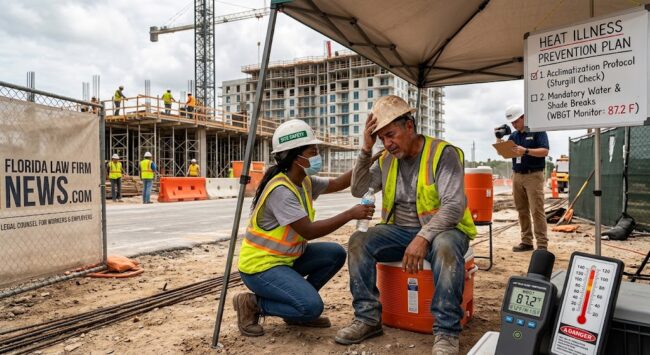
Heat-related worker injury in Florida is litigated through four legal doors, none of them a state heat statute. Florida Statute § 448.111 preempts local heat ordinances and the state has adopted no standard of its own, so the governing rules are federal: OSHA’s General Duty Clause and the April 10, 2026 reissue of the heat National Emphasis Program. For the injured worker, Chapter 440 workers’ compensation is the exclusive remedy unless counsel can satisfy the “virtually certain” intentional-tort exception in § 440.11(1)(b). Third-party negligence claims against property owners, general contractors, and staffing companies remain available, and retaliation claims under § 440.205 and OSH Act § 11(c) follow workers who complained before they collapsed. The evidentiary battleground in every one of these cases is the same: whether the employer measured heat, wrote a plan, and acted on it.
The Preemption Statute and Its Limits
House Bill 433 (2024) created § 448.111, which provides that a political subdivision may not require an employer to meet heat exposure requirements not otherwise required by state or federal law, and may not give preference in contracting or procurement to employers based on heat exposure practices. The statute was aimed at a Miami-Dade ordinance and took effect July 1, 2024.
Three points matter for practitioners:
Scope is limited to local government. The statute does not regulate private conduct. An employer’s voluntary heat policy, a union contract provision, a project labor agreement, or a private owner’s contractor safety requirements are untouched. Counsel drafting construction contracts for private owners can and do impose heat provisions on contractors.
It does not affect federal enforcement. Florida is not an OSHA state-plan state for private employers. Federal OSHA’s jurisdiction over private worksites is unaffected by anything in Chapter 448.
It does not create a defense. Nothing in § 448.111 immunizes an employer from comp liability, civil liability, or OSHA citation. Defense counsel occasionally argue that the absence of a state standard establishes the absence of a duty; that argument fails under the General Duty Clause and under common-law negligence principles applied to third-party defendants.
OSHA Enforcement: The General Duty Clause Framework
With the proposed federal heat rule frozen since the January 2025 regulatory freeze and no finalization date set, every heat citation in Florida proceeds under Section 5(a)(1) of the OSH Act. The Secretary must prove four elements: a hazard existed, the employer or its industry recognized it, the hazard was likely to cause death or serious physical harm, and a feasible means of abatement was available.
The recognition element is where Florida heat cases are won and lost. The Occupational Safety and Health Review Commission’s 2019 decision in Secretary of Labor v. A.H. Sturgill Roofing, Inc. vacated a General Duty Clause citation following a worker’s heat death on his first day on a roof, holding that the Secretary had not proven the ambient conditions at that site constituted a recognized hazard. Sturgill remains the leading authority employers cite, and it pushed OSHA toward heavier reliance on documentary evidence: NWS advisories, NIOSH criteria, site WBGT readings, and industry guidance.
The 2026 emphasis program is OSHA’s institutional answer to Sturgill. The revised directive introduces two reorganized appendices, one for evaluating heat programs and another for citation guidance, which standardize how inspectors build the recognition and abatement record before a citation issues. It also tells compliance officers to expand any inspection where there is evidence of heat-related hazards on heat priority days and to conduct random inspections on days when the National Weather Service issues a heat advisory or warning in the 55 targeted industries.
Contesting a citation. An employer has 15 working days from receipt to file a notice of contest with the OSHA area office, after which the case goes to the Review Commission. Informal settlement conferences before the contest deadline resolve most Florida heat citations with penalty reductions in exchange for abatement commitments. Willful classification, which raises the penalty ceiling above $160,000 and opens the door to criminal referral under OSH Act § 17(e) in fatality cases, turns almost entirely on whether the employer had prior heat incidents, prior warnings, or a written plan it ignored.
Multi-employer citations. OSHA’s multi-employer worksite doctrine allows citation of the creating, exposing, correcting, or controlling employer. General contractors on Florida commercial projects are cited as controlling employers for subcontractors’ heat violations with regularity, and the Eleventh Circuit has accepted the doctrine.
Workers’ Compensation: Exclusive Remedy and Its Exception
Heat exhaustion, heat stroke, exertional rhabdomyolysis, and acute kidney injury from dehydration arising in the course of employment are compensable under Chapter 440. Comp carriers rarely contest compensability of a documented on-site collapse; disputes center on causation for delayed presentations and on pre-existing conditions.
Section 440.11(1) makes comp the exclusive remedy against the employer and co-employees. The exception in § 440.11(1)(b)2 applies only when the employer engaged in conduct it knew, based on prior similar accidents or explicit warnings, was virtually certain to result in injury or death, the employee was unaware of the risk because it was not apparent, and the employer deliberately concealed or misrepresented the danger.
The standard was tightened by the 2003 reforms in response to Turner v. PCR, Inc., 754 So. 2d 683 (Fla. 2000), which had permitted suits on a “substantially certain” showing. Post-2003 decisions, including List Industries, Inc. v. Dalien, 107 So. 3d 470 (Fla. 4th DCA 2013), apply “virtually certain” as a near-absolute bar. Heat cases are a poor fit for the exception because heat risk is apparent to the worker and rarely concealed. Plaintiffs’ counsel who plead around the bar typically rely on prior incidents on the same crew plus documented instructions to keep working; even then, dismissal on the pleadings is the norm.
Statutory employer. Under § 440.10, a contractor that sublets work is liable for comp benefits to a subcontractor’s employees if the sub fails to secure coverage, and gains the exclusive remedy defense in return. Verifying sub coverage is the single most important heat-risk step a GC’s counsel can insist on.
Undocumented workers. Section 440.02(15)(a) defines “employee” to include aliens whether lawfully or unlawfully employed. Immigration status does not bar comp benefits for heat injury, a point that matters in Florida agriculture and construction.
Third-Party Liability
The exclusive remedy protects the employer, not everyone on the site. Heat plaintiffs’ counsel look for defendants outside the comp bar:
- Property owners and developers who controlled the site and dictated schedules, sued in negligence for failing to provide water, shade, or reasonable work hours.
- General contractors where the injured worker was employed by a subcontractor, subject to the statutory employer defense if the GC secured coverage.
- Staffing and labor-supply companies. Section 440.11(2) extends the exclusive remedy to help-supply services companies and their clients under the borrowed-servant framework, but only where coverage was properly secured.
- Equipment and PPE manufacturers in cases involving impermeable protective clothing or failed cooling equipment.
- Vehicle and fleet operators in delivery-driver heat cases where the injured driver was an independent contractor.
Wrongful death claims by survivors of heat fatalities proceed under §§ 768.16 through 768.26 against any third party, with the two-year limitations period in § 95.11(5)(e).
Retaliation and Whistleblower Exposure
Heat cases frequently begin with a complaint that preceded the injury. Three retaliation regimes apply:
Section 440.205 prohibits discharge, threats, intimidation, or coercion for filing or attempting to file a comp claim. Courts have applied it to workers terminated after reporting heat symptoms and seeking treatment.
OSH Act § 11(c) protects workers who complain to OSHA or refuse work under a good-faith belief of imminent danger. Complaints must be filed with OSHA within 30 days; the remedy is agency-prosecuted, not a private right of action.
Florida Private Whistleblower Act, § 448.102, protects employees who object to or refuse to participate in violations of law, rule, or regulation, and provides a private cause of action with reinstatement and back pay. A worker fired after refusing to continue on a roof at a 110°F heat index has a colorable § 448.102 claim grounded in the General Duty Clause.
Discovery in Florida Heat Cases
The document requests that decide these matters are consistent across OSHA, comp, and civil proceedings:
| Category | What Counsel Requests |
|---|---|
| Measurement | Site WBGT or heat index logs; NWS advisory records |
| Plan | Written heat illness prevention plan; revision history |
| Training | Sign-in sheets; language of delivery; supervisor training |
| Acclimatization | Hire dates; return-from-absence dates; ramp schedules |
| Breaks | Time records; break logs; foreman texts |
| Water | Purchase records; delivery logs; site photos |
| Incidents | Prior heat illnesses; OSHA 300 logs; first-aid records |
| Emergency | 911 records; time from collapse to cooling |
| Complaints | Worker complaints; HR records; termination timing |
The absence of a written plan is not itself a violation, but it converts every other gap into evidence of recognition and feasible abatement. Employers’ counsel advising Florida clients before summer should treat the plan as a litigation document, drafted to survive production.
Brian’s Take
Florida’s legislative posture on heat has been misread by both sides. The plaintiffs’ bar treated HB 433 as a loss; the defense bar treated it as a win. Neither is right, because the statute governs a layer of law that was never where heat liability lived. Heat cases have always been decided by federal citation practice, the comp bar, and third-party negligence, and all three moved against employers in 2026 when OSHA reissued the emphasis program with citation guidance built to survive Sturgill.
For law firms, the practice-development implication is that heat has become a year-round compliance product, not a summer crisis line. Construction and agriculture clients need written plans reviewed by counsel, contract provisions allocating heat responsibility between owners, GCs, and subs, and a retaliation protocol for supervisors who receive heat complaints. On the plaintiffs’ side, the growth is in third-party and whistleblower claims, where the comp bar does not reach and where the employer’s own OSHA inspection file, obtained by public records request, often makes the case.
Frequently Asked Questions
Is there a private right of action for a General Duty Clause violation?
No. OSHA violations are enforced by the agency. They are admissible in Florida civil cases as evidence of the standard of care but do not establish negligence per se.
Can an injured worker sue a Florida employer for heat stroke?
Only by satisfying the intentional-tort exception in § 440.11(1)(b), which requires proof the employer knew injury was virtually certain and concealed the risk. Courts apply the standard restrictively.
Does § 448.111 prevent a private owner from requiring contractors to follow heat rules?
No. The preemption applies to political subdivisions. Private contractual heat requirements are enforceable.
How long does an employer have to contest an OSHA heat citation?
Fifteen working days from receipt of the citation, by written notice of contest to the area office.
Are undocumented workers entitled to workers’ comp for heat injuries in Florida?
Yes. Section 440.02(15)(a) includes aliens whether lawfully or unlawfully employed within the definition of employee.
What is the leading case on OSHA heat citations?
Secretary of Labor v. A.H. Sturgill Roofing, Inc. (OSHRC 2019), which vacated a General Duty Clause citation for failure to prove the site conditions were a recognized hazard. OSHA’s 2026 emphasis program appendices are designed to meet that burden.
Can a worker be fired for refusing to work in extreme heat in Florida?
Termination may support claims under OSH Act § 11(c), the Florida Private Whistleblower Act, and, if a comp claim was involved, § 440.205. None of these provide an absolute right to refuse work, and outcomes depend on the reasonableness of the refusal.
Sources and Further Reading
- Florida Statutes § 448.111, Preemption of Heat Exposure Requirements – https://www.leg.state.fl.us/statutes/index.cfm?App_mode=Display_Statute&URL=0400-0499/0448/Sections/0448.111.html
- Florida Statutes § 440.11, Exclusiveness of Liability – https://www.leg.state.fl.us/statutes/index.cfm?App_mode=Display_Statute&URL=0400-0499/0440/Sections/0440.11.html
- Florida Statutes § 440.10, Liability for Compensation (Statutory Employer) – https://www.leg.state.fl.us/statutes/index.cfm?App_mode=Display_Statute&URL=0400-0499/0440/Sections/0440.10.html
- Florida Statutes § 440.205, Coercion of Employees – https://www.leg.state.fl.us/statutes/index.cfm?App_mode=Display_Statute&URL=0400-0499/0440/Sections/0440.205.html
- Florida Statutes § 448.102, Private Whistleblower Act – https://www.leg.state.fl.us/statutes/index.cfm?App_mode=Display_Statute&URL=0400-0499/0448/Sections/0448.102.html
- Occupational Safety and Health Act, 29 U.S.C. § 654(a)(1), General Duty Clause – https://www.osha.gov/laws-regs/oshact/section5-duties
- OSHA, National Emphasis Program – Outdoor and Indoor Heat-Related Hazards, CPL 03-00-024 (April 10, 2026) – https://www.osha.gov/news/newsreleases/osha-national-news-release/20260410
- Ogletree Deakins, OSHA Revives National Emphasis Program for Heat-Related Illness (2026) – https://ogletree.com/insights-resources/blog-posts/osha-revives-national-emphasis-program-for-heat-related-illness/
- Secretary of Labor v. A.H. Sturgill Roofing, Inc., OSHRC Docket No. 13-0224 (2019) – https://www.oshrc.gov
- Turner v. PCR, Inc., 754 So. 2d 683 (Fla. 2000) – https://supremecourt.flcourts.gov
- List Industries, Inc. v. Dalien, 107 So. 3d 470 (Fla. 4th DCA 2013) – https://4dca.flcourts.gov
- OSHA, Multi-Employer Citation Policy, CPL 02-00-124 – https://www.osha.gov/enforcement/directives/cpl-02-00-124
- cyclonePort, The Proposed OSHA Heat Rule: What Employers Need to Know in 2026 – https://cycloneport.com/the-proposed-osha-heat-rule-what-employers-need-to-know-in-2026/
About the Author