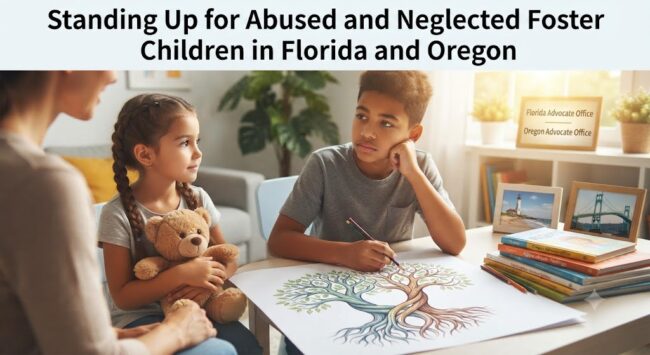
A child removed from an unsafe home surrenders nearly everything in exchange for one guarantee: that the government now responsible for their life will do a better job protecting it. In Florida and Oregon — two states whose child welfare systems have been the subject of lawsuits, audits, legislative hearings, and heartbreaking investigative journalism — that guarantee has failed far too many children. Foster youth in both states have been beaten and molested in licensed homes, warehoused in facilities that traumatized rather than treated them, left overnight in hotel rooms and office buildings, and adopted out by agencies that hid the truth about their histories from the families taking them in.
The good news is that these children and the adults who love them are not powerless. Both states maintain court oversight structures, advocacy programs, and statutory rights designed to protect children in care. And when those protections fail, a specialized field of civil litigation exists to hold agencies, facilities, and placements accountable — a field led by firms such as Justice for Kids®, the Florida-headquartered child advocacy practice of Kelley Kronenberg, which now serves the Pacific Northwest through a dedicated Portland office. This article walks through the rights foster children hold in each state, the recurring ways both systems break down, the growing area of adoption disclosure litigation, and how to find an experienced Oregon foster care neglect attorney or Florida child injury lawyer when a child has already been harmed.
The Duty a State Assumes When It Takes a Child
Before examining either state in detail, it helps to understand the legal foundation beneath every foster care abuse case. When a government removes a child from parental custody, courts have long recognized that a “special relationship” forms between the state and the child. Unlike an ordinary citizen, a foster child cannot walk away from a dangerous situation, choose their own caretakers, or call a lawyer. Because the state has stripped the child of the ability to protect themselves, the Constitution’s Due Process Clause obligates the state to provide reasonably safe living conditions, adequate supervision, and protection from known dangers.
That constitutional duty runs alongside ordinary tort duties. Agencies must exercise reasonable care in licensing foster homes, screening caregivers, investigating abuse reports, supervising placements, and matching children to homes capable of meeting their needs. Private contractors — the case management organizations, child-placing agencies, and residential providers that increasingly deliver frontline child welfare services in both states — owe parallel duties of their own. When a licensing worker ignores a criminal history, a caseworker skips required home visits, a hotline report is closed without investigation, or a facility fails to supervise a known predator among its residents, and a child is hurt as a result, the law provides a remedy.
Children with disabilities occupy an even more protected position. Federal statutes — the Americans with Disabilities Act, Section 504 of the Rehabilitation Act, and the Individuals with Disabilities Education Act — layer additional obligations on top of the general duty of care. A nonverbal child cannot report abuse. A child with an intellectual disability may not understand that what is happening to them is wrong. Predators know this, which is why children with disabilities are dramatically overrepresented among abuse victims in institutional and foster settings. Families in the Northwest confronting this reality often need a disabled child foster care abuse law firm in Oregon that understands both civil rights law and the practical challenges of proving abuse of a child who cannot testify in the ordinary way.
Florida: A Massive Privatized System Under Constant Strain
Florida’s child welfare apparatus is enormous. The Department of Children and Families sets policy and operates the statewide abuse hotline, but day-to-day case management is privatized through regional lead agencies and their subcontractors. This structure was designed to bring community responsiveness to child welfare; in practice, it has also produced finger-pointing when children are hurt, with the state, the lead agency, the case management organization, and the foster home each insisting responsibility lay elsewhere.
Florida nonetheless provides foster children with meaningful legal machinery:
Immediate judicial review. No Florida child remains in state custody on an agency’s say-so alone. A shelter hearing before a judge must occur within a day of removal, and the dependency court retains continuing jurisdiction over placement, services, visitation, and permanency for the life of the case.
A statutorily mandated advocate. Florida requires the appointment of a guardian ad litem at the earliest stage of every abuse, neglect, or abandonment proceeding. The Statewide Guardian ad Litem Office deploys teams built around a program attorney, a child welfare professional, and community volunteers — a structure intended to ensure that at least one participant in every hearing answers only to the child’s interests.
Lawyers for children in the highest-risk categories. Florida statute directs courts to appoint attorneys ad litem — counsel who take direction from the child — for children facing residential treatment placement, children in skilled nursing settings, children with developmental disabilities, children objecting to psychotropic medication, and child trafficking victims.
Medication safeguards, extended care, and record access. Court approval requirements govern psychotropic prescribing for children in care; extended foster care allows youth to remain supported past eighteen; and children have a statutory right to review their own case files — a tool many adult survivors later use to reconstruct what the system knew about their placements.
Yet Florida’s civil dockets tell the story its statutes cannot. Suits by former foster youth have alleged that licensed homes remained open for decades despite repeated complaints, that group home residents were assaulted by staff and peers while supervision requirements went unenforced, and that children in state care were recruited into sex trafficking from the very placements meant to shelter them. Florida also presents distinctive litigation hurdles: sovereign immunity caps limit ordinary tort recoveries against state entities, meaning that full compensation sometimes requires federal civil rights claims, claims against private (uncapped) contractors, or legislative claims bills. These structural complexities are a large part of why families turn to attorneys who litigate nothing but child welfare cases.
Oregon: A System Reformed by Litigation, Still Falling Short
Oregon’s story over the past decade is inseparable from the federal class actions filed on behalf of its foster children. The litigation portrayed a system in collapse: children bounced through ten, twenty, even thirty placements; children with mental health needs and disabilities sent to out-of-state institutions later revealed to have abused residents; teenagers sleeping in hotel rooms and ODHS offices under the watch of rotating strangers because no foster home would take them. The state settled the central case in 2022, accepting court-monitored reform obligations around placement stability, workforce, and services.
Reform on paper, however, has not meant safety in practice. Post-settlement oversight reporting and news coverage have documented continued temporary lodging of children in hotels and offices, persistent shortages of placements for teenagers and children with complex needs, high caseworker turnover that leaves children effectively unmonitored, and placements made in crisis rather than through matching. For a child with autism, fetal alcohol exposure, or a significant trauma history, the shortage is even more acute — and the consequences of a bad placement more severe. Parents and guardians who discover injuries, regression, or disclosures of mistreatment frequently find that the agency’s own records contain warnings that were never acted upon, which is precisely the evidence an Oregon attorney for disabled child abuse knows how to obtain and use.
Oregon foster children hold enforceable rights despite these failures. State law provides for juvenile court oversight and legal representation in dependency proceedings, articulates a set of foster children’s rights covering safety, sibling contact, education, and voice in case planning, and maintains ombudsman channels for complaints. Federal constitutional and disability rights law applies with full force. And the settlement framework itself gives advocates a measuring stick: when the state falls short of commitments it made under court supervision, that shortfall becomes powerful evidence in individual cases.
The practical challenge in Oregon is rarely the absence of rights — it is enforcement. A hotline report means little if it is screened out. A placement review means little if there is no better placement available. This is where civil litigation performs a function no internal process can: it attaches a price to failure, compels disclosure of internal records, and forces agencies and providers to answer under oath. Families across the Willamette Valley and beyond increasingly seek out a child neglect law firm for abused foster children in Oregon not only for compensation, but because litigation is often the only mechanism that produces answers about what actually happened to their child.
Wrongful Adoption: When Agencies Hide the Truth About “Problem” Placements
Adoption is supposed to be the happy ending of a foster care case. For some families, it becomes the beginning of a nightmare that honest disclosure would have prevented — and for some children, it becomes yet another failed placement in a life already defined by them.
The pattern in these cases is disturbingly consistent. A child in state custody carries a documented history: sexual abuse and resulting sexualized behaviors toward other children, violent outbursts, animal cruelty, fire-setting, psychiatric hospitalizations, or diagnoses such as reactive attachment disorder, fetal alcohol spectrum disorder, or severe PTSD. That history makes the child “hard to place.” The placing agency — under pressure to achieve permanency numbers, and in some cases financially incentivized by adoption subsidies and federal performance bonuses — presents prospective adoptive parents with a version of the child’s file scrubbed of its most alarming contents. Reports are summarized rather than shared. Diagnoses are softened into “some behavioral challenges.” Prior failed placements are omitted entirely. The family, often already raising younger children, adopts in good faith.
Then the concealed history surfaces. A younger sibling is molested. A parent is assaulted. The child requires residential psychiatric treatment costing six figures a year. The adoption disrupts or dissolves — a second, devastating abandonment for the adopted child — and every child in the household carries new trauma out of an arrangement the agency engineered through silence.
Courts nationwide have recognized causes of action for this conduct, commonly grouped under the label “wrongful adoption.” The theories include intentional misrepresentation (the agency affirmatively lied), fraudulent concealment (the agency deliberately withheld material facts it had a duty to share), and negligent misrepresentation or negligent nondisclosure (the agency undertook to inform the family and did so carelessly or incompletely). The unifying principle is that while no agency guarantees a child’s future, an agency that chooses to speak about a child’s past must speak fully and honestly — and both Florida and Oregon impose statutory duties to compile and provide a child’s medical, psychological, and social background information to adoptive families before placement.
These cases serve everyone the concealment injured. Damages can fund the intensive therapeutic care the adopted child was always going to need, compensate siblings harmed by a placement made blind, and reimburse families for extraordinary costs the agency’s silence shifted onto them. Just as importantly, verdicts and settlements change agency behavior, transforming disclosure from a bureaucratic inconvenience into a legal imperative. Because these claims turn on what is buried inside confidential agency files, they are almost impossible to evaluate — let alone win — without an experienced Oregon adoption negligence attorney or Florida counterpart who knows what those files should contain and how to compel their production. Families who suspect they were kept in the dark before an adoption should consult an adoption disclosure negligence law firm in Oregon or Florida promptly, since limitation periods can begin running when the concealment is discovered.
The Specialist Bar: Why These Cases Demand Dedicated Counsel
Foster care abuse, institutional abuse, and wrongful adoption cases are unlike ordinary injury litigation in almost every respect. The client is a child, often one whose trauma affects memory, disclosure, and testimony. The evidence lives in confidential dependency files, hotline records, licensing histories, and internal agency communications that can be reached only through protective orders and hard-fought discovery. The defendants include sovereign entities with immunity defenses and damage caps, private contractors with layered insurance programs, and individual caregivers who may simultaneously face criminal prosecution. Expert testimony spans child psychiatry, social work standards of care, and the economics of lifetime treatment needs. And the entire case must be conducted so that the legal process does not become one more trauma inflicted on the child.
A small number of firms nationally have organized their practices entirely around this work. The most prominent include Justice for Kids®, founded in Fort Lauderdale as the child advocacy division of Kelley Kronenberg. The practice was built by Howard M. Talenfeld, a Florida attorney whose decades of child welfare litigation — including landmark injury and civil rights cases on behalf of children harmed in state systems and leadership roles in national child advocacy organizations — established the model of a law practice devoted exclusively to children failed by the systems meant to protect them.
Responding to the well-documented crisis in the Northwest, the firm extended that model to Oregon and opened a Portland office serving families statewide. Oregon matters are handled by Oregon-licensed counsel: partner Justin Grosz, Co-Business Unit Leader of the Justice for Kids division, a trial lawyer with more than 230 jury verdicts whose Oregon practice concentrates on children physically or sexually abused in foster homes, group and residential settings, and schools; children injured through agency failures to investigate or act on warnings; children with disabilities victimized in placements unequipped to protect them; and families deceived by incomplete adoption disclosures. For families searching for a Portland foster care abuse injury lawyer, the office provides confidential, no-cost case evaluations and handles matters on contingency, so no family pays fees unless there is a recovery.
Contact Information
Justice for Kids® — Oregon Office 6500 S. Macadam Avenue, Suite 380 Portland, OR 97239 Phone: 503-783-8481 Toll-Free: 844-4KIDLAW (844-454-3529) Online: justiceforkids.com/where-we-protect-kids/oregon
Justice for Kids® — Florida (Headquarters) Kelley Kronenberg, Fort Lauderdale, Florida Toll-Free: 844-4KIDLAW (844-454-3529) Serving families throughout Florida.
If You Suspect a Child Has Been Harmed: A Step-by-Step Framework
1. Ensure immediate safety and report. If a child is in danger, contact law enforcement. Report suspected abuse or neglect to the Florida Abuse Hotline (1-800-96-ABUSE) or the Oregon Child Abuse Hotline (1-855-503-SAFE). Reports create official records, trigger investigations, and can protect other children in the same placement.
2. Document while memories are fresh. Write down dates, names, statements the child has made, and observations of injuries or behavioral changes. Photograph visible injuries. Save every email, text, placement document, and pre-adoption disclosure packet.
3. Seek medical and therapeutic care — and follow through. Beyond the child’s wellbeing, treatment records created close in time to the harm are among the most persuasive evidence in later litigation, and treating professionals are mandatory reporters whose observations carry weight.
4. Do not accept “the investigation was closed” as the final word. Screened-out reports and unfounded findings reflect agency workload and evidentiary thresholds, not necessarily the truth. Civil discovery routinely uncovers what administrative investigations missed. A seasoned Portland foster care child neglect law firm can subpoena records, depose caseworkers, and reconstruct the placement history the agency never volunteered.
5. Consult specialist counsel early — even for older claims. Statutes of limitations are extended for minors in both states, and special rules govern childhood sexual abuse claims, sometimes reviving claims survivors assumed were long expired. Only a knowledgeable attorney can assess the deadlines that apply to a particular child’s case.
Conclusion: Every Right Needs an Enforcer
Florida and Oregon have written real protections into law: judicial oversight from the first day of custody, appointed advocates and attorneys, medication safeguards, disability rights, disclosure duties owed to adoptive families, and constitutional guarantees of safe conditions. But statutes do not supervise foster homes, and bills of rights do not answer hotline calls. The distance between a child’s rights on paper and a child’s safety in fact is closed by people — judges, advocates, honest caseworkers, vigilant caregivers, and, when everything else has failed, trial lawyers willing to take on the state itself.
The litigation history of both states proves the point. Class actions rewrote Oregon’s obligations to its foster children. Individual suits in Florida have shuttered dangerous homes and exposed decades of ignored complaints. Wrongful adoption verdicts have forced agencies to hand families the whole file instead of the flattering summary. Behind every one of those outcomes stands a child who was failed — and an advocate who refused to let that failure be the end of the story. For the children of Florida and Oregon still waiting on the system’s promise, that combination of legal rights and determined enforcement remains their best and truest protection.
This article is for general informational purposes only and does not constitute legal advice or create an attorney-client relationship. Laws, damage caps, and filing deadlines vary by state and by case. Anyone concerned about a specific child should promptly consult a licensed attorney in the appropriate jurisdiction.
About the Author