What Every Boater Needs to Know About Operating on Florida Waters
Florida hosts approximately 1 million registered recreational vessels — more than any other American state. The state’s 1,350 miles of coastline, thousands of inland lakes and rivers, distinctive intercoastal waterway, hundreds of marinas and boat ramps, and substantial recreational boating culture make it arguably the most consequential American boating state. From Naples on the Gulf to Jupiter on the Atlantic, from the Florida Keys through Tampa Bay through the St. Johns River through the Panhandle, Floridians and visitors operate boats year-round in numbers that would be remarkable anywhere else but feel routine in Florida.
That extraordinary scale of recreational boating activity has produced an equally substantial body of Florida boating law — combining federal maritime regulations, Florida statutes, county and municipal ordinances, environmental protection requirements, safety regulations, and the broader legal framework that affects everyone who operates a vessel on Florida waters.
For boaters who haven’t given the legal framework substantial attention, the rules can feel surprisingly comprehensive. Boater safety education requirements. Vessel registration mandates. Operating under the influence laws with serious criminal consequences. Manatee zone regulations. No-wake zones. Anchoring restrictions. Insurance considerations. Accident reporting requirements. Children safety equipment rules. Distance-from-swimmers requirements. The enforcement infrastructure of FWC officers, U.S. Coast Guard, county sheriffs marine units, and local police marine patrols.
This article walks through the essential framework of Florida boating law — what every Florida boater needs to understand about operating vessels legally on Florida waters, how the regulatory framework actually works, and what consequences can flow from violations. The goal isn’t to make you a boating lawyer; it’s to give you working knowledge that helps you operate legally, avoid problems, and understand when professional legal help may be needed.
This article is for informational and educational purposes only and is not legal advice. Boating law involves complex federal, state, local, and regulatory considerations that vary substantially based on specific circumstances. Always consult qualified licensed attorneys for specific matters affecting your situation. If you have been involved in a boating accident, charged with a boating offense, or face potential legal exposure, consult qualified counsel immediately rather than relying on general informational articles.
The Regulatory Framework: Multiple Authorities at Once
Before getting into specific rules, the structure of Florida boating regulation deserves attention.
Florida boating law operates through multiple distinct regulatory authorities that frequently apply simultaneously to the same activities.
Federal Authority
The U.S. Coast Guard maintains substantial federal authority over American waters including Florida coastal waters and many inland waters. Federal jurisdiction includes:
- Vessel safety standards including required equipment, navigation lighting, and broader safety requirements
- Navigation rules including the Inland Navigation Rules and International Navigation Rules
- Boating accident reporting for incidents meeting federal thresholds
- Coast Guard documentation for certain larger vessels
- Federal waters jurisdiction in offshore areas, certain large inland waters, and other federally regulated areas
Florida State Authority
Florida state law governs most recreational boating activity in Florida waters through the Florida Fish and Wildlife Conservation Commission (FWC) and Florida Statutes including Chapter 327 (Vessel Safety Law) and Chapter 328 (Vessel Registration and Identification).
The FWC’s Division of Law Enforcement maintains the substantial state law enforcement authority over Florida boating, with FWC officers operating across Florida waters as the primary state-level enforcement presence.
County and Municipal Authority
Counties and municipalities maintain substantial regulatory authority over local waters through local ordinances addressing:
- Anchoring restrictions
- No-wake zones in specific areas
- Local safety regulations
- Marina and dock regulations
- Specific recreational area rules
Environmental Regulatory Authority
Multiple environmental authorities affect boating activity through species protection (particularly manatees), water quality regulations, ecosystem protection, and broader environmental requirements affecting how vessels can operate in protected areas.
The Practical Reality
For everyday boaters, the practical reality is that operating a vessel in Florida waters involves compliance with federal navigation rules, Florida state safety and registration requirements, local ordinances applicable to specific waters, and environmental regulations protecting specific species and ecosystems — frequently all simultaneously.
Brian’s Take: Most Florida Boaters Don’t Fully Appreciate How Comprehensive the Regulatory Framework Actually Is Until Something Goes Wrong.
Florida’s recreational boating culture is so embedded in daily life that many boaters operate vessels for years without thinking carefully about the regulatory framework affecting their activities. Most of the time, this works out — boaters operate reasonably, follow common-sense practices, and never encounter serious legal issues. But when something goes wrong — an accident, an enforcement contact, an injury, a property damage incident — the substantial regulatory framework suddenly matters intensely, and boaters who haven’t paid attention to the rules often face consequences they didn’t anticipate. Florida boaters benefit substantially from understanding the regulatory framework before incidents occur rather than learning about it through enforcement contact or litigation.
— Brian
Vessel Registration Requirements
Florida law requires registration of most motorized vessels operating in Florida waters.
Registration Basics
The Florida Department of Highway Safety and Motor Vehicles (DHSMV) administers vessel registration through county tax collector offices. Registration requirements include:
- Initial registration when vessel ownership changes or when first registered in Florida
- Annual renewal maintaining current registration
- Display requirements including registration numbers and decals affixed to vessel hulls
- Documentation including bills of sale, prior registrations, and identification
Vessels Requiring Registration
Generally, motorized vessels operating in Florida waters require registration. Specific exemptions may apply to:
- Vessels documented with the U.S. Coast Guard
- Certain non-motorized vessels
- Vessels meeting specific exemption criteria
Display Requirements
Registration numbers must be displayed on both sides of the bow according to specific format requirements, with current registration decals affixed in required locations. Failure to properly display registration creates enforcement issues.
Penalties for Non-Registration
Operating an unregistered vessel that should be registered creates legal violations with potential penalties including fines and other consequences.
Boater Safety Education Requirements
Florida law requires boater safety education for many vessel operators.
Who Must Complete the Course
Florida law requires boater safety education for anyone born on or after January 1, 1988, who operates a vessel of 10 horsepower or more. Operators meeting this requirement must:
- Complete an approved boater safety course
- Carry photographic identification and the boating safety education ID card when operating
- Display credentials to enforcement officers when requested
Acceptable Courses
Multiple acceptable courses satisfy the requirement, including:
- Florida Fish and Wildlife Conservation Commission approved courses
- U.S. Coast Guard Auxiliary courses
- U.S. Power Squadrons courses
- National Association of State Boating Law Administrators (NASBLA) approved courses
- Various online options approved by FWC
Practical Implications
For Florida boaters meeting the age requirement, completing boater safety education before operating vessels of 10+ horsepower is a legal requirement, not optional best practice. Operating without required certification creates legal violations.
Course Content
Approved courses generally cover navigation rules, required safety equipment, accident reporting, environmental considerations, vessel handling, weather considerations, emergency procedures, and broader safety topics that all Florida boaters benefit from understanding.
Required Safety Equipment
Florida boaters must carry specific required safety equipment varying by vessel size and type.
Personal Flotation Devices (Life Jackets)
Federal and Florida law require:
- One U.S. Coast Guard-approved wearable life jacket of appropriate size for each person on board
- Life jackets must be readily accessible (not in original packaging or stored where inaccessible)
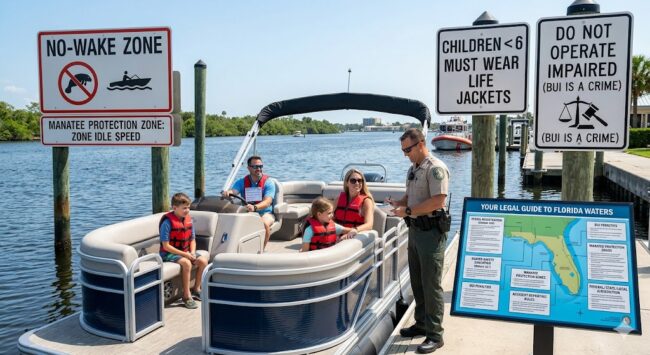
- Children under 6 must wear a life jacket while on a vessel under 26 feet that is underway
- Throwable Type IV PFDs required on vessels 16 feet or longer
Fire Extinguishers
Most powered vessels require U.S. Coast Guard-approved fire extinguishers based on vessel size and configuration, with specific requirements varying by vessel type.
Visual Distress Signals
Vessels operating in coastal waters generally require visual distress signals — including pyrotechnic flares, electronic distress signals, or other approved signaling devices. Specific requirements vary by vessel size and waters of operation.
Sound-Producing Devices
Vessels require sound-producing devices — typically horns or whistles — appropriate to vessel size for navigation signaling.
Navigation Lights
Vessels operating between sunset and sunrise must display required navigation lights according to federal Navigation Rules.
Backfire Flame Arrestors and Ventilation
Inboard gasoline engines require backfire flame arrestors and proper engine compartment ventilation.
State-Specific Requirements
Florida-specific requirements may apply additionally, including specific equipment requirements for certain waters or vessel types.
Boating Under the Influence: Serious Criminal Consequences
Operating a vessel while impaired by alcohol or drugs creates serious criminal exposure under Florida law.
Florida BUI Standards
Florida Boating Under the Influence (BUI) law applies to operating a vessel while:
- Blood alcohol concentration of 0.08 or higher (same threshold as DUI for vehicles)
- Impaired by alcohol to the extent normal faculties are impaired
- Impaired by controlled substances to the extent normal faculties are impaired
- For commercial vessel operators, lower thresholds may apply
Criminal Penalties
BUI penalties are substantial and similar to DUI penalties, including:
- First offense — fines up to $1,000, possible imprisonment up to six months
- Second offense — increased fines and potential extended imprisonment
- Third offense — felony charges with substantially increased penalties
- BUI causing serious bodily injury — felony charges with substantial imprisonment exposure
- BUI manslaughter — second-degree felony with potential 15-year imprisonment
Implied Consent
Florida operates under implied consent for BUI testing — operating a vessel in Florida waters constitutes implied consent to chemical testing if lawfully arrested for BUI. Refusal creates additional legal consequences.
Practical Reality
The combination of recreational boating culture, substantial alcohol consumption that frequently accompanies recreational boating, and serious BUI enforcement creates substantial legal exposure for Florida boaters. The “boating with a beer” recreational culture that many Florida boaters consider normal can produce serious criminal consequences if it crosses into impaired operation.
Enforcement
Florida BUI enforcement is substantial, with FWC officers, U.S. Coast Guard, and local marine patrol units actively conducting BUI enforcement particularly during high-traffic boating periods, holiday weekends, and at popular boating destinations.
Brian’s Take: BUI Enforcement Is Substantially More Active in Florida Than Most Recreational Boaters Appreciate.
The combination of Florida’s substantial recreational boating activity, the cultural normalcy of alcohol consumption during boating, and the serious BUI legal consequences creates a regulatory environment where many recreational boaters face genuine legal exposure they don’t fully appreciate. FWC officers, Coast Guard personnel, and local marine patrol units actively enforce BUI laws — particularly during peak boating periods, at popular destinations, and following accidents. The legal consequences of BUI conviction extend far beyond the immediate criminal penalties to include substantial impacts on insurance, professional licensing, immigration status, and broader life consequences. Florida boaters benefit substantially from approaching alcohol consumption while boating with the same caution they would apply to driving — including designating non-drinking operators, using transportation alternatives, and avoiding the assumption that boating creates exceptions to impaired-operation legal frameworks.
— Brian
Reckless and Careless Operation
Beyond BUI specifically, Florida law prohibits reckless and careless vessel operation.
Reckless Operation
Florida Statutes Section 327.33 makes reckless vessel operation a first-degree misdemeanor. Reckless operation involves operating a vessel “in willful or wanton disregard for the safety of persons or property.” Penalties can include fines up to $1,000 and imprisonment up to one year.
Careless Operation
Careless operation — a lower standard than reckless — applies when operators fail to use due care given the circumstances. Careless operation creates noncriminal infraction liability with fine consequences.
Common Examples
Examples of operations potentially constituting reckless or careless operation include:
- Operating at excessive speed in restricted areas
- Operating too close to swimmers, divers, or other vessels
- Failing to maintain proper lookout
- Operating in conditions exceeding vessel capability
- Wake disturbance creating dangers to other vessels or property
- Failing to follow navigation rules creating collision risks
Manatee Protection Zones
The federally protected West Indian manatee creates substantial regulatory considerations for Florida boaters.
Manatee Zone Types
Florida waters include multiple manatee protection zone types:
- Slow speed zones requiring vessels to operate at minimum speed needed for steerage
- Idle speed zones requiring vessels to operate at minimum speed
- No entry zones prohibiting vessel entry entirely
- Seasonal zones with restrictions during specific periods (typically when manatees are most concentrated)
Posted Zone Requirements
Manatee protection zones are typically marked with signage indicating specific restrictions. Boaters must:
- Recognize and comply with zone signage
- Reduce speed appropriately when entering posted zones
- Maintain distance from manatees when sighted
- Avoid disturbing manatees through proximity, contact, or other interactions
Penalties
Manatee zone violations create substantial penalties including:
- State law violations with criminal and civil penalties
- Federal Marine Mammal Protection Act violations with substantial federal penalties
- Federal Endangered Species Act violations potentially applicable
- Substantial fines that can reach thousands of dollars per violation
Practical Importance
Manatee zones are taken seriously by enforcement authorities, with FWC officers actively enforcing zone requirements. The combination of distinctive enforcement, substantial penalties, and federal protection creates substantial legal exposure for boaters who don’t pay careful attention to manatee zone requirements.
No-Wake Zones and Speed Restrictions
Beyond manatee zones specifically, Florida waters include extensive speed restriction areas.
No-Wake Zones
No-wake zones require vessels to operate at minimum speed creating no wake. Common no-wake zone locations include:
- Marina entrances and basins
- Areas near bridges and docks
- Residential canal systems
- Swimming areas
- Areas near boat ramps
- Specific designated areas
Slow Speed Zones
Slow speed zones require operating at speeds that allow safe vessel control while creating reduced wake.
Recognition and Compliance
Zone boundaries are typically marked with signage. Boaters must:
- Reduce speed appropriately when entering posted zones
- Maintain compliant speed throughout zone transit
- Resume normal speed only after exiting zones completely
Enforcement
No-wake and slow-speed zone violations generate substantial enforcement activity, particularly in areas where wake creates property damage or safety risks for other boaters and shoreline residents.
Boating Accident Requirements
Florida law creates specific requirements following boating accidents.
Accident Reporting
Boating accidents meeting specific thresholds require reporting to FWC, including:
- Injuries requiring medical treatment beyond first aid
- Death or disappearance
- Property damage exceeding $2,000
- Total vessel loss
Accident Response Requirements
Following accidents, vessel operators must:
- Render assistance to other persons affected by the accident
- Provide identification to others involved
- Report the accident as required by law
- Cooperate with investigating authorities
Hit-and-Run Provisions
Leaving the scene of a boating accident creates serious criminal exposure under Florida law, particularly when injuries or fatalities are involved.
Practical Implications
Boating accidents create immediate legal obligations that affect operators substantially. The combination of accident response requirements, potential criminal exposure, civil liability considerations, and insurance implications makes accidents one of the most legally consequential boating events.
Boating Insurance Considerations
While Florida doesn’t generally require boating insurance for recreational vessels, insurance considerations matter substantially.
Liability Exposure
Boating accidents can produce substantial liability exposure including:
- Bodily injury claims from injured parties
- Property damage claims for vessel damage, dock damage, and other property
- Medical expense claims
- Wrongful death claims in fatal accidents
- Defense costs for litigation regardless of outcome
Insurance Coverage Options
Recreational boating insurance options typically include:
- Liability coverage for damage to others
- Hull coverage for vessel damage
- Medical payments coverage
- Uninsured/underinsured boater coverage
- Personal effects coverage
- Towing coverage
- Specialized coverage for fishing equipment, electronics, and other vessel-specific items
Marina and Storage Insurance
Vessels stored at marinas or other facilities frequently require insurance as a condition of dockage agreements.
Financial Responsibility
Even without insurance, vessel owners may face financial responsibility requirements following accidents, with substantial implications for personal financial exposure.
Children and Vessel Operation
Florida law includes specific provisions affecting children on vessels.
Life Jacket Requirements
Children under 6 years of age must wear a U.S. Coast Guard-approved life jacket while on board a vessel under 26 feet in length that is underway.
Operation by Minors
Specific provisions affect vessel operation by minors, including age and education requirements that affect when minors can legally operate vessels.
Personal Watercraft Restrictions
Personal watercraft (jet skis, etc.) have additional restrictions including age requirements for operation that exceed restrictions for traditional vessels.
Personal Watercraft Specific Rules
Personal watercraft (jet skis, wave runners, etc.) face additional regulatory requirements.
Operator Age
Personal watercraft operators must be at least 14 years old, with operators 14-21 required to have completed an approved boater safety course.
Safety Equipment
Personal watercraft operators and passengers must wear U.S. Coast Guard-approved life jackets at all times.
Operating Restrictions
Personal watercraft cannot be operated:
- Between sunset and sunrise (with limited exceptions)
- Within specific distances of swimmers, vessels, and other restrictions
- In ways creating dangers to others
Engine Cut-Off Switches
Personal watercraft equipped with engine cut-off switches require their proper use, with the lanyard attached to the operator.
Brian’s Take: Personal Watercraft Operations Generate Disproportionate Legal Issues Relative to Their Numbers in Florida Boating.
Personal watercraft — jet skis, wave runners, and similar vessels — generate substantially more legal problems per vessel than traditional boats in Florida. The combination of high-speed operation, frequent inexperienced operators, rental operations introducing operators to unfamiliar equipment, distance-from-swimmer requirements, and the overall higher accident rate creates substantial legal exposure for personal watercraft operators. Florida boaters considering personal watercraft purchases or rentals benefit substantially from understanding the specific regulatory framework affecting these vessels, the higher liability exposure they create, and the appropriate insurance coverage that addresses personal watercraft risks. Operations that seem like routine recreation can produce serious legal consequences when accidents occur.
— Brian
Anchoring Regulations
Florida boating includes substantial regulatory consideration affecting where and how vessels can anchor.
State Anchoring Law
Florida Statutes generally permit anchoring in most navigable waters, but with specific regulations affecting:
- Anchoring near marinas, mooring fields, and other restricted areas
- Long-term anchoring in specific locations
- Anchoring near residential properties with specific restrictions
- Anchoring during severe weather with potential restrictions
Local Anchoring Ordinances
Counties and municipalities maintain authority over local anchoring ordinances, with substantial variation across Florida communities. Specific local ordinances affect:
- Maximum anchoring duration
- Specific restricted anchoring areas
- Mooring field requirements
- Anchoring near beaches, residential areas, and specific locations
Recent Legislative Changes
Florida anchoring law has been subject to substantial recent legislative attention, with continued evolution affecting how and where boaters can anchor in Florida waters.
Practical Considerations
Boaters should research specific anchoring rules applicable to their planned waters before extended anchoring activity, particularly given the substantial variation across Florida communities.
Environmental Considerations
Beyond manatee protection specifically, broader environmental considerations affect Florida boating.
Sea Turtle Protection
Florida waters host multiple federally protected sea turtle species. Boaters must:
- Avoid disturbing nesting beaches during nesting season
- Maintain distance from sea turtles in water
- Avoid impacts that could harm turtles
Coral Reef Protection
Florida coral reef ecosystems — particularly in the Florida Keys — face substantial protection requirements affecting:
- Anchor placement to avoid coral damage
- Vessel operations in coral areas
- Specific regulations in protected coral areas
Seagrass Protection
Florida seagrass beds receive substantial protection, with regulations affecting:
- Propeller scarring that damages seagrass beds
- Anchoring in seagrass areas
- Specific protected areas with enhanced restrictions
Fish and Wildlife Regulations
Beyond direct vessel operation, fishing regulations, hunting regulations, and broader fish and wildlife regulations affect activities boaters frequently engage in.
Pollution Prevention
Federal and state regulations prohibit:
- Discharge of oil or hazardous substances
- Improper sewage disposal
- Trash and waste discharge
- Other pollution activities
Marine Sanitation and Sewage
Florida law addresses marine sanitation and sewage requirements.
MSD Requirements
Vessels with installed toilets generally require Marine Sanitation Devices (MSDs) meeting U.S. Coast Guard standards.
No-Discharge Zones
Specific Florida waters are designated as no-discharge zones where overboard discharge of any sewage — even from approved MSDs — is prohibited.
Pump-Out Requirements
Vessels must use pump-out facilities at marinas and other locations rather than discharging sewage in restricted areas.
Practical Compliance
Vessels with onboard plumbing should understand applicable sewage regulations to avoid violations that can produce substantial penalties.
What Florida Boaters Should Do When Problems Arise
For Florida boaters facing legal issues — accidents, enforcement contacts, charges, or other situations — several practical steps apply.
Don’t Make Statements Without Counsel
Following accidents or enforcement contacts, avoid making detailed statements to authorities or other parties beyond what’s strictly required. Statements made in the immediate aftermath frequently affect later legal proceedings substantially.
Document Everything
Following accidents, document everything possible — photographs, witness contact information, weather conditions, exact location, vessel information, and broader circumstances.
Notify Insurance Promptly
Following accidents, notify insurance carriers promptly even if no immediate claims are anticipated.
Engage Qualified Counsel for Serious Matters
For BUI charges, accidents involving injuries, criminal charges, substantial property damage, or other serious matters, engage qualified maritime or boating attorneys promptly. The legal consequences of serious boating matters extend far beyond immediate situations into insurance, criminal record, and broader life consequences.
Don’t Delay
Boating legal matters frequently involve specific timelines — accident reporting requirements, statute of limitations for various claims, insurance notification deadlines, and other time-sensitive considerations. Delay can foreclose options that prompt action would preserve.
Consider Professional Maritime Counsel
For substantial matters, qualified maritime attorneys with specific experience in Florida boating law often produce substantially better results than general practitioners with limited maritime experience.
What Comes Next: Continued Evolution of Florida Boating Law
Several trends will shape Florida boating law across coming years.
Continued Anchoring Law Evolution
Florida anchoring law continues evolving through legislative attention, with continued changes likely affecting how boaters can anchor in Florida waters.
Environmental Protection Continued Strengthening
Continued environmental protection considerations — including manatee protection, coral reef protection, seagrass protection, and broader environmental considerations — will continue affecting boating regulations.
Technology Integration
Continued integration of technology in boating safety, navigation, accident reconstruction, and broader regulatory enforcement will continue affecting how boating law operates.
Insurance Industry Evolution
Continued evolution of marine insurance markets will continue affecting financial responsibility considerations for Florida boaters.
Continued Enforcement Activity
FWC, Coast Guard, and local marine enforcement activity will continue at substantial levels reflecting the scale of Florida recreational boating.
Climate Considerations
Continued climate considerations — including hurricane response, storm surge, sea level rise, and broader climate dynamics — will continue affecting boating regulations and practical operations.
The Bottom Line: Florida Boating Law Is More Comprehensive Than Most Boaters Realize
The substantial regulatory framework affecting Florida boating — combining federal Coast Guard authority, Florida state law, county and municipal ordinances, environmental protection requirements, criminal law considerations, civil liability frameworks, and continued regulatory evolution — represents one of the most comprehensive American boating regulatory environments operating today.
For most Florida boaters, the practical reality is that most operations don’t create legal issues — boaters operate reasonably, follow common-sense practices, and never encounter serious problems. The substantial framework primarily affects operations during incidents, accidents, enforcement contacts, and edge cases where the regulatory framework suddenly matters intensely.
For Florida residents, visitors, and businesses involved in recreational boating, understanding the regulatory framework before incidents occur produces substantial benefits compared to learning about the framework through enforcement or litigation experience. The investment of time understanding boater safety education, BUI considerations, accident response requirements, environmental protection rules, and broader regulatory considerations pays dividends in avoiding the situations that produce serious legal consequences.
For Florida boaters facing serious issues — BUI charges, accidents involving injuries, substantial property damage, criminal charges, or other consequential matters — qualified legal representation matters substantially. Don’t navigate serious boating legal matters alone or rely on general informational articles for advice on specific situations.
The water is open. The boats are launching. The regulatory framework continues operating. The enforcement activity continues. The legal consequences of serious situations continue producing substantial implications for those involved. The opportunities to operate legally, enjoyably, and safely continue available to Florida boaters who approach the activity with appropriate awareness of the regulatory framework affecting their operations.
That’s the Florida boating law reality.
That’s a Florida regulatory and recreational reality worth understanding seriously — and one that affects approximately one million registered Florida vessels and the substantial recreational boating community that defines so much of Florida’s distinctive lifestyle and culture.
Disclaimers and Methodology
Article Purpose and Methodology. This article provides a general overview of the boating law framework affecting Florida waters based on publicly available information about federal regulations, Florida state law, local ordinances, and broader regulatory considerations. Information is intended for general informational and educational purposes for Florida boaters, visitors, and others seeking to understand the basic regulatory framework affecting Florida recreational boating. The information reflects general considerations and is not comprehensive.
Important Limitations. This article is not legal advice and should not be relied upon for any specific legal decision, accident response, criminal matter, or other consequential situation. Boating law involves complex federal, state, local, and regulatory considerations that vary substantially based on specific circumstances, geographic locations, vessel characteristics, operator characteristics, and dozens of other factors. Specific matters affecting your situation — including accidents, BUI charges, criminal matters, insurance disputes, civil litigation, regulatory enforcement, or other consequential situations — require qualified licensed attorneys with specific maritime or boating law experience, not reliance on general informational articles. Specific regulations including registration requirements, equipment requirements, manatee zones, no-wake zones, anchoring restrictions, and other regulatory considerations vary by location and circumstance and may have changed since article publication. Always consult qualified professionals, current FWC and Coast Guard publications, and current Florida statutes for advice specific to your circumstances. The author and publisher disclaim any liability for outcomes resulting from the use, application, or interpretation of information in this article. If you have been involved in a boating accident, charged with a boating offense, or face potential legal exposure, consult qualified licensed counsel immediately rather than relying on general informational articles for guidance on serious matters.
Resources & Further Reading
- Florida Fish and Wildlife Conservation Commission — Boating — Official Florida state agency website with comprehensive information on Florida boating regulations, safety education, vessel registration, enforcement, and broader recreational boating considerations.
- U.S. Coast Guard Boating Safety — Official Coast Guard recreational boating safety resource with information on federal regulations, safety equipment, navigation rules, and broader boating safety considerations.
- Florida Statutes Chapter 327 (Vessel Safety Law) — Official Florida statutes governing vessel safety, including BUI, reckless operation, equipment requirements, and broader operational considerations.
- Florida Statutes Chapter 328 (Vessel Registration and Identification) — Official Florida statutes governing vessel registration and identification requirements.
- U.S. Coast Guard Auxiliary — Volunteer organization providing boating safety education and broader recreational boating support.
- National Association of State Boating Law Administrators (NASBLA) — National organization addressing boating safety education, regulation, and broader recreational boating issues.
- Florida Department of Highway Safety and Motor Vehicles — Vessels — Official state resource for vessel registration, titling, and broader administrative requirements.
- BoatUS Foundation — National recreational boating advocacy organization providing safety education, advocacy, and resources for recreational boaters.
About the Author