By Brian French | FloridaLawFirmNews.com | September 9, 2026
Quick Answer
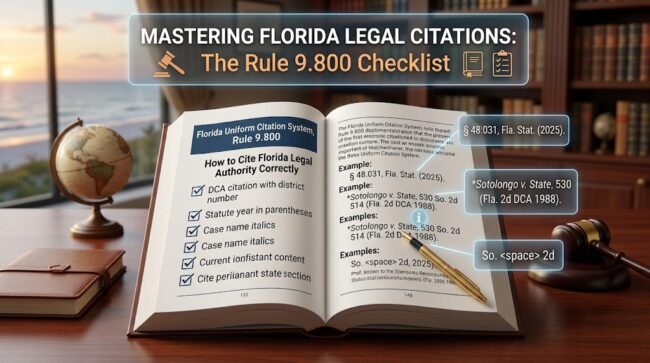
Florida courts require citations in the form set by Florida Rule of Appellate Procedure 9.800, the Uniform Citation System. The rule governs every legal document filed in Florida, including court opinions. It sets the format for Florida Supreme Court and District Court of Appeal cases, trial court decisions, statutes, the state constitution, session laws, administrative rules, court rules and Attorney General opinions. Anything Rule 9.800 does not cover defaults first to The Bluebook and then to the Florida Style Manual.
Why Florida Has Its Own Citation Rule
Most states let The Bluebook govern citation form. Florida adopted Rule 9.800 in 1977 to standardize appellate practice and reduce the burden on courts, and the rule now states that it applies to all legal documents, including court opinions. The rule has been amended repeatedly, most substantially in 2018 (Case No. SC17-999), with the Florida Style Manual’s ninth edition conformed to the version of the rule effective January 1, 2024.
The practical effect is that a Florida judge or law clerk expects a specific format, and a brief that uses generic Bluebook forms for Florida statutes or rules reads as sloppy even when technically understandable. Rule 9.800 also carries one formatting instruction that trips up drafters: citation forms are spelled out in full when they are part of a sentence, and abbreviated only when the citation stands alone in text or a footnote.
Florida Case Citations
Florida Supreme Court
Cases from 1887 forward are cited to the Southern Reporter with the court designation “Fla.” and the year:
Fenelon v. State, 594 So. 2d 292 (Fla. 1992).
Cases from 1846 to 1886 cite to the original Florida Reports, such as Livingston v. L’Engle, 22 Fla. 427 (1886). Note the required space between “So.” and “2d” or “3d,” a point the Supreme Court specifically clarified in a 1992 amendment. Modern opinions are in Southern Reporter, Third Series (So. 3d).
District Courts of Appeal
DCA citations add the district number and “DCA” inside the parenthetical:
Sotolongo v. State, 530 So. 2d 514 (Fla. 2d DCA 1988).
Florida now has six districts. The Sixth District Court of Appeal began operating January 1, 2023, so cases from Lakeland are cited as (Fla. 6th DCA 2024). The 2023 realignment also moved counties between districts, which matters when you are checking whether a decision is binding in your trial court.
When a case is not yet in the Southern Reporter
Rule 9.800 sets a strict hierarchy for recent opinions. Cite first to Florida Law Weekly:
Myers v. State, 16 Fla. L. Weekly D1507 (Fla. 4th DCA June 5, 1991).
If the case is not in Florida Law Weekly, cite the slip opinion by docket number and full date, and you may add a parallel Westlaw or LEXIS citation:
Williams v. State, No. 2D14-2438, 2014 WL 3418358 (Fla. 2d DCA June 12, 2014).
Supreme Court slip opinions use the “SC” docket prefix, such as No. SC10-1544. Florida Law Weekly page prefixes carry meaning: “S” pages are Supreme Court, “D” pages are DCA decisions, “C” pages are circuit court and “Fed.” is the federal supplement.
Circuit and county courts
Trial court decisions cite to Florida Law Weekly Supplement with the circuit number or county named:
State v. Ruoff, 17 Fla. L. Weekly Supp. 619 (Fla. 17th Cir. Ct. Feb. 13, 2010).
Gables Ins. Recovery v. Progressive Am. Ins. Co., 22 Fla. L. Weekly Supp. 637 (Miami-Dade Cty. Ct. Oct. 8, 2014).
Older decisions cite to Florida Supplement or Florida Supplement Second. Because trial court orders are persuasive only, many practitioners cite them sparingly, but PIP and insurance litigation relies on them heavily.
Statutes, Constitution and Session Laws
| Authority | Rule 9.800 form |
|---|---|
| Florida Statutes | § 48.031, Fla. Stat. (2025). |
| Statutes supplement | § 120.54, Fla. Stat. (Supp. 1998). |
| Fla. Stat. Annotated | 7 Fla. Stat. Ann. § 95.11 (2017). |
| Constitution (current) | Art. V, § 3(b)(3), Fla. Const. |
| Constitution (historical) | Art. V, § 3(b)(3), Fla. Const. (1972). |
| Laws of Florida after 1956 | Ch. 74-177, § 5, Laws of Fla. |
| Laws of Florida before 1957 | Ch. 22000, Laws of Fla. (1943). |
| Administrative Code | Fla. Admin. Code R. 62D-2.014. |
| Attorney General opinion | Op. Att’y Gen. Fla. 73-178 (1973). |
Three details generate most of the errors here. First, the statute year is the year of the Florida Statutes edition, not the year the section was enacted; use the edition in force at the relevant time. Second, the Florida form places “Fla. Stat.” after the section number, unlike the Bluebook’s “Fla. Stat. § 48.031.” Third, when a constitutional provision, rule or administrative rule has been amended or repealed, the rule requires the year of the version being cited.
Session laws are cited by chapter number in the year-number format (“Ch. 74-177”) for laws after 1956. Before 1957 chapters were numbered sequentially, so the year goes in a parenthetical.
Florida Court Rules
Rule 9.800(j) lists 23 sets of rules with their abbreviations. The ones lawyers cite most:
| Rule set | Abbreviation |
|---|---|
| Civil Procedure | Fla. R. Civ. P. 1.180 |
| Criminal Procedure | Fla. R. Crim. P. 3.850 |
| Appellate Procedure | Fla. R. App. P. 9.100 |
| General Practice & Jud. Admin. | Fla. R. Gen. Prac. & Jud. Admin. 2.110 |
| Family Law | Fla. Fam. L. R. P. 12.010 |
| Probate | Fla. Prob. R. 5.120 |
| Traffic Court | Fla. R. Traf. Ct. 6.165 |
| Small Claims | Fla. Sm. Cl. R. 7.070 |
| Juvenile | Fla. R. Juv. P. 8.070 |
| Rules Regulating Fla. Bar | R. Regulating Fla. Bar 4-1.10 |
| Code of Judicial Conduct | Fla. Code Jud. Conduct, Canon 4B |
| Std. Jury Instr. (Civil) | Fla. Std. Jury Instr. (Civ.) 601.4 |
| Std. Jury Instr. (Criminal) | Fla. Std. Jury Instr. (Crim.) 3.7 |
The 2021 renaming of the Rules of Judicial Administration to the Rules of General Practice and Judicial Administration changed the abbreviation; briefs still citing “Fla. R. Jud. Admin.” are using a retired form.
Administrative Agency Decisions
Subdivision (d) was rewritten in 2011 and again in 2018 after agencies began posting orders on the Division of Administrative Hearings website instead of printed reporters. The current forms cite the docket number, agency and date, with the order type in a parenthetical:
Dep’t of Fin. Servs., Div. of Ins. Agent & Agency Servs. v. Pearson, No. 13-4478PL (Fla. DOAH Oct. 15, 2014) (Recommended Order).
A final order adds the order number, such as (Final Order No. DOH-12-2692-FOF-MQA). Subsequent history strings the recommended order, final order and any DCA review together with italicized connectors such as adopted with reduced penalty and aff’d in part and rev’d in part. Only decisions not available online are cited to the older administrative reporters (F.A.L.R., F.C.S.R., F.P.E.R. and similar).
Federal Authority in Florida Filings
Rule 9.800 also prescribes federal forms, and they differ slightly from the Bluebook. U.S. Supreme Court cases cite to United States Reports, then Supreme Court Reporter, then Florida Law Weekly Federal, then the slip opinion. Eleventh Circuit cases cite to the Federal Reporter, then Florida Law Weekly Federal, then Federal Appendix, then slip opinion. District court cases cite to Federal Supplement, then Florida Law Weekly Federal, then slip opinion, with Westlaw or LEXIS parallels optional. The U.S. Constitution is cited Florida-style with the article first: Art. IV, § 2, cl. 2, U.S. Const.
Typeface, Pinpoints and Signals
Rule 9.800(q) requires case names to be underscored or italicized in both text and footnotes. Pinpoint citations to the Southern Reporter page are described as optional but preferred; in practice, appellate judges treat a missing pinpoint as a defect. Signals (see, see also, cf., but see) and short forms (Id. and supra) come from the Bluebook under subdivision (p), and the Florida Style Manual, published by the FSU Law Review, fills gaps such as legislative staff analyses, bill citations and executive orders that neither source addresses.
How Courts Check Citations
Florida appellate courts do not have a citation police office, but three mechanisms enforce the rule. Rule 9.045 governs document form and gives clerks authority to reject nonconforming filings. Law clerks verify every cited authority, and a wrong reporter, missing district designation or stale statute year costs credibility with the panel. Since 2023, Florida courts have also confronted AI-generated briefs containing fabricated cases, and several judges have issued sanctions orders under Rule 2.515 and the Rules Regulating the Florida Bar. A citation in perfect 9.800 form that leads to a case that does not exist is worse than a formatting error.
Brian’s Take
Citation form looks like clerical work until you are the one reading the brief. Judges and clerks decode dozens of filings a week, and the Florida forms exist so that a reader can go from “Fla. 2d DCA 2019” to the right shelf, the right district and the right precedential weight in one glance. The firms that get this consistently right tend to be the ones with a citation checklist in the drafting workflow. The single most common error I see quoted in published opinions is the wrong statute year, which changes the law being argued.
Frequently Asked Questions
Does Florida use the Bluebook?
Only as a backup. Rule 9.800 controls; the Bluebook applies to citations the rule does not cover, and the Florida Style Manual covers what the Bluebook misses.
How do I cite a Florida statute?
Section symbol, section number, “Fla. Stat.,” and the edition year in parentheses: § 95.11, Fla. Stat. (2025).
How do I cite a case from the new Sixth DCA?
Same as other districts: Case Name, ___ So. 3d ___ (Fla. 6th DCA 2024).
What if the case is not in the Southern Reporter yet?
Cite Florida Law Weekly; if not there, the slip opinion by docket number and date, with an optional Westlaw or LEXIS parallel.
Are pinpoint citations required?
The rule calls them optional but preferred. Treat them as required in appellate briefs.
Sources and Further Reading
- Florida Rule of Appellate Procedure 9.800, full text (Florida Style Manual reproduction): https://www.floridastylemanual.com/florida-rule-of-appellate-procedure-9800
- Florida Style Manual, Florida State University Law Review: https://www.floridastylemanual.com/
- In re Amendments to Florida Rule of Appellate Procedure 9.800, No. SC17-999 (Fla. Oct. 25, 2018): https://www.floridalawweekly.com/forms/sc17-999.pdf
- Rule 9.800 with committee notes and amendment history: https://rules.floridaappellate.com/rule-9-800/
- The Florida Bar Journal – Legal Citation: Which Guide Should You Use: https://www.floridabar.org/the-florida-bar-journal/legal-citation-which-guide-should-you-use-and-what-is-the-difference/
- Florida Supreme Court proposed Rule 9.800 two-column comparison: https://supremecourt.flcourts.gov/content/download/326817/file/04-108_TwoColumnProposedR9.800.pdf
- In re Amendments to Florida Rules (1992 Rule 9.800 clarification), Justia: https://law.justia.com/cases/florida/supreme-court/1992/79619-0.html
- RuleDex – Rule 9.800 Uniform Citation System: https://ruledex.com/florida/florida-rules-of-appellate-procedure/rule-9-800-uniform-citation-system/
About the Author