By Brian French | FloridaLawFirmNews.com | September 9, 2026
Quick Answer
The “code” on a Florida traffic ticket is the Florida Statute number the officer says you violated. Most begin with 316 (traffic laws), 320 (registration) or 322 (driver licenses). The number determines whether the ticket is a civil infraction or a criminal charge, the base fine, how many points go on your license, and whether you must appear in court. This guide decodes the citation form, the most common statute codes, the points schedule and your options after a ticket.
How to Read a Florida Uniform Traffic Citation
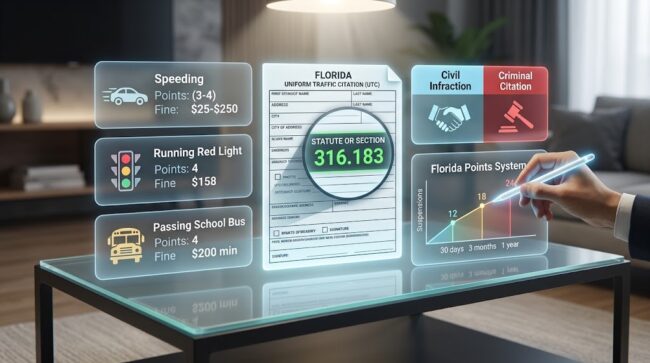
Every Florida officer, trooper and deputy uses the same form, the Florida Uniform Traffic Citation (UTC), created under Section 316.650, Florida Statutes. The key fields are:
- Citation number: the unique ID the clerk uses to look up your case.
- Statute number and subsection: the actual “citation code,” written as 316.183 or 322.34(2)(a). This is the charge.
- Infraction or criminal box: noncriminal infractions are handled by the clerk or a hearing officer; criminal violations go before a county judge.
- Court appearance required: checked for criminal charges and for infractions with a mandatory hearing, such as 50-plus mph over the limit.
- Actual and posted speed: the two numbers that set your speeding fine tier.
Statute numbers are read as chapter, section and subsection. In 316.074(1), the chapter is 316 (State Uniform Traffic Control), the section is 074 (obedience to traffic control devices) and the subsection is (1). Chapter 318 sets the fines and procedures for infractions; Chapter 322 governs licenses and points.
The Most Common Florida Citation Codes
| Code | Violation | Type | Points |
|---|---|---|---|
| 316.183 | Unlawful speed | Infraction | 3 (4 if 16+ over) |
| 316.1895 | School zone speeding | Infraction | 3–4 |
| 316.074(1) | Traffic control device | Infraction | 3 |
| 316.075 | Running red light | Infraction | 4 |
| 316.123 | Stop sign / failure to yield | Infraction | 3–4 |
| 316.0895 | Following too closely | Infraction | 3 |
| 316.089 | Improper lane change | Infraction | 3 |
| 316.155 | No turn signal | Infraction | 3 |
| 316.1925 | Careless driving | Infraction | 3 |
| 316.1926 | Aggressive careless driving | Infraction | 3 |
| 316.305 | Texting while driving | Infraction | 0 first, 3 second |
| 316.614 | Seat belt (adult) | Nonmoving | 0 |
| 316.613 | Child restraint | Moving | 3 |
| 316.172 | Passing a stopped school bus | Infraction | 4 |
| 316.1936 | Open container (driver) | Moving | 3 |
| 316.646 | No proof of insurance | Nonmoving | 0 |
| 320.02 | Expired / no registration | Nonmoving | 0 |
| 322.03 | No valid driver license | Criminal (2nd degree misd.) | 0 |
| 322.34(1) | Driving while license suspended, no knowledge | Infraction | 0 |
| 322.34(2) | DWLS with knowledge | Criminal | 0 |
| 316.192 | Reckless driving | Criminal | 4 |
| 316.193 | DUI | Criminal | 0 (suspension) |
| 316.061 / 316.027 | Leaving the scene | Criminal | 6 |
| 316.1935 | Fleeing or eluding | Felony | 0 (revocation) |
| 316.191 | Racing on highways | Criminal | 0 (revocation) |
Points shown are the standard DHSMV assessments; any moving violation that causes a crash adds points (typically 4 total), and camera-issued red-light tickets carry no points.
Civil Infractions vs. Criminal Citations
The single most important thing a citation code tells you is which court process you are in.
Noncriminal infractions (most of Chapter 316) are governed by Chapter 318. You are not arrested, there is no jail exposure, and the standard of proof at a hearing is preponderance of the evidence. The penalty is a fine, points, and possibly traffic school.
Criminal traffic offenses are punishable by jail. The most common are DUI (316.193), reckless driving (316.192), driving while license suspended with knowledge (322.34(2)), no valid license (322.03), leaving the scene of a crash (316.061, 316.027), fleeing (316.1935) and racing (316.191). A criminal citation is a formal charge; the UTC serves as the charging document and you must appear. Convictions create a permanent criminal record, not just a driving record.
A subtle trap: 322.34 appears on both sides. Subsection (1), suspension without knowledge, is an infraction. Subsection (2), with knowledge, is a misdemeanor, and three DWLS convictions can trigger a five-year habitual traffic offender revocation.
Base Fines Under Section 318.18
Section 318.18 sets the civil penalties. The statutory base amounts before county and court surcharges are:
| Violation | Base fine |
|---|---|
| Nonmoving violation | $30 |
| Moving violation (standard) | $60 |
| Speeding 6–9 mph over | $25 |
| Speeding 10–14 mph over | $100 |
| Speeding 15–19 mph over | $150 |
| Speeding 20–29 mph over | $175 |
| Speeding 30+ mph over | $250 |
| School zone camera speeding | $100 |
| Red-light camera | $158 |
| Passing stopped school bus | $200 minimum |
Fines in school zones and active construction zones are doubled. The amount actually printed on your ticket is higher because clerks add statutory court costs, surcharges and county assessments, which is why a “$60 moving violation” typically costs $150 to $200 at the window. Failing to pay within 30 days adds a $16 late penalty under 318.18(8) and can lead to a license suspension.
The Florida Points System
Points attach to your license under Section 322.27 when you pay a ticket or are found guilty. The suspension thresholds are:
- 12 points in 12 months: 30-day suspension
- 18 points in 18 months: 3-month suspension
- 24 points in 36 months: 1-year suspension
Insurers pull the driving record, so points affect premiums for three to five years even without a suspension. Drivers under 18 face a separate rule: six points in 12 months restricts them to business-purpose driving for a year.
Your Options After a Citation
Section 318.14 gives you 30 days from the citation date to choose one of three paths:
- Pay the civil penalty. This is an admission; points post to your record.
- Elect traffic school. If eligible, you pay the fine, complete a basic driver improvement course, and no points are assessed. You can elect this once every 12 months and five times in your lifetime, and it is not available for speeding 30+ over or for CDL holders.
- Request a hearing. You contest the ticket before a county judge or traffic hearing officer. If found guilty you may pay up to $500 plus costs, but the hearing officer also has discretion to withhold adjudication and points.
For criminal citations there is no pay-by-mail option; you must appear on the arraignment date, and a plea of not guilty starts a standard misdemeanor case.
Not to Be Confused With Legal Citation Form
Lawyers use “citation” in a second sense: the format for referencing Florida authorities in court filings. That is governed by Florida Rule of Appellate Procedure 9.800, which prescribes forms such as § 316.183, Fla. Stat. (2025) for statutes and Fla. R. Civ. P. 1.140 for rules, with case citations to Florida Reports and Southern Reporter. If you are drafting a brief rather than reading a ticket, Rule 9.800 is the reference.
Brian’s Take
Most Floridians treat the statute number on a ticket as trivia and just pay. That is the wrong instinct on two codes in particular. First, anything with a 4-point value (red light, school bus, 16+ over) is worth a hearing or at least traffic school, because a second one inside a year puts you within striking distance of a suspension. Second, any 322.34 or 322.03 citation should go to a lawyer before you do anything, since paying or pleading converts a paperwork problem into a criminal conviction. The code is the case.
Frequently Asked Questions
Where is the citation code on my Florida ticket?
In the “Statute” or “Section” box on the UTC, written as a decimal number such as 316.183.
What does 316.074 mean on a ticket?
Failure to obey a traffic control device, usually a sign or signal. It is a 3-point moving violation.
Do red-light camera tickets carry points?
No. Camera notices under 316.0083 are $158 civil penalties with no points unless ignored and converted to a UTC.
How long do points stay on a Florida license?
Points count toward suspension for 12 to 36 months but remain visible on the record for three to five years.
Can I take traffic school for a criminal citation?
No. Traffic school under 318.14(9) applies only to noncriminal infractions.
Sources and Further Reading
- Florida Statutes, Chapter 316 – State Uniform Traffic Control: https://www.flsenate.gov/Laws/Statutes/2025/Chapter316
- Florida Statutes, Section 318.14 – Noncriminal traffic infractions, procedure: https://www.flsenate.gov/Laws/Statutes/2025/318.14
- Florida Statutes, Section 318.18 – Civil penalties schedule: https://m.flsenate.gov/Statutes/318.18
- Florida Statutes, Section 322.27 – Points system and suspensions: https://www.flsenate.gov/Laws/Statutes/2025/322.27
- Florida Statutes, Section 322.34 – Driving while license suspended: https://www.flsenate.gov/Laws/Statutes/2025/322.34
- Florida Statutes, Section 316.650 – Uniform traffic citation form: https://www.flsenate.gov/Laws/Statutes/2025/316.650
- Florida House of Representatives – Chapter 318 full text (2025): https://www.flhouse.gov/Statutes/2025/Chapter0318/All/
- FLHSMV – Florida driver license points and suspensions: https://www.flhsmv.gov/driver-licenses-id-cards/education-courses/points-suspensions/
- Florida Rules of Appellate Procedure, Rule 9.800 – Uniform citation system: https://www.floridabar.org/rules/ctproc/
About the Author