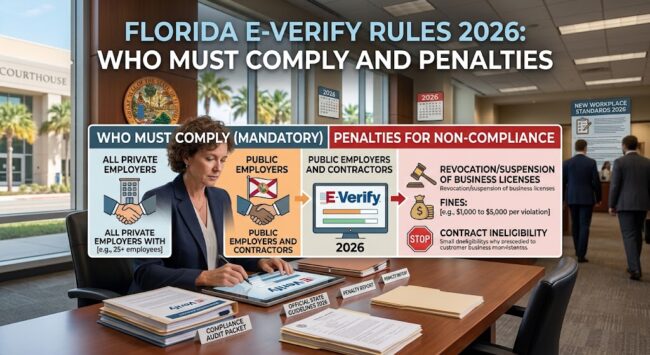
Quick Answer: Florida private employers with 25 or more employees must run every new hire through the federal E-Verify system within three business days of the start date, under Florida Statute § 448.095 (SB 1718). Public employers and their contractors must use it regardless of size. The 25-employee threshold survived the 2026 legislative session after a bill to extend the mandate to all employers passed the House but died in the Senate. Three violations in 24 months trigger fines of up to $1,000 per day and suspension of state licenses until the employer proves compliance.
Who Is Covered
The mandate comes from SB 1718, the 2023 immigration enforcement package signed by Governor DeSantis. Under Florida law, private employers with 25 or more employees and all public agencies are legally required to utilize the federal E-Verify system to confirm the employment eligibility of all new hires. Public contractors and subcontractors fall under a separate, older requirement that applies at any size.
Headcount is measured company-wide, not by Florida payroll. The 25-employee threshold refers to the total number of company employees, not just those employees who work in Florida. A company headquartered out of state with 30 employees nationwide and a few in Florida is covered.
The rule is forward-looking. It applies only to new hires made on or after July 1, 2023 — not retroactively to existing employees. Independent contractors are not “employees” under the statute, though misclassification to avoid the count carries its own risks.
| Employer type | E-Verify required? |
|---|---|
| Private, 25+ total employees | Yes |
| Private, under 25 employees | No (I-9 only) |
| Public employer or agency | Yes, any size |
| Public contractor/subcontractor | Yes, any size |
| PEO client at or above threshold | Yes |
The 2026 Push to Cover Every Employer
Lawmakers have tried twice to erase the threshold. For the second year in a row, the Florida House has greenlit a measure requiring all businesses to use a federal verification tool to determine whether new hires can legally work in the country. HB 197, sponsored by Rep. Berny Jacques, would mandate that all employers use the online database called E-Verify.
It did not become law. The Senate never took it up, and the bill’s last action was March 13, 2026, when it died in the Senate Rules Committee. While recent legislative efforts attempted to expand this mandate to all private employers regardless of size, those bills failed to pass, leaving the 25-employee threshold firmly intact. Given the House has passed the concept in consecutive sessions, employers under 25 should expect a third attempt in 2027.
Step-by-Step Compliance Timeline
E-Verify does not replace the federal I-9. You must still complete the I-9 for every new hire, then run the information through E-Verify within three business days of the start date.
- Enroll at E-Verify.gov before the first covered hire, or engage a PEO or payroll provider as an E-Verify employer agent.
- Day 1–3: Complete Form I-9 and create the E-Verify case no later than the third business day after the employee starts work for pay.
- Retain records for at least three years. The state may demand the I-9, the E-Verify case result, and proof of enrollment.
- Document outages. If the federal E-Verify system is down or inaccessible, employers are required by law to document the outage by taking daily screenshots illustrating the lack of access. During this time, they must utilize the standard federal Form I-9 protocol.
- Certify annually. Every private employer would be required to use E-Verify and certify that the business complies with its first tax return of the calendar year — this certification already applies to covered employers through the reemployment tax return filed with the Department of Revenue.
Penalty Structure
Enforcement moved to FloridaCommerce (formerly DEO) and became active July 1, 2024. The process runs in stages.
If FloridaCommerce determines that an employer with 25 or more employees failed to use the E-Verify system to verify the employment eligibility of a new employee as required under section 448.095, Florida Statutes, FloridaCommerce must notify the employer of FloridaCommerce’s determination of noncompliance and provide the employer with 30 days to cure the noncompliance.
Repeat failures escalate. If an employer fails to use E-Verify three times within a 24-month period, they may face a fine of $1,000 per day and have their state licenses revoked until compliance is achieved. The license reach is broad: noncompliance constitutes grounds for the suspension of all licenses issued by a licensing agency subject to chapter 120, Florida Statutes, until the noncompliance is cured. That includes contractor licenses, liquor licenses, professional licenses, and DBPR registrations.
| Violation stage | Consequence |
|---|---|
| First determination | 30-day cure notice |
| 3 failures in 24 months | Up to $1,000/day fine |
| Uncured after 3 failures | All state licenses suspended |
Knowingly Employing Unauthorized Workers
Separate from E-Verify paperwork, § 448.09 penalizes employers who knowingly hire or keep unauthorized workers. A first finding places the employer on one-year probation with quarterly reporting to FloridaCommerce. A second finding within 24 months brings license suspension scaled to the number of unauthorized workers involved, with longer suspensions as the count rises. Willful violations can also feed into federal exposure, where federal I-9 penalties for knowingly hiring unauthorized workers range from $716 to $28,619 per worker depending on the offense.
Using E-Verify correctly is the main shield here. An employer that receives a work-authorized result in good faith is presumed not to have knowingly hired an unauthorized worker under Florida law.
Audit Protocols: How the State Finds You
Florida does not rely solely on random audits. Complaints drive much of the activity. If you believe that an employer is not verifying the employment eligibility for a new employee, you may notify FloridaCommerce by sending an email to EVerifyCompliance@commerce.fl.gov. Competitors, former employees, and advocacy groups all use this channel.
Tax filings are the second trigger. The Florida Department of Revenue (FDOR) plays a central, administrative role in tracking this compliance through the state’s reemployment tax framework. An employer that reports 25 or more employees on quarterly wage filings but has no E-Verify enrollment on record is a visible mismatch.
Enforcement authority is shared. The Florida Department of Law Enforcement, the Attorney General, the State Attorney, and FloridaCommerce all hold enforcement powers under the law, and Florida’s 2025 special-session immigration package added a State Board of Immigration Enforcement and expanded coordination with federal agencies, raising the odds that a workplace complaint becomes a broader investigation.
Industry Hot Spots
Construction, agriculture, hospitality, and landscaping account for the bulk of Florida’s complaint activity because of seasonal hiring volume and subcontractor layering. General contractors should note that a subcontractor’s E-Verify failure does not automatically transfer liability, but a GC that knowingly uses a non-compliant sub can lose the good-faith defense on its own projects. Agricultural employers using H-2A workers must still run E-Verify on those hires.
Compliance Checklist for 2026
- Count total employees company-wide each quarter; cross 25 and the mandate applies at the next hire.
- Confirm enrollment and that the designated E-Verify user list is current.
- Audit the last 24 months of hires for missing or late cases and cure any gaps now, before a complaint arrives.
- Train hiring managers on the three-day rule and on non-discrimination; E-Verify cannot be used to pre-screen applicants.
- Keep outage screenshots and I-9 files together for three years.
- Watch the 2027 session for a renewed universal-mandate bill.
This article is general information, not legal advice. Employers facing a FloridaCommerce notice should consult an employment or immigration attorney promptly.
Sources and Further Reading
- FloridaCommerce, VerifyFlorida E-Verify compliance page – https://www.floridajobs.org/secure-florida/VerifyFlorida
- Florida Senate, HB 197 (2026) Employment Eligibility bill history – https://www.flsenate.gov/Session/Bill/2026/197
- Florida House staff analysis of HB 197, Commerce Committee, Dec. 2025 – https://www.flsenate.gov/Session/Bill/2026/197/Analyses/h0197c.COM.PDF
- Florida Phoenix, “Florida’s universal E-Verify mandate passes House Floor,” Jan. 15, 2026 – https://floridaphoenix.com/2026/01/15/floridas-universal-e-verify-mandate-passes-house-floor/
- Corporate Compliance Insights, “Navigating Florida’s E-Verify Mandate: Compliance, Tax Certification & Audit Realities,” June 2026 – https://www.corporatecomplianceinsights.com/navigating-florida-everify-mandate/
- Hinshaw & Culbertson, “FAQs: Florida Requires Certain Employers to Use Federal E-Verify System” – https://www.hinshawlaw.com/en/insights/blogs/employment-law-observer/faqs-florida-requires-certain-employers-to-use-federal-e-verify-system-to-confirm-employees-are-legally-eligible-to-work
- Paychex, “Understanding Florida’s E-Verify Mandate,” Mar. 2026 – https://www.paychex.com/articles/compliance/florida-e-verify-requirements-for-private-employers
- Nimble Advisors, “Florida HR Compliance Guide for Employers (2026)” – https://www.bynimble.com/hr-briefs/florida-hr-compliance-guide
- Greenspoon Marder, “Florida Lawmakers Advance House Bill 197,” May 2026 – https://www.gmlaw.com/news/florida-lawmakers-advance-house-bill-197-to-mandate-e-verify-for-private-employers/
- Florida Statutes § 448.09 and § 448.095 – http://www.leg.state.fl.us/statutes/
About the Author