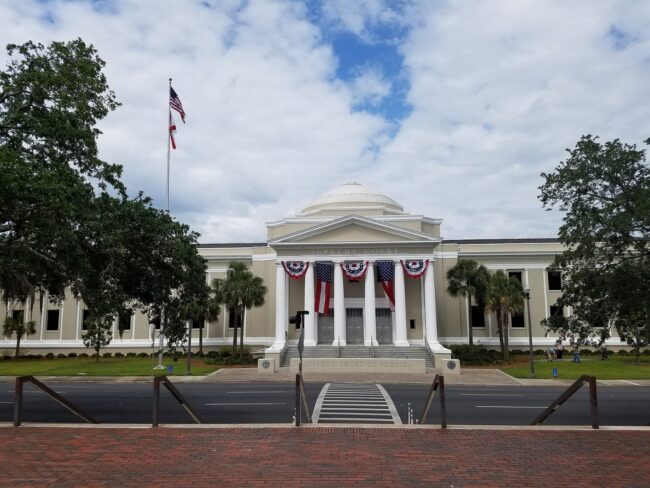
The Florida State Capitol in Tallahassee, where lawmakers passed the CHOICE Act in 2025. Source: Mick Haupt, Unsplash, Unsplash License.
Quick Answer: Florida’s CHOICE Act (sections 542.41-542.45, Florida Statutes) lets employers bind high earners to garden-leave or noncompete agreements of up to four years and requires courts to enforce them with preliminary injunctions. Since its July 1, 2025 effective date, no reported Florida decision construing it has been identified, and the 2026 Florida Statutes show no amendments.
The Florida Contracts Honoring Opportunity, Investment, Confidentiality, and Economic Growth Act, better known as the CHOICE Act, created two new kinds of employment agreements that courts must enforce through near-automatic injunctions. With the federal noncompete ban abandoned, Florida’s statute is now a live test of how far a state can push enforceability.
What Is the Florida CHOICE Act?
The CHOICE Act is a set of new statutory sections, 542.41 through 542.45 of the Florida Statutes, created by section 2 of chapter 2025-213, Laws of Florida. The House passed the bill 91-21 on April 23, 2025, and the Senate followed 28-9 the next day, according to the Florida Senate’s bill history. Governor Ron DeSantis neither signed nor vetoed it, and it became law without his signature on July 3, 2025.
How did the bill become law, and when did it take effect?
Section 22 of the act states that it “shall take effect July 1, 2025.” But the bill did not become law until July 3, two days later. The Florida Statutes’ editor’s note on section 542.44 records the stated July 1 effective date and adds that the constitutional effective date is August 15, 2025. A Jackson Lewis analysis called the timing odd without resolving it, and for agreements signed in summer 2025 the gap could matter.
What Does the CHOICE Act Require?
The Act applies only to “covered employees” and two defined contract types. Other restrictive covenants remain governed by section 542.335.
Who counts as a covered employee?
Under section 542.43(3), a covered employee is an employee or individual contractor who earns, or is reasonably expected to earn, a salary “greater than twice the annual mean wage” of the Florida county where the employer has its principal place of business. If the employer’s principal place of business is outside Florida, the reference is the county where the employee lives. Fisher Phillips noted in July 2025 that discretionary bonuses and commissions do not count toward salary.
The statute carves out one profession entirely: the term “does not include a person classified as a health care practitioner as defined in s. 456.001.” The 2026 Florida Statutes still contain that exclusion.
What is a covered garden leave agreement?
A garden leave agreement requires the employee to give advance notice before leaving, up to a maximum of four years. During that period, the employer must keep paying the same salary and benefits as in the last month before notice, excluding discretionary incentive pay. After the first 90 days of the notice period, the employee does not have to provide services, but may not work elsewhere without the employer’s permission. The employer may shorten the notice period with at least 30 days’ written notice.
What is a covered noncompete agreement?
A covered noncompete may last up to four years within a geographic area defined in the agreement. It bars work that is similar to the services the employee provided during the three years before the noncompete period, or work in which the employee would likely use the employer’s confidential information or customer relationships. If an employee signs both kinds of agreement, the noncompete period is reduced day-for-day by any nonworking portion of the garden leave.
What procedural steps must employers follow?
To qualify for the Act’s protections, an agreement must meet several formal requirements:
- The employee must be “advised, in writing, of the right to seek counsel before execution.”
- The employee must acknowledge in writing that he or she will receive confidential information or customer relationships.
- A prospective employee must receive the proposed agreement at least seven days before the job offer expires.
An agreement that meets these conditions “does not violate public policy as a restraint of trade” and is “fully enforceable according to its terms,” the statute says.
How Does Enforcement Work Under the CHOICE Act?
Under sections 542.44(5) and 542.45(5), a court “must preliminarily enjoin” a covered employee from providing services to anyone else during the notice or noncompete period. The employee can have the injunction modified or dissolved only by proving, “by clear and convincing evidence, based on nonconfidential information,” one of a short list of grounds:
- the employee will not perform similar work or use the employer’s confidential information or customer relationships;
- for a noncompete, the new employer is not engaged in a similar business; or
- the employer failed to pay the required garden-leave salary or the agreed consideration.
The employee’s written acknowledgment creates a presumption of access to confidential information, confidential filings must be sealed, and the injunction “is not an exclusive remedy,” so damages remain available. The prevailing party recovers reasonable attorney fees and costs. The Act also applies to covered employees whose primary place of work is Florida “regardless of any applicable choice of law provisions.”
How does that compare with Florida’s older noncompete law?
The Florida Senate’s April 17, 2025 staff analysis explains that, under section 542.335, an employer seeking to enforce a restrictive covenant “must prove that the contractually specified restraint is reasonably necessary” to protect a legitimate business interest. The CHOICE Act removes that showing for covered agreements. University of Florida law professor Rachel Arnow-Richman writes in the November/December 2026 issue of The Florida Bar Journal that the word “reasonable” does not appear in the new statute.
| Feature | Section 542.335 (existing law) | CHOICE Act (ss. 542.43-542.45) |
|---|---|---|
| Who is covered | Any employee party to a restrictive covenant | Employees and contractors earning more than twice the county annual mean wage; health care practitioners excluded |
| Employer’s burden | Prove a legitimate business interest and that the restraint is reasonably necessary | Show a covered agreement meeting the notice and acknowledgment conditions |
| Preliminary injunction | Discretionary; employer must also show irreparable harm (Fisher Phillips) | Court “must” enjoin |
How Have Courts Treated the CHOICE Act Since July 2025?
Barely at all. A Florida practitioner analysis published in August 2026 states: “No reported Florida decision construing the CHOICE Act has been identified as of August 2026.” A February 2026 Vermont Law Review analysis and the Florida Bar Journal critique likewise cite no ruling under the Act, and research for this article found no reported opinion interpreting sections 542.44 or 542.45.
Agreements signed after July 2025 produce disputes only as covered employees resign, and trial-court injunction orders are often unreported. Employers are drafting under a statute whose text, as that practitioner analysis put it, is “the only guide.”
What legal questions are waiting for a court?
Commentators have identified several issues likely to be litigated first:
- Federal courts. Jackson Lewis noted federal courts are divided on applying the irreparable-harm presumption in section 542.335(1)(j). The injunction mandate could face similar scrutiny, making removal to federal court a strategic choice.
- Constitutional challenges. Arnow-Richman raises separation-of-powers, Thirteenth Amendment and due process concerns. The Vermont Law Review analysis argues the county wage test may fail rational-basis review.
- Conflicts with other states. Fisher Phillips said disputes with employees living in states that ban noncompetes, such as California, may turn on where the first suit is filed.
- Non-solicitation gaps. The Act does not address non-solicitation provisions, which Jackson Lewis said could create “potential enforcement inconsistency” with a four-year noncompete.
- Older agreements. Chapter 2025-213 does not say whether it reaches agreements signed before its effective date.
Has the Legislature Changed the CHOICE Act in 2026?
No. The 2026 Florida Statutes list the history of each section from 542.41 through 542.45 as “s. 2, ch. 2025-213,” with no 2026 chapter law cited, and the health care practitioner exclusion in section 542.43(3) remains in place.
Proposals for change are coming from outside the Capitol. The Vermont Law Review piece proposes replacing the county test with a statewide threshold updated periodically by FloridaCommerce, with grandfathering for existing contracts. Arnow-Richman proposes a threshold limited to the top 1 to 3 percent of earners, restraints of about two years and restored judicial discretion, and ultimately calls for repeal.
What happened to the federal noncompete ban?
The Senate staff analysis notes the Northern District of Texas set aside the Federal Trade Commission’s rule in Ryan, LLC v. FTC on August 20, 2024. NPR reported that in September 2025 the FTC voted 3-1 to dismiss its appeal and move to vacate the rule, shifting to case-by-case Sherman Act enforcement. The FTC had estimated about 30 million workers, or 1 in 5, are bound by noncompetes. State law, including Florida’s, now controls.
How Much Do Florida Employees Have to Earn to Be Covered?
The answer depends on the county, and the statute does not name the wage data series to be used. The Senate staff analysis cited one figure: the statewide annual mean wage for all Florida occupations, $60,210, from the U.S. Bureau of Labor Statistics. Twice that is $120,420, but the statute uses county figures, not statewide ones.
The Vermont Law Review analysis used BLS county wage data for 2024 and estimated an average annual wage of about $79,000 in Miami-Dade County, implying a threshold of about $158,000, and about $48,150 in rural Liberty County, implying about $96,000. A $100,000 earner would be covered in Liberty but not Miami-Dade.
The table below uses the most recent BLS county release, published June 9, 2026, covering the fourth quarter of 2025. It annualizes the average weekly wage (times 52) and doubles it. These are illustrations only: a single quarter’s average is not the same as the “annual mean wage” the statute names.
| County / area | Avg. weekly wage, Q4 2025 | Annualized (x52) | Illustrative 2x threshold |
|---|---|---|---|
| Palm Beach | $1,710 | $88,920 | $177,840 |
| Miami-Dade | $1,659 | $86,268 | $172,536 |
| Hillsborough | $1,559 | $81,068 | $162,136 |
| Broward | $1,532 | $79,664 | $159,328 |
| Duval | $1,503 | $78,156 | $156,312 |
| Orange | $1,435 | $74,620 | $149,240 |
| Lee | $1,289 | $67,028 | $134,056 |
| Polk | $1,161 | $60,372 | $120,744 |
| Holmes (lowest in state) | $891 | $46,332 | $92,664 |
| Florida statewide | $1,471 | $76,492 | $152,984 |
Across the counties shown, the illustrative threshold ranges from about $93,000 in Holmes County to nearly $178,000 in Palm Beach County. The Vermont Law Review analysis warns employers could move a principal place of business to widen coverage, and that remote workers raise unresolved questions.
What Does the CHOICE Act Mean for Florida Employers?
Fisher Phillips, writing in July 2025, called Florida the most enforcement-friendly state for noncompetes. Morgan Lewis lawyers, writing in Bloomberg Law’s US Law Week on August 1, 2025, said the Act makes it easier for an employer to obtain an injunction and harder for employees to challenge one.
Practitioner guidance published since then converges on a few steps:
- Review existing agreements against the covered-agreement requirements.
- Keep section 542.335 documentation for employees below the threshold.
- Check whether candidates are bound by covered agreements with a prior employer.
- Budget for garden leave, which requires full salary and benefits for up to four years.
- Weigh forum carefully before filing.
What are the risks for employers relying on the Act?
The largest risk is the lack of precedent. If a court declines to enforce the injunction mandate or a constitutional challenge succeeds, employers that dropped protectable-interest documentation could hold weaker agreements. Before the Act took effect, a coalition of business groups and legal scholars urged a veto, according to Bloomberg Law, arguing it “would distinguish Florida as having the most starkly anti-worker noncompetes regime in the nation.”
What Does the CHOICE Act Mean for Florida’s Legal Market?
Even without case law, the Act generates advisory work: employers have been told to audit and redraft agreements, and the written right-to-counsel notice plus the seven-day review window build a role for employee-side lawyers into every covered agreement.
Fee shifting, sealed filings, clear-and-convincing evidentiary contests and choice-of-law fights point to specialized, front-loaded litigation. The first appellate rulings will likely shape how aggressively employers rely on the Act.
This article is news and analysis, not legal advice. Employers and employees should consult counsel about specific agreements.
Frequently Asked Questions
When did the Florida CHOICE Act take effect?
The act states an effective date of July 1, 2025. It became law on July 3, 2025; the statutes’ editor’s note lists a constitutional effective date of August 15, 2025.
How long can a CHOICE Act noncompete last?
Up to four years, within a geographic area defined in the agreement. Garden-leave notice periods are also capped at four years.
Does the CHOICE Act apply to doctors and nurses?
No. The definition of covered employee excludes anyone classified as a health care practitioner under section 456.001, Florida Statutes.
Has any Florida court ruled on the CHOICE Act?
No reported Florida decision construing the Act had been identified as of August 2026.
Did Florida amend the CHOICE Act in 2026?
No. The 2026 Florida Statutes cite only chapter 2025-213 in the history of sections 542.41 through 542.45.
Sources and Further Reading
- CS/CS/CS/HB 1219 (2025), Employment Agreements: bill history and committee substitute text, The Florida Senate
- Bill Summary, CS/CS/CS/HB 1219 Employment Agreements, Florida Senate Commerce and Tourism Committee
- Bill Analysis and Fiscal Impact Statement, CS/CS/SB 922 (April 17, 2025), Florida Senate Committee on Rules
- Florida Statutes 2025, Section 542.44, and Florida Statutes 2026, Chapter 542, Online Sunshine / The Florida Senate
- The Florida CHOICE Act: Freedom of Contract Run Amok, The Florida Bar Journal
- Everything is Not What it Seems: How Florida’s CHOICE Act County Wage Based System Detrimentally Affects Employees, Vermont Law Review
- County Employment and Wages in Florida, Fourth Quarter 2025, U.S. Bureau of Labor Statistics
- Florida Makes It Easier to Stop Employees Competing After Leaving, Bloomberg Law
- Florida’s CHOICE Act Enacted: Helping Employers Read Between the Lines of New Non-Compete Law, Jackson Lewis
- Florida Clinches Spot as Most Enforcement-Friendly State for Non-Competes, Fisher Phillips
- How Florida’s CHOICE Act Reshaped Non-Compete Enforcement, The Jimerson Firm
- Under Trump, the Federal Trade Commission Is Abandoning Its Ban on Noncompetes, NPR
About the Author