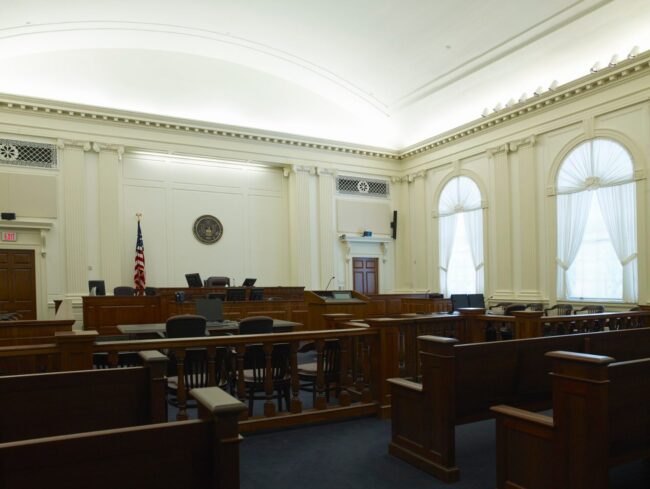
Photo: Zoshua Colah/Unsplash, Unsplash License
Quick Answer: Florida recorded 142,576 eviction filings in 2025, according to the University of Florida’s Shimberg Center. That is down 5.7% from the 2023 peak of 151,181 but still about 11% above 2019’s pre-pandemic total of 128,754. Big urban counties such as Miami-Dade and Duval account for a large share of the volume. Meanwhile, laws passed from 2023 through 2026 have pushed landlord-tenant rules toward a single statewide standard and added new fast-track and fraud-based removal routes.
Eviction cases are among the most common and most standardized civil filings in Florida’s county courts. For landlord-side firms, legal aid organizations and clerks, filing counts measure how much work there is. The latest numbers show the post-pandemic surge leveling off at a high level, while the legislature has changed the governing rules in four straight sessions. Figures run through calendar year 2025 unless stated otherwise.
How many eviction cases are filed in Florida each year?
The Shimberg Center compiles eviction filings from Florida Court Clerks & Comptrollers, individual county clerks and the Office of the State Courts Administrator (OSCA). Rates are per 1,000 renter households, based on 2019-2023 Census survey data, and totals may include a small number of commercial evictions.
| Year | Statewide eviction filings | Filings per 1,000 renter households |
|---|---|---|
| 2019 | 128,754 | 48.25 |
| 2020 | 82,525 | 27.69 |
| 2021 | 94,181 | 33.72 |
| 2022 | 142,754 | 49.28 |
| 2023 | 151,181 | 52.81 |
| 2024 | 146,856 | 50.27 |
| 2025 | 142,576 | 48.8 |
Florida had 2.9% fewer filings in 2025 than in 2024, which had 2.9% fewer than 2023. Even so, the 2025 total remains roughly 10.7% above 2019. The filing rate per 1,000 renter households, 48.8 in 2025, is almost the same as the 2019 rate of 48.25. The growth in case counts since before the pandemic roughly tracks growth in the renter population. Shimberg’s monthly series runs through June 2026; a full-year 2026 total is not yet available.
What does academic research say about the trend?
A December 2025 preprint by Antoine Lovell, Earl J. Edwards and Jennifer R. Daniels, not yet peer-reviewed, used Eviction Lab data and found that Florida averaged 10,766 filings a month before the pandemic, 6,551 a month while moratoria were in effect, and 11,754 a month after protections ended in July 2021. That is about 9% above the pre-pandemic average. Expressed per 1,000 renter households, the monthly rates were 3.89, 2.37 and 4.25. Filings peaked in January and October and were lowest in April.
Which Florida counties drive eviction volume?
Eviction work is concentrated in large urban counties. Full-year 2025 totals are not yet published for every major county, but available figures show where volume comes from.
| County | 2019 | 2022 | 2023 | 2024 | 2025 |
|---|---|---|---|---|---|
| Miami-Dade | 17,687 | 19,972 | 19,479 | 18,142 | Not yet reported in county memo |
| Duval | 13,174 | 12,756 | 13,879 | 13,818 | 15,026 |
| Orange | n/a | 15,969 | 15,191 (year to date, mid-December) | Second-highest in decades (no count published) | n/a |
| St. Johns | 499 | 502 | 584 | 657 | 718 |
Sources: Miami-Dade County pilot-program report (Shimberg data); News4JAX (Shimberg data); Orange County Clerk records via Central Florida Public Media.
How concentrated is the caseload?
In 2024, Miami-Dade’s 18,142 filings were about 12.4% of the statewide total, and Duval’s 13,818 were about 9.4%. Together, those two counties made up more than one in five Florida eviction filings that year. In 2025, Duval moved in the opposite direction from the state. Its filings rose 9% to 15,026, about 10.5% of all filings statewide, while the state total fell. The county’s 2025 count was also about 14% above its 2019 level of 13,174.
Miami-Dade, by contrast, peaked in 2022 at 19,972 filings. By 2024 it was down about 9% from that peak, and only about 2.6% above 2019. St. Johns County’s 718 filings in 2025 were its most in at least seven years, about 44% above 2019, though still a sliver of statewide volume.
What is happening in Central Florida and Tampa Bay?
An analysis of Shimberg data published by Central Florida Public Media in March 2025 found that seven Central Florida counties ended 2024 at record or near-record filing levels. All nine counties in the analysis set record highs in 2023. Osceola and Sumter filings were each about 70% above 2019 levels. Seminole was about 50% higher, and Brevard filings rose nearly 82% over five years. Sheriff’s office records from six counties showed that, on average, 59% of eviction cases ended with law enforcement removing tenants.
The Legal Services Corporation’s Civil Court Data Initiative tracks monthly filings for some counties. It counted 77,907 eviction filings in Hillsborough County from March 16, 2020 onward, including 1,142 in September 2026. It recorded 317 Brevard filings that same month.
Who files matters for the business side. A 2024 Tampa Bay Times investigation, republished by Governing, found that the 10 largest corporate single-family landlords in Hillsborough and Pinellas counties accounted for 35% of single-family eviction filings, nearly double their share of rental homes. The largest single-family operators filed against about 945 Hillsborough households in 2023. At least one in 10 of those households faced more than one filing from the same landlord.
How much money do eviction filings generate for Florida’s courts?
Section 34.041, Florida Statutes, sets the county court filing fee for a removal-of-tenant action at $180. The first $10 of each fee goes to the State Courts Revenue Trust Fund, and most of the rest stays with the clerk as fee income. The state’s Article V Revenue Estimating Conference tracks this revenue as its own line item.
| Fiscal year | Removal-of-tenant fee revenue ($ millions) | Status |
|---|---|---|
| 2019-20 | 20.3 | Actual |
| 2020-21 | 16.9 | Actual |
| 2021-22 | 20.5 | Actual |
| 2022-23 | 27.8 | Actual |
| 2023-24 | 27.7 | Actual |
| 2024-25 through 2029-30 | 26.8 per year | Forecast (February 2025 conference) |
At $180 per case, $27.7 million is roughly 154,000 filings, close to Shimberg’s calendar-year counts (an approximate comparison, since fiscal and calendar years differ). The February 2025 conference forecast flat revenue of $26.8 million a year through 2029-30, which suggests state economists expect eviction volume to hold steady rather than drop sharply.
How does Florida’s eviction procedure shape the economics of practice?
Florida’s process favors speed. Under section 83.60(2), Florida Statutes, a tenant who raises any defense other than payment must deposit the accrued rent alleged in the complaint, plus rent that comes due while the case is pending, into the court registry. As an alternative, the tenant can file a motion asking the court to determine the rent. Either step must happen within five days of service, not counting weekends and legal holidays. A tenant who misses that deadline gives up all defenses except payment. The landlord is then entitled to an immediate default judgment for removal, and the writ of possession issues without further notice or hearing.
Because of that rule, a large share of cases end without a contested hearing. Miami-Dade’s 2025 pilot-program report noted that default judgments rose sharply in 2022 and topped 1,600 a month in the county by October 2022. The same report said a writ of possession generally gives the occupant 24 hours to vacate. For landlord-side firms, this leads to a high-volume, low-touch model built on standardized complaints, quick motions for default and flat fees. Defense work is scarcer and depends more on grants. Miami-Dade’s Eviction Diversion Pilot Program handled about 2,060 cases. Of those, 617 received extended representation, with 251 evictions prevented and 296 delayed. That caseload is small compared with roughly 18,000 to 20,000 filings a year in the county.
What landlord-tenant laws has Florida changed since 2023?
What did HB 1417 (2023) do?
CS/HB 1417 created section 83.425, Florida Statutes, which places regulation of residential tenancies and the landlord-tenant relationship at the state level. It expressly overrides local rules and makes existing local ordinances on those subjects null and void. The bill also doubled the required written notice to end a month-to-month tenancy from 15 days to 30 days. For leases with a fixed term, it set the notice window for ending the lease at the end of the term at 30 to 60 days. The law took effect July 1, 2023, after passing the Senate 29-8 and the House 81-33. For practitioners, preemption means one statewide rulebook instead of county-by-county overlays.
What did HB 621 (2024) change about squatters?
CS/CS/HB 621 created an optional process that lets a residential property owner skip the courts and ask the sheriff to remove an unauthorized occupant. The owner files a complaint under penalty of perjury using a form set out in the statute. The sheriff must remove the person if the complaint shows the owner qualifies and the sheriff can verify ownership. The owner pays the civil eviction fee and, if a deputy has to stand by, an hourly rate. A person who is wrongfully removed can sue for three times the fair market rent, plus damages, costs and attorney fees. The bill also created three new crimes related to unlawful occupancy and fraudulent advertising of property for sale or lease. It passed both chambers unanimously, 39-0 in the Senate and 108-0 in the House, and took effect July 1, 2024. Some unauthorized-occupant matters can now be resolved without a county court filing.
What changed in 2025 and 2026?
In 2025, lawmakers extended the same approach beyond homes. SB 322 lets commercial property owners ask law enforcement to remove unauthorized occupants under certain conditions, including prior notice to leave, and allows wrongful-removal lawsuits. SB 606 lets law enforcement quickly remove hotel and lodging guests who overstay without paying, and it clarifies how guests differ from tenants. Both took effect July 1, 2025.
In 2026, CS/HB 1293, now Chapter 2026-143, Laws of Florida, created section 817.537. That section makes it a third-degree felony to knowingly enter and take possession of a rental unit by using a materially false written statement about one’s identity on a rental application, presenting forged documents such as an ID or pay stub, or impersonating the applicant. The act also amended section 83.56(2)(a) to make such fraud a lease violation the tenant cannot cure. A landlord may terminate the lease whether or not criminal charges have been filed, and the tenant has seven days to vacate. The governor approved the bill on June 12, 2026, and it took effect October 1, 2026. The act does not create a self-help remedy. A landlord who needs possession still has to go through a county court action, so the law adds a new ground for eviction without removing the court step.
What should Florida’s legal market watch next?
Key indicators: whether the 2026 statewide total keeps easing or holds near 140,000; whether high-volume counties such as Duval keep rising while the state falls; how often landlords invoke the new fraudulent-entry ground; and whether the flat Article V revenue forecast holds at the next conference update.
This article is news and analysis, not legal advice.
Frequently Asked Questions
How many evictions were filed in Florida in 2025?
The Shimberg Center counted 142,576 eviction filings statewide in 2025, or 48.8 per 1,000 renter households. That is down from 146,856 in 2024 and from a 2023 peak of 151,181.
Which Florida county files the most evictions?
Miami-Dade is consistently among the largest, with 18,142 filings in 2024. Duval recorded 15,026 in 2025. Orange County filed 15,969 cases in 2022, its highest total in a decade at the time.
What is the filing fee for an eviction in Florida county court?
Section 34.041, Florida Statutes, sets the removal-of-tenant filing fee at $180, with the first $10 going to the State Courts Revenue Trust Fund. Sheriff service and writ fees are separate.
Can Florida cities pass their own tenant protection ordinances?
Generally no. HB 1417 (2023) created section 83.425, which places residential tenancy regulation at the state level and voids local ordinances on those subjects.
What is the new 2026 fraudulent-entry law?
Chapter 2026-143, effective October 1, 2026, makes it a third-degree felony to gain possession of a rental through identity fraud on an application. It also lets landlords end the lease with a seven-day notice that the tenant cannot cure, though landlords still need a court order to remove the tenant.
Sources and Further Reading
- Eviction and Foreclosure Filings, Florida Statewide Results – Florida Housing Data Clearinghouse, Shimberg Center for Housing Studies, University of Florida
- Final Report on the Eviction Diversion Pilot Program (memorandum to the Board of County Commissioners, September 2025) – Miami-Dade County
- St. Johns County evictions reach highest level in seven years as housing costs outpace incomes – News4JAX (WJXT)
- St. Johns County eviction and foreclosure activity spiked in 2025 – St. Johns Citizen
- Eviction cases hit record highs in Central Florida – Central Florida Public Media
- Orange County evictions in 2023 on track to meet or exceed 10-year record high – Central Florida Public Media / WUSF
- Florida real estate investors clog courts and are quick to evict – Tampa Bay Times, via Governing
- Eviction Tracker: Hillsborough and Brevard Counties – Legal Services Corporation Civil Court Data Initiative
- The Eviction Cliff: Pandemic Moratoria, Structural Breaks, and Housing Vulnerability in Florida (preprint) – Preprints.org
- Article V Revenue Estimating Conference, February 11, 2025 – Florida Office of Economic and Demographic Research
- Section 34.041, Florida Statutes (2024) and Section 83.60, Florida Statutes (2026) – The Florida Senate
- Bill Summary, CS/HB 1417 (2023) Residential Tenancies – The Florida Senate
- Bill Summary, CS/CS/HB 621 (2024) Property Rights – The Florida Senate
- Chapter 2026-143, Laws of Florida (CS/HB 1293) – Florida Department of State
- DeSantis signs bills targeting squatters in commercial properties, hotels – WUSF
About the Author