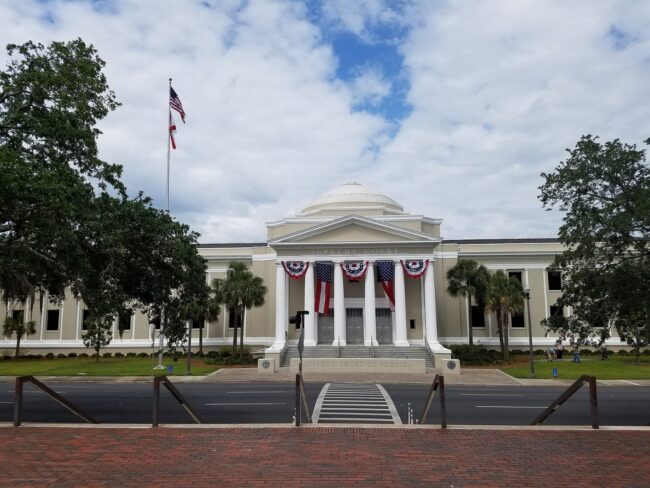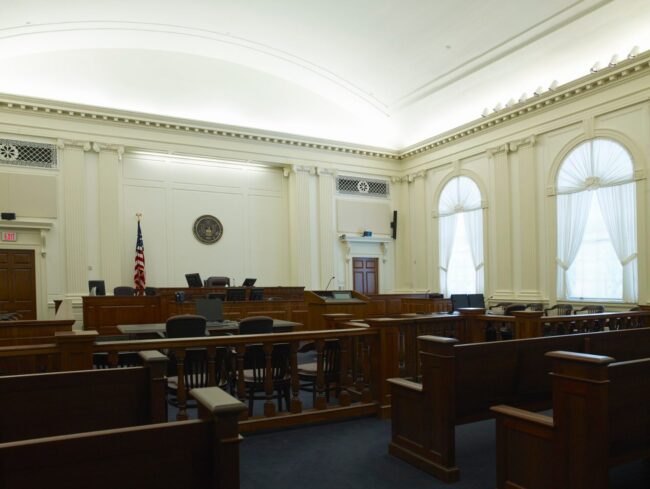
Courtroom, U.S. Courthouse, Tallahassee, Florida. Photo: Carol M. Highsmith, Library of Congress, via Wikimedia Commons. License: Public domain.
Quick Answer: As of November 2026, Florida’s business courts are still local creations: dedicated complex business divisions in the Ninth (Orange and Osceola), 11th (Miami-Dade), 13th (Hillsborough) and 17th (Broward) circuits, each with its own entry rules, from no dollar minimum for core corporate disputes to more than $750,000 in Miami. The push for a statewide business court stalled again in 2026, when House Bill 1511 died in committee, and the Florida Bar Business Law Section task force that studied the idea was disbanded in June 2025.
Florida has had specialized business courts for more than two decades, yet it still has no statewide business court. Instead, chief judges have created circuit-level divisions by administrative order, each with its own case categories, dollar thresholds and case management rules. This review covers what published court orders and official records show as of November 20, 2026.
Which Florida circuits have business courts?
Four judicial circuits operate formal complex business divisions. The Ninth Judicial Circuit says it created Florida’s first Business Court in 2004 in Orange County, and that Miami-Dade, Broward and Hillsborough set up their own courts in the years that followed. A 2008 Florida Bar News report likewise identified the Ninth, 11th, 13th and 17th circuits as having special business courts.
| Circuit / county | Started | Governing order cited | Dollar threshold |
|---|---|---|---|
| Ninth: Orange (Div. 43), Osceola (Div. 23) | 2004; Osceola added Jan. 3, 2023 | Amended AO 2019-08-02 (eff. Nov. 21, 2019) | $500,000 or more for commercial categories; any amount for governance, trade secrets, IP, securities, antitrust |
| 11th: Miami-Dade | 2006 | AO 1-25-01 (2025 re-establishment of procedures) | Over $750,000; others by discretionary motion |
| 13th: Hillsborough (Div. L) | Jan. 22, 2007 | AO S-2013-021 (eff. April 22, 2013) | None stated; mandatory assignment by case type |
| 17th: Broward | By 2008 | AO 2017-35-Civ, Amendment 2 (April 30, 2021) | Over $150,000 for most categories; over $500,000 for some; over $250,000 for class actions |
Sources: Ninth Judicial Circuit Court of Florida; Thirteenth Judicial Circuit of Florida; Seventeenth Judicial Circuit (via Broward County Bar Association); The Florida Bar News; King & Spalding/Law360.
How do cases qualify for Florida’s business courts?
Two models appear in the orders: a dollar threshold for ordinary commercial disputes paired with core business case types that qualify at any amount, or assignment purely by case type.
What does the Ninth Circuit require in Orange and Osceola counties?
The Ninth Circuit’s Amended Administrative Order 2019-08-02, signed by Chief Judge Donald A. Myers Jr. and effective November 21, 2019, sets a $500,000 minimum for commercial categories such as Uniform Commercial Code transactions, business purchases and sales, commercial property transactions, franchise relationships and business insurance coverage disputes.
A second list applies at any dollar amount: internal affairs and governance of business entities, trade secrets and non-compete agreements, intellectual property, securities and antitrust claims, shareholder derivative actions and qualifying class actions, and corporate trust or director and officer liability. Personal injury, consumer class actions, most employment cases and residential real estate are excluded.
Filers certify eligibility on the civil cover sheet and attach a Business Court Addendum. The clerk assigns qualifying cases to Subdivision 43-2; cases under $500,000 go randomly to a general circuit civil subdivision.
The circuit extended the court to Osceola County effective January 3, 2023, with jury trials held at the Osceola County Historical Courthouse in Kissimmee. The circuit says Osceola became the fifth of Florida’s 67 counties with a formal business court. Its business court page now lists Circuit Judge Chad K. Alvaro.
What does Miami-Dade’s Complex Business Litigation division handle?
According to the December 2025 King & Spalding review, the 11th Circuit’s division was founded in 2006 with Judge Gill Freeman as its first judge. It hears cases with more than $750,000 in controversy involving breach of contract, construction defect, business torts, shareholder disputes and trade secrets. Other cases may come in by discretionary motion decided by the court’s administrative judge.
The review identified Judges Lisa Walsh and Thomas Rebull as the division’s judges at the time of writing and cited the circuit’s most recent administrative order, numbered 1-25-01, re-establishing the division’s procedures.
How does Hillsborough’s Division L assign cases?
The 13th Circuit took a different path. Chief Judge Manuel Menendez Jr. issued the original order on January 4, 2007, and the Complex Business Litigation Division opened January 22, 2007, under Judge Richard A. Nielsen, according to The Florida Bar News. That first version used a threshold of more than $75,000 for listed commercial categories.
Administrative Order S-2013-021, effective April 22, 2013, superseded the 2008 order and housed the business court in General Civil Division “L.” It assigns cases by type rather than dollar amount. Mandatory categories include entity governance, trade secrets and non-competes, intellectual property, securities, antitrust, shareholder derivative actions, non-consumer UCC transactions, business sales and franchise relationships.
Other cases can be referred as a “complex business case” when the Division L judge, weighing seven factors, finds they need extensive judicial management. The factors include novel pretrial motions, many separately represented parties, large document volumes and many expert witnesses. The order also lets the administrative judge temporarily suspend discretionary transfers based on caseload.
What thresholds apply in Broward County?
The 17th Circuit’s Amendment 2 to Administrative Order 2017-35-Civ, signed April 30, 2021, by Chief Judge Jack Tuter, sets procedures for direct filing or reassignment to the complex business and complex tort divisions. Most business categories require more than $150,000 in controversy. Business asset sales, non-personal-injury construction litigation and commercial foreclosures seeking a receiver require more than $500,000. Class actions require more than $250,000, excluding attorney fees.
Motions to transfer pending business cases are heard by the chief judge on Wednesday mornings. Transfers can be refused for cases pending more than six months.
How do business court procedures differ from regular civil divisions?
The divisions share a common theme: heavier front-end case management, tighter motion practice and earlier settlement pressure. The 13th Circuit’s posted CBLD procedures, last revised January 26, 2012, assign cases to three tracks with trial targets measured from filing. They also set presumptive discovery limits.
| 13th Circuit CBLD feature | Published standard |
|---|---|
| Track 1, Business Expedited | Trial target 13 months from filing |
| Track 2, Business Standard | Trial target 18 months |
| Track 3, Business Complex | Trial target 24 months |
| Interrogatories and requests for admission | 50 each per opposing party |
| Depositions | 12 per side, excluding testifying experts |
| Joint case management report | Due at least 5 days before the conference |
| Final case management conference | At least 90 days before trial |
| Settlement notice to the court | Within 24 hours |
Source: Thirteenth Judicial Circuit of Florida, CBLD Amended Procedures and Local Rule 3.
The circuit’s Local Rule 3 for the business court adds mandatory mediation in all business court cases, expert reports at least 30 days before any expert deposition, and 25-page limits on supporting and opposing memoranda with five-page replies. The rule states that it takes effect only upon Florida Supreme Court approval and operates as guidelines until then.
In Miami, the King & Spalding review reported federal-style briefing, mandatory initial case management conferences with client attendance expected, and mostly Zoom hearings. It noted that mandatory case management conferences and pre-motion conferral, both required in the division, became statewide requirements in January 2025.
Did Florida expand its business courts in 2025 or 2026?
No new circuit-level business court division was found in a review of published court orders and official records for 2025 and 2026. The most recent geographic expansion on record is the Ninth Circuit’s move into Osceola County in January 2023. In Miami-Dade, the 2025 administrative order cited in the King & Spalding review re-established the division’s procedures rather than creating a new court.
At the statewide level, momentum faded. The Florida Bar Business Law Section’s Business Courts Task Force, formed in 2018 to assess whether Florida needs a statewide business court system, was disbanded in June 2025, according to the section’s website. In January 2020, The Florida Bar News reported that the task force, co-chaired by retired Judge Gill Freeman and Jon Polenberg, was preparing a plan for business courts in each of Florida’s five appellate districts, which would have needed Supreme Court approval and legislative funding.
Political interest surfaced from the executive branch in October 2024, when Chief Financial Officer Jimmy Patronis announced a statewide business court initiative at a Florida TaxWatch conference. His office said more than 481,000 business-related cases were pending as of January 2024 and that “Florida has the highest backlog of business-related court cases nationwide.”
The Legislature did not act. House Bill 1511, filed January 9, 2026, by Rep. LaMarca, was summarized as recommending that the Supreme Court create a statewide business court. It died in Ways & Means on March 13, 2026.
| Date | Statewide business court milestone |
|---|---|
| April 30, 2008 | Supreme Court complex litigation task force delivers final report recommending tracking of business court cases |
| January 2020 | Task force prepares plan for courts in five appellate districts |
| October 31, 2024 | CFO announces statewide business court initiative |
| June 2025 | Business Courts Task Force disbanded |
| March 13, 2026 | HB 1511 dies in House Ways & Means Committee |
Sources: The Florida Bar News; Business Law Section of The Florida Bar; Florida Chief Financial Officer; Florida Senate.
Is there published caseload or time-to-disposition data for Florida business courts?
Not in a form that allows side-by-side comparison. None of the circuit business court pages or administrative orders reviewed for this article report case counts, clearance rates or median time to disposition for their business divisions. The gap is long-standing: in 2008, The Florida Bar News reported that a Supreme Court complex litigation task force found no good count of complex cases. The task force recommended that business court cases be specifically tracked and reported.
The available signals are indirect. The King & Spalding review reported that the Miami-Dade circuit court received almost 12,000 civil filings in the first six months of 2024, with thousands involving contract or business disputes, and that the civil division’s 24 judges shared a single civil general magistrate. The 13th Circuit’s track targets of 13, 18 and 24 months are goals, not reported outcomes.
Business courts have also proven vulnerable to resource pressure. The Florida Bar News reported in 2020 that the Ninth Circuit’s business court closed in January 2018 because of a family division backlog and reopened only after lawmakers funded a new judgeship.
What do Florida’s business courts mean for commercial litigation practices?
The record points to several practical consequences for commercial litigation practices.
- Venue drives eligibility. The same $400,000 contract dispute could qualify for Broward’s complex business division but fall below the Ninth Circuit’s $500,000 line and well below Miami-Dade’s $750,000 line. Core governance, trade secret and IP disputes qualify at any amount in Orlando and Tampa.
- Front-loaded costs. Mandatory case management meetings, joint reports, client attendance, conferral certificates and early expert reports shift work to the first months of a case, which matters for budgeting and fee arrangements.
- Coverage gaps. The Ninth Circuit counts only five of Florida’s 67 counties with a formal business court, so businesses in the other 62 counties litigate complex commercial disputes on general civil dockets unless their circuit adopts its own division.
- Statewide change is not imminent. With the Bar task force disbanded and HB 1511 dead, any statewide court would need a new proposal, Supreme Court action and funding.
A National Center for State Courts study cited by The Florida Bar News in 2020 found 23 states with some form of business or complex litigation court.
Frequently Asked Questions
Does Florida have a statewide business court?
No. As of November 2026, business courts operate only as divisions created by administrative orders in the Ninth, 11th, 13th and 17th judicial circuits. HB 1511, which recommended a statewide court, died in committee in March 2026.
What is the minimum amount to get into Miami-Dade’s business court?
The King & Spalding review published in December 2025 reported a threshold of more than $750,000 in controversy, with other cases eligible by discretionary motion decided by the administrative judge.
Does Hillsborough’s business court have a dollar threshold?
Administrative Order S-2013-021 assigns cases to Division L by case type, not dollar amount. The original 2007 order used a threshold of more than $75,000.
When did Osceola County get a business court?
The Ninth Circuit extended its business court to Osceola County effective January 3, 2023, as Division 23, making it the fifth Florida county with a formal business court.
Sources and Further Reading
- Divisions 43 (Orange County) and 23 (Osceola County) Business Court — Ninth Judicial Circuit Court of Florida
- Ninth Judicial Circuit Adds Business Court Division in Osceola County — Ninth Judicial Circuit Court of Florida
- Amended Administrative Order Governing Business Court, No. 2019-08-02 — Ninth Judicial Circuit Court of Florida
- Administrative Order S-2013-021, Business Court — Thirteenth Judicial Circuit of Florida
- Complex Business Litigation Division Amended Procedures — Thirteenth Judicial Circuit of Florida
- Local Rule 3, Business Court Procedure — Thirteenth Judicial Circuit of Florida
- Amended Administrative Order 2017-35-Civ (Amendment 2) — Seventeenth Judicial Circuit of Florida
- The Biz Court Digest: Welcome To Miami — King & Spalding / Law360
- 13th Circuit opens business court — The Florida Bar News
- Court panel recommends rule for complex litigation — The Florida Bar News
- Section poised to call for a statewide business court — The Florida Bar News
- Business Courts Task Force — Business Law Section of The Florida Bar
- CFO Patronis Announces Statewide Business Court Initiative — Florida Department of Financial Services
- HB 1511 (2026), Corporations — The Florida Senate
About the Author