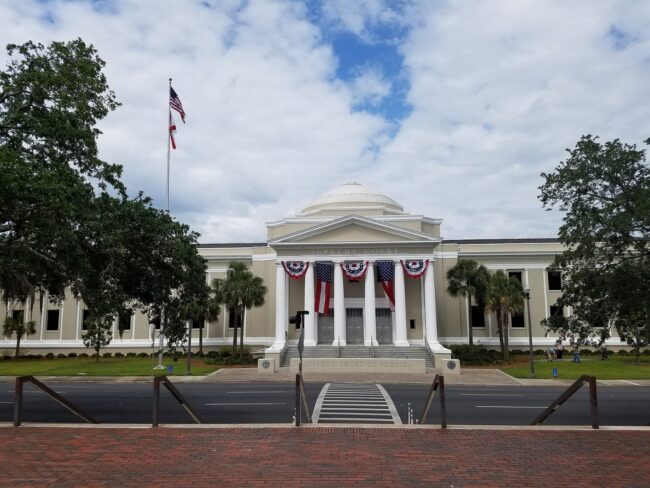
The Florida Supreme Court Building in Tallahassee, 2019. Source: Bruin79 via Wikimedia Commons. License: CC0 (public domain dedication).
Quick Answer: Court and regulator data show that Florida’s 2023 tort reform (HB 837) first pulled years of lawsuits forward into a single month, then left a sharp trough. Statewide civil filings hit 274,777 in March 2023 and fell to 78,944 in March 2024, below pre-reform Marches. Property-insurance suits have fallen each year since, and in preliminary 2025 data Florida’s share of U.S. homeowners claim lawsuits dropped to 41.29%.
Three and a half years after Gov. Ron DeSantis signed HB 837 on March 24, 2023, the debate over Florida’s civil justice changes has moved from forecasts to filing counts. Court administrators, circuit clerks, the Office of Insurance Regulation (OIR) and Citizens Property Insurance Corporation have all published numbers. Read together, they show a one-time surge, a steep drop, early signs of recovery in some personal-injury dockets, and a lasting decline in property-insurance litigation. This article sets out what those sources report as of November 20, 2026, and what the pattern means for how Florida plaintiff and defense practices make money.
What happened to Florida civil filings in March 2023?
HB 837, enacted as Chapter 2023-15, Laws of Florida, took effect when it was signed on March 24, 2023. Among other changes, it cut the statute of limitations for general negligence from four years to two. Because the new rules applied only to suits filed after the effective date, lawyers raced to file cases under the old law while they still could.
Data from the Office of the State Courts Administrator (OSCA), presented to the Senate Judiciary Committee on January 14, 2025 by Fourth Judicial Circuit Judge Mark H. Mahon, show the scale. Statewide civil filings in March 2023 totaled 274,777. That was about 2.7 times the March totals for 2021 (99,989) and 2022 (99,947). The three months before the surge, December 2022 through February 2023, produced 250,552 filings combined. March 2023 alone beat that.
Which case types drove the surge?
The OSCA charts single out small claims in county court and auto negligence and commercial premises liability in circuit court as the most affected case types. Small-claims filings in March jumped from 66,409 in 2022 to 146,855 in 2023. Circuit-court auto negligence filings went from 3,101 to 72,269 in the same comparison. Commercial premises liability rose from 802 to 16,851.
| March filings, statewide | 2021 | 2022 | 2023 | 2024 |
|---|---|---|---|---|
| All civil filings | 99,989 | 99,947 | 274,777 | 78,944 |
| County small claims | 64,014 | 66,409 | 146,855 | 42,387 |
| Circuit auto negligence | 3,174 | 3,101 | 72,269 | 2,839 |
| Circuit commercial premises liability | 912 | 802 | 16,851 | 639 |
Source: Office of the State Courts Administrator data, Florida Senate Judiciary Committee meeting packet (January 14, 2025).
How did individual circuits experience it?
The surge hit unevenly. In the Fourth Judicial Circuit, circuit civil filings rose 1,005% during March 2023, and auto negligence filings went from 237 in March 2022 to 6,081 in March 2023. The Thirteenth Judicial Circuit recorded a 1,094% increase in circuit civil filings that month. In the Eleventh Circuit, about 60,000 county civil cases were filed in Miami-Dade in March 2023. By the time of the Senate presentation, 1,415 of them were still open.
In Broward, Seventeenth Circuit Chief Judge Jack Tuter told an April 10, 2023 forum that his circuit had taken in about 30,000 new cases tied to HB 837. The Florida Bar News reported more than 10,000 circuit civil and more than 18,000 county civil cases logged over 30 days, an average of 700 to 775 extra cases per judge.
Did lawsuit filings fall after the surge?
Yes, at first. March 2024 statewide civil filings were 78,944, about 21% below March 2022 and a fraction of March 2023. Small claims (42,387) and circuit auto negligence (2,839) were both below their 2021 and 2022 March levels. That is the expected result when years of claims are filed early: the cases that would have arrived in 2024 and later had already been filed.
Clearance rates show how courts worked through the backlog. In the Fourth Circuit, the circuit civil clearance rate (dispositions as a share of filings) was 114% in fiscal year 2021-22, fell to 56% in 2022-23 as the surge outran judges, then rose to 163% in 2023-24 as courts closed more cases than they took in.
Are personal-injury filings coming back?
Some newer local data point to a partial rebound. A Law.com report, summarized in August 2026 by the Florida defense firm Cole, Scott & Kissane, said Miami-Dade auto negligence filings were 10,900 in the 12 months from June 2022 to June 2023, which includes the surge. The following 12 months had 4,938, and the year after that had 8,073. The same report said Broward and Palm Beach showed similar patterns, though it gave no figures for those counties.
Annual figures from the Sixth Judicial Circuit (Pasco and Pinellas) show the same shape. Circuit civil filings were 9,023 in 2022, 14,000 in 2023, 8,651 in 2024 and 11,145 in 2025. County civil filings kept rising throughout, from 14,129 in 2022 to 21,261 in 2025, and small claims reached 26,092 in 2025.
| Sixth Circuit filings | 2021 | 2022 | 2023 | 2024 | 2025 |
|---|---|---|---|---|---|
| Circuit civil | 8,643 | 9,023 | 14,000 | 8,651 | 11,145 |
| County civil | 14,626 | 14,129 | 16,087 | 18,836 | 21,261 |
| County small claims | 19,216 | 15,965 | 16,188 | 19,973 | 26,092 |
Source: Sixth Judicial Circuit of Florida, SRS and UCR filings report, 2021–2025.
The Sixth Circuit figures come with a caveat. During 2024, Pinellas and Pasco moved from the older Summary Reporting System (SRS) to Uniform Case Reporting (UCR), and the circuit’s report mixes data from both systems. Year-to-year changes around 2024 may partly reflect that switch. The two-year limitations period is also starting to matter: negligence claims arising after March 24, 2023 must generally be filed within two years, so cases that would once have trickled in over four years now arrive sooner.
What do the data show for property-insurance litigation?
Property insurance shows the clearest and longest-lasting decline. The 2022 special-session reforms ended one-way attorney fees and assignment-of-benefits agreements for property claims, and HB 837 added changes in 2023. OIR’s Property Insurance Stability Report, dated July 1, 2026, tracks lawsuits served on insurers through the state’s Legal Service of Process (LSOP) system. For personal residential policies, filings fell 23% from 2023 to 2024 and 25% from 2024 to 2025. From January through May 2026, they were down another 25% from the same months of 2025. OIR says filings have declined steadily since a 2021 peak.
How does Florida compare with the rest of the country now?
OIR uses National Association of Insurance Commissioners market-conduct data to compare Florida’s share of U.S. homeowners claims with its share of homeowners lawsuits. For years Florida had a small share of the nation’s claims but most of its lawsuits.
| Year | Florida share of U.S. homeowners claims | Florida share of U.S. homeowners suits |
|---|---|---|
| 2019 | 8.16% | 76.45% |
| 2020 | 8.81% | 79.16% |
| 2021 | 6.91% | 76.00% |
| 2022 | 14.93% | 70.83% |
| 2023 | 9.73% | 71.59% |
| 2024 | 12.33% | 73.15% |
| 2025 (preliminary) | 4.85% | 41.29% |
Source: Florida Office of Insurance Regulation, Property Insurance Stability Report (July 2026), using NAIC market conduct annual statement data.
The 2025 figure is preliminary, and OIR said final data were expected in the third quarter of 2026. Even so, 41.29% is still far above Florida’s 4.85% share of claims.
How often are Florida homeowners claims litigated?
OIR’s closed-claim data for calendar year 2025 counted 456,200 closed residential claims. Of those, 53,413 involved litigation, about 12.10% statewide. Litigation is concentrated in South Florida. The litigated share was 27.27% in Palm Beach, Broward and Miami-Dade, 14.01% in Seminole, Orange, Lake and Osceola, and 8.16% in the rest of the state. Insurers reported paying about $57.8 million in defense and cost-containment expenses on domestic homeowners claims in 2025.
What is happening with Citizens’ lawsuit counts?
Citizens Property Insurance Corporation, the state-backed insurer of last resort, offers the most direct read on litigation. Insurance Journal reported in November 2025 that Citizens had 3,721 lawsuits served from January through July 2025, 34% fewer than in the same period of 2024. At a June 2026 board meeting, Citizens President Tim Cerio reported 4,353 lawsuits for all of 2025, continuing a steady decline from 2022. Only 5% of Citizens claims were litigated in 2025, the lowest share since 2018.
Cerio’s presentation also tracked suits against all other Florida insurers: 18,077 in 2013, a peak of 127,915 in 2021 and 86,618 in 2025. That is down about a third from the peak but still well above 2013. Citizens has also shrunk. It had about 1.4 million policies at its 2023 high and 293,465 as of June 5, 2026, according to OIR.
What does the data mean for plaintiff firm economics?
For contingency-fee plaintiff practices, the March 2023 surge pulled future claims forward. Firms that filed thousands of cases under the old rules put a large group of matters into court at once. Those cases have been moving through dockets since, and courts like the Fourth Circuit cleared far more cases than they received in 2023-24. That means a stream of resolutions, and fees, from cases filed in 2023, followed by a thinner pipeline of new filings in 2024.
The Miami-Dade and Sixth Circuit data suggest personal-injury intake did not collapse. Auto negligence filings in Miami-Dade recovered to 8,073 in the most recent 12-month period reported, about three-quarters of the surge-year total. With a two-year filing deadline, firms have less time to investigate and negotiate before suing, so cases are likely to reach court sooner after an accident.
Property-insurance litigation is a different business now. With one-way fees and assignment-of-benefits agreements gone, and residential suits down roughly a quarter a year for three years running, a practice built mainly on homeowners claims has a much smaller market. Former deputy insurance commissioner Lisa Miller told Claims Journal that under the old system fee awards were in some cases “five or six times greater than the claim amount itself.” That fee incentive is what the 2022 reforms removed.
What does the data mean for defense firms and insurers?
Insurance defense work follows insurer lawsuit volume, and that volume has fallen. Fewer property suits and fewer new Citizens suits mean fewer new assignments for panel counsel. The roughly $57.8 million in homeowners defense and cost-containment spending OIR recorded for 2025 is the budget that defense firms compete for in that line.
The surge did create a temporary bump in defense work, because each surge-era case still needs an answer, discovery and either a settlement or trial. As those cases close, that bump fades. On the auto side, OIR data reported by Insurance Business show the top five auto insurers, with about 78% of the personal auto market, raised rates an average of 31.7% in 2023, then cut them 7.4% in 2025 and an average of 8% in 2026. Florida’s 2025 personal auto liability loss ratio of 52.5% was the state’s lowest in 15 years. Lower loss ratios point to fewer or cheaper claims, which can mean less work for outside counsel, although the rebound in some auto negligence dockets may offset part of that.
The property side looks better for carriers. Florida-domiciled insurers went from a net underwriting loss of almost $1.5 billion in 2020 to a net underwriting gain of more than $1.7 billion in 2025, according to OIR data reported by Claims Journal. At least 20 new carriers entered the market after the 2022 and 2023 changes. More carriers could mean more potential defense clients even as each one sees fewer suits.
Frequently Asked Questions
How many civil cases were filed in Florida in March 2023?
OSCA data show 274,777 civil filings statewide in March 2023, compared with 99,947 in March 2022 and 78,944 in March 2024. The jump came just before HB 837 took effect on March 24, 2023.
Why did lawyers file so many cases before HB 837 took effect?
The law’s changes, including a shorter two-year negligence limitations period, applied to suits filed after the effective date. Filing earlier kept a claim under the prior rules.
Have Florida property-insurance lawsuits declined?
Yes. OIR reports personal residential lawsuit filings fell 23% from 2023 to 2024, 25% from 2024 to 2025 and another 25% in January–May 2026 versus a year earlier.
What share of U.S. homeowners lawsuits are filed in Florida?
Preliminary 2025 data put Florida at 41.29% of U.S. homeowners claim lawsuits, down from 79.16% in 2020, while it had 4.85% of claims.
How many lawsuits did Citizens face in 2025?
Citizens reported 4,353 lawsuits in 2025, and 5% of its claims were litigated, the lowest share since 2018.
Are personal-injury lawsuit filings rising again?
In some places. Miami-Dade auto negligence filings rose from 4,938 to 8,073 between the two 12-month periods after the surge year, and Sixth Circuit circuit civil filings rose from 8,651 in 2024 to 11,145 in 2025.
Sources and Further Reading
- Senate Judiciary Committee Meeting Packet, January 14, 2025 (OSCA civil filing data presented by Judge Mark H. Mahon) — The Florida Senate
- Property Insurance Stability Report, July 2026 — Florida Office of Insurance Regulation
- 2021–2025 SRS and UCR Filings Annual Report — Sixth Judicial Circuit of Florida
- Courts gear up to handle a slew of new civil filings in the wake of tort law changes — The Florida Bar News
- Sign of the Times: Florida Citizens’ Market Share, Litigation Levels Dropping to New Lows — Insurance Journal
- Citizens lawsuit counts and Southeast litigation trends (November 10, 2025) — Insurance Journal
- Florida’s Share of US Claims Lawsuits Down to Nearly Half of 2020 Numbers, Data Show — Claims Journal
- Florida Personal Injury Filings Rise as Litigation Landscape Continues to Evolve — Cole, Scott & Kissane
- Florida tort reform delivers as carriers slash auto rates across the board — Insurance Business
About the Author